Showing posts with label Mom. Show all posts

Wednesday, May 10, 2017

Reading "Moshi Moshi" And Sharing Tea, Grief, Hotels, And Smiles With Banana Yoshimoto


"I nodded and sipped my cocktail. The taste of fresh fruit spread over my tongue.  This was all that being alive meant, really." - From the novel "Moshi Moshi" by Banana Yoshimoto


The first novel I read by Banana Yoshimoto was "Kitchen." It is a short novel about a woman in her twenties dealing with grief. I was also in my twenties at the time, and it hadn't been that many years since I had lost my dad at the age of fifteen. In "Kitchen," lead character, Mikage, has just suffered the loss of her grandmother to whom she had been very close. To deal with her loss, she takes to sleeping on her kitchen floor because the hum of the refrigerator makes her feel less alone. "Kitchen" is what hooked me to Yoshimoto's novels and solidified her as my favorite modern author. Yoshimoto's newest English-translated novel is called "Moshi Moshi," and it continues to display her genius in describing twenty-something women suffering early loss. What is different about Yoshimoto's novels is that although her characters are hurting, each of her novels shows a glimmer of optimism. I haven't come across any other writer who accurately depicts the devastation of dealing with grief while simultaneously describing the protagonist's ability to maintain a positive attitude. Each of her characters finds happiness in the simplest of things. This trait matches Yoshimoto's "deceptively simple" prose, as her writing has often been described. Her language is simple, yet the meanings underlying her novels' themes are deep.


"Moshi Moshi" takes this grief theme full circle from "Kitchen." "Moshi Moshi" is the story of a young woman in her twenties named Yoshe who has just lost her father by carbon monoxide poisoning. Her dad had recently begun a relationship with a bewitching woman without Yoshe and her mom knowing.  This woman wanted to die but needed someone to take along with her, so she coerced Yoshe's dad into a car parked in the forest and poisoned them both.

Yoshe is an only child, just barely a woman, who is living on her own. She is fresh out of culinary school and now has a job helping out in the kitchen of a bistro. Yoshe tries to deal with her grief, and as she is "finally starting to be able to feel the joy in sitting down to a cup of tea or just getting up in the morning," her mom decides she can no longer bear living in the condo the three of them had shared in the town of Meguro. Instead, she wants to move in with Yoshe to the city of Shimokitazawa which has younger residents and many tourists. She tells Yoshe that Shimokitazawa reminds her of the first city she and Yoshe's dad lived in when Yoshe was a baby:

"Back then both your Dad and I were happy, for no particular reason - maybe because we were young, or it was just that kind of age.  We'd shop every day in Yanaka Ginza - we'd get deli food for dinner, savory preserves, roasted rice crackers, and then a cup of tea. If we had time, we'd stop at the traditional dessert parlor and have a beer, or some isobeyaki."

Yoshe realizes that her mom needs this time to heal. Yoshe absorbs herself in her cooking and waitressing work at the bistro and begins dating a customer she meets there named Shintani-Kun. But her grief overwhelms her.  Still, she shows up to work every day at the bistro no matter how badly she feels:

"Even so, come tomorrow morning, I'd be kneading bread dough, boiling water, shredding salad vegetables, mopping the floor. My body would know what to do, and I'd smile and greet customers when they came in."

Pretty soon, Yoshe and Shintani-Kun start going out for drinks after she finishes her workdays at the bistro, and she feels a sense of hope:

"I felt joy. Working at the bistro, Shintani-kun feeling at home there. Seeing my apartment across the street. I knew it wasn't going to last forever - things changed and moved on, and if you thought they could stay the same, they got ruined, like our family had done. Still, I desperately wanted all of this happiness to stay, just the way it was."
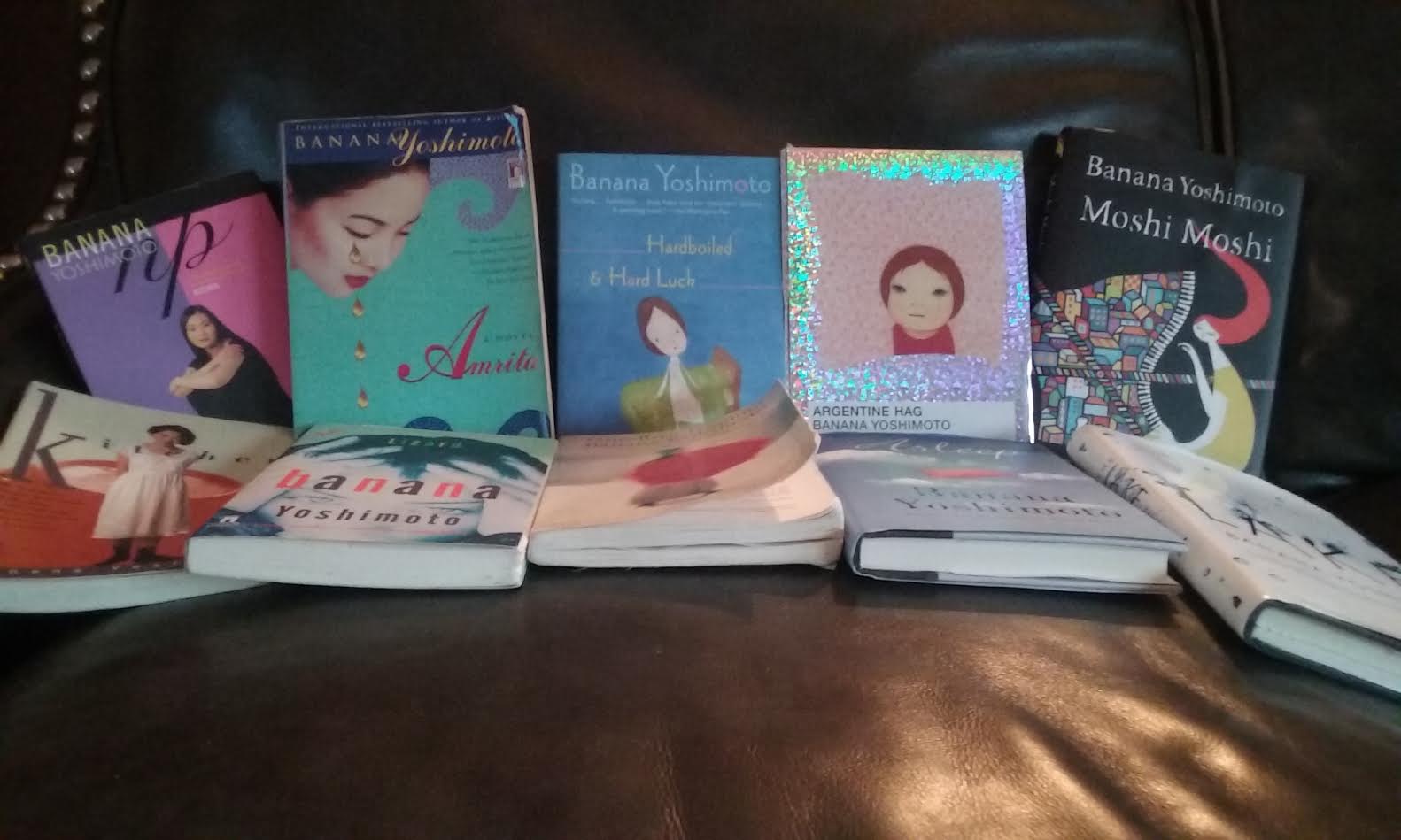

My Banana Yoshimoto collection of books on my couch

When your parent dies while you are still in childhood, a part of you remains arrested in that state because the only place you can be with them throughout adulthood is in your memories. I definitely related to the solace Yoshe seeks in her memories that she relays throughout "Moshi Moshi." Yoshe remembers her childhood vacations this way:

"The light from the TV dappling the dark room made me think of family vacations of old. I felt as though I was back in a room in a traditional inn, already asleep, while Mom and Dad watched TV lounging on the mat floor."

I particularly liked this hotel memory because my happiest memories from childhood are the times my mom, dad and brother took family vacations to Disney World or the Poconos, and we had our parents' undivided attention. We explored the parks and swimming pools by day and then shared the same hotel room by night.


Yoshe believes that memories of her dad are etched not only in her heart and mind but also in the places he walked through: "Of course, there were some things that didn't change - the familiar and nostalgic colors and smells, tastes and places in our memories.  But we could no longer relive them as things that were real to our own bodies."

These lines remind me of Walt Whitman's "Leaves of Grass" poems which were a favorite of my dad's. He even wrote his own rock opera in the late 1960's-early 1970's by composing his own versions of Whitman's poems through several original songs, often titled the same as Whitman's poems.  The main theme in "Leaves of Grass" is how we are all connected as entities who live the human experience. This includes all of us now living in the present, those who have lived in the past, and those who will walk this earth in the future. Whitman talks about how all generations have physically walked over the same grounds as each other, and when blades of grass grow, these blades are nourished and grown out from the bodies of our ancestors. There is a connection between past, present and future generations because we walk the same steps over the same parts of earth together. The following line from "Moshi Moshi" reminds me of Whitman and also of my dad:

"I started walking again, and even though I was wearing grown-up shoes on a grown woman's feet, the lightness of my step felt just the same as they had when I'd walked in my favorite childhood sneakers, which Dad had taken me to buy."


My dad and me

As the seasons pass, Yoshe's mom embraces the fact that there are so many young people living in Shimokitazawa, and she seems to be returning to a previous youthful self that Yoshe didn't even know existed.  My mom did that too after my dad died. Suddenly, she started hanging out with friends who were in their twenties, and she listened to pop music on the radio and went out dancing. It makes sense now because she was so young back then: my dad was only forty-one when he died, and my mom just turned forty the next month. I remember one of my mom's friends gave her a birthday card that said: "Life begins at 40," and my mom hung that card up in our kitchen.  But I didn't like that card. I wasn't ready for anyone to have any kind of new life other than the childhood I had grown familiar with.

Yoshi expresses similar thoughts. It appears to her that her mom suddenly doesn't need any help with her grief while Yoshe is still struggling so much. It feels like a blow to her when she finds out her mom has landed a job in a tea shop. Yoshe wants to be happy for her mom but realizes she is initially unable to:

"I'm the one who didn't want Mom to get better, I realized. I was shocked at my own immaturity. I was the one who wanted her to stay at home in my apartment, who wanted to keep my mother to myself.  Now, standing in this shop, she was back in the wider world, among everyone else."

I can relate to those feelings too.  All children believe that even as life changes, and they leave school and move on to work life, at least their family will still remain intact. It was a rude awakening for Yoshe and for me when our lives suddenly changed before we properly reached adulthood.


Yoshe tries to follow her mom's example to move forward, but she is still very vulnerable and not in the proper mindset to enter into a healthy and mature relationship with Shintani-Kun. When she finally allows herself to take the next step in their relationship, she's not really into it: "We're probably going to sleep together now..., but so what? What's it going to change?"

Yoshe's nihilistic attitude is a common example of the depression that often hits young women after a major loss in the family. Your entire world has been turned upside down and everything you thought you believed in as a child has suddenly changed due to that one event. I remember sitting in a movie theater in 1990 watching the film "Sweetie" and relating to one of the lead characters, a woman named Kay. She analyzed everything but felt nothing. She looked for symbolism to try and make sense out of life and find messages in things while performing obsessive rituals. In her case, she was obsessed with trees and cracks in the sidewalk. But her anxiety only increased. I also suffered from obsession, anxiety and a feeling of meaninglessness. Looking back, I see I was still trying to make sense out of life and to heal from my grief. Life is frightening when you have to recover from loss. You long for the security you knew as a child.

At the end of the novel, Yoshe visits the scene in the forest where her father and the woman were found dead in the car. She tells her dad it is alright to let go, and he can be at peace. She realizes that she must now focus on the present. Once you suffer a loss, you always fear it will happen again. It's probably more on your mind than someone who has never experienced a significant loss in their life. But we have to be thankful and mindful of what we have in the present. We don't have to worry every single minute. The people we have in our lives are still here:

"My father was gone now, but my mother was here. I could be with her today, for certain, at least, and hopefully much longer than that. I'm coming home now, Mother - Mother, I'm glad you're here - I'll be coming through the door in a moment."


My mom put this yellow happy face in her car to cheer herself up on cloudy days

While getting ready for the paperback version of "Moshi Moshi" to come out, Banana Yoshimoto lost her own father unexpectedly. For years, people had criticized her for not writing about grief in a realistic way. After all, many of her novels are about losing primary family members, but she had never lost one. I remember after I'd read "Kitchen," I was shocked to learn that she herself had not lost a parent. Yoshimoto says that after she lost her father, she realized that she indeed had been on the right track all those years. She said her own writing in "Moshi Moshi" gave her the answers she now looked for as if she somehow knew what she was going to need to help her heal.


Recently, I posted my Goodreads Review of "Moshi Moshi" and was thrilled when Banana Yoshimoto responded to me and thanked me in English for my "beautiful review!" Previously, she had only communicated to me through emoticons and emojis because she doesn't speak or write in English. But just like how Whitman believed previous generations can communicate with present and future generations through shared experiences, language is not a barrier either. I will forever treasure the time that Banana Yoshimoto sent me this smile:


I'm still dreaming that one day I will take a trip to Japan and meet her in person. Why wouldn't I want to meet my favorite novelist?


Saturday, March 7, 2015

Someone Who Gets Me


My mom and I get along well now, but that's because we're very different.  We don't see our own faults staring back at us from each other's eyes. But I also don't think she gets where I'm coming from, and I'd accepted that years ago. When we did our Myers-Briggs Type Indicator which is a personality test developed by a mother/daughter psychologist team and based on Carl Jung's theories, my mom's results were ESFJ which is the most popular personality type, yet my results were INFJ which is the least popular personality type. Emily Dickinson is thought to have been an INFJ so that gives some indication of what my mom was dealing with while raising me. My dad never took the test, but I believe he would have tested as an extrovert (the "E" in the four-letter Indicator stands for Extrovert, and the "I" stands for Introvert). He was a musician who played in a club band, and when he wasn't performing music, teaching or tutoring, he still always wanted to be out of the house. I can't remember him even once saying, "You know, I'd really prefer to stay at home tonight" or "I need my alone time." That spells extrovert because as an introvert, I find myself saying that at least twenty times a day.

So where did I get my introvert gene? I look to my grandmother -  my mom's mother. She was definitely an introvert, and we used to hang at home together a lot when I was growing up. She didn't really have any outside friends and rarely had people over her house which was downstairs from ours. She didn't want to be involved in the ladies' groups at her church and definitely didn't want to bond with my grandfather's sisters who lived nearby: She was German, and they were Italian, and she believed they always ostracized her because of that. But I don't think that was the reason. They just didn't get her. Probably because her personality was different: She liked to stay home and study the Bible and write about it in her notebooks. They liked to meet in groups to coffee klatch.

The only person my grandmother used to seem to really enjoy talking about was her younger brother, my great-uncle, Richard. Her face always lit up when she told me stories about the two of them growing up in Pennsylvania. She said they'd climb mountains to pick "huckleberries." He was creative like my grandmother and used to paint pictures of people or things that interested him. He painted my mom when she was sixteen, and in it, she lounged on a bed with a bunch of brightly-colored pillows. He always used very bright colors, a lot of pinks and light blues, and often painted the cherry blossoms he saw when he traveled to Washington D.C.

Uncle Richard had dinner at my grandmother's apartment in Brooklyn every Sunday where she had moved to from Pennsylvania and now lived with my grandfather and my mom who was still a child. He always brought along what now would be described as his "partner," a man named Bill who was about twenty years older than he was. My mom said that back in the fifties, these relationships were usually not spoken of. She said it eventually clicked in as she got older that Bill was more than just a friend to Uncle Richard.

Several years later, when Bill died, my Uncle Richard was distraught. First he took up with another man, also named "Bill," but this time, Bill was the younger one. That relationship didn't work out, and soon afterwards, Uncle Richard retired from his office job in Manhattan and moved to Texas.

I only met my Uncle Richard once in my life when he visited us when I was nine.  He stayed downstairs with my grandparents for about a week, and I didn't like him because his sense of humor was extremely sarcastic and what I had considered mean. Nowadays, I would have loved this about him and laughed along, but my nine-year-old little girl brain couldn't appreciate this type of wit. When he asked me if I would be sad when he had to go back home, I answered him honestly and said: "No." Still, he promised me that once he got back home, he'd mail me a Texas girl doll since I loved dolls so much. I watched intensely for the mail for a couple of months but eventually gave up and decided I had been right about him all along.

The only time I ever saw my grandmother break down in tears was when Uncle Richard died. In her younger days, my grandmother was not a woman who had it easy. She suffered two stillborn babies and gave birth to one baby that only lived an hour, yet she never cried or even choked up whenever she told me about them. In his last years, Uncle Richard's health had deteriorated due to alcoholism and probably a broken heart. He moved from Texas back to his hometown in Pennsylvania where my grandmother's sister and cousins still lived. My grandmother's sister said that people sometimes told her they'd seen Uncle Richard wandering around the park or sitting on park benches, looking like a homeless person. Seemed he never really got over losing the older Bill. One night, my grandmother came up our stairs crying, saying she had just gotten a phone call that her brother Richard had died. I always regretted I didn't give Grandma a giant hug right then, but I was a teenager, and I looked for a cue from my older brother who was never really one for expressing his emotions. He didn't move from his spot on the living room couch, so I didn't move from my recliner either. It hadn't been more than a year or two after our dad had died so neither of us were the clearest thinkers at the time. But my grandmother didn't seem to mind. I think she was in her own world. I believe if it had bothered her that I didn't hug her, she would have told me in the next few days. She had always been very verbal regarding any situation where she felt she'd been wronged, so I think she would have mentioned it. It doesn't mean I don't still regret it. But overall, I'm sure she did understand where I was coming from that night because she was one of those few people in the world who truly gets me.


Saturday, August 2, 2014

My Love Letter To Writing


Yes, I'm in love with writing. I couldn't survive without it.  Flannery O'Connor once said: "I write because I don't know what I think until I read what I say." That's exactly it. My mind is an emotional mess until I write my thoughts down. Afterwards, I feel better, less emotional, less confused, and I have an enormous sense of relief.

My mom was the first person to suggest I become a writer. I was 8 years old. It wasn't because she recognized talent in me, and it didn't stem from anything positive. It was because I was driving her insane with my phobia. There was a huge northeastern snowstorm that year, and I had read a news story about a boy who got buried in the snow in his yard and hadn't been found until a month later. The several feet tall snow drifts in our backyard hung around the entire winter, and I was terrified that the same thing would happen to me. I remembered every detail from that news story and kept on replaying it in my head: how the mailman found him because his mitten was sticking out from the snow; how the picture of the side of his house that looked like a barn had an "X" marked on it near the spot of the snow where he was found; how they used the word "vanished" in the article; and how everyone thought he was somewhere in the neighborhood, but he had been in the front yard all along. Every day I asked my mom if that was going to happen to me. She listened to me recount the details in the article for her, and one day, she finally said: "You should become a writer. There's got to be something positive you could do with all that misery stuck in your head!"

My mom's advice came in handy when I was 14.  My father was very sick, and my two best friends from school had turned against me.  I hated school and hated life and couldn't wait for the year to be over.  So I created a 30 year-old woman named Nazd to hang out with. She had long brown hair, brown eyes, wore a long, beige, raincoat and had her nails painted that neutral color you never see anymore.  We went everywhere together. My novel-to-be was simply titled "Nazd." As often as I could, I'd lock my bedroom door, put on Prince music, and write about Nazd with my same red pen on sheets of loose-leaf paper. Nazd was wise and said little.  She wasn't a chatterbox with her feelings always out on display.  She had all the answers. My world was falling apart, but I had Nazd as a shoulder to lean on.

In high school, I sat in the back of class and began a screenplay on tiny scraps of paper.  The action takes place in one day where a young woman sits in a dimly-lit Brooklyn apartment as an older man tells her about a doomed couple he knew years ago named Jimmy and Diana.  Jimmy often visited Diana in her Brooklyn brownstone, but her parents were against the relationship because they were wealthy, and Jimmy was poor. He was also heavily involved with drugs and eventually hanged himself. Diana was so distraught that she left home, left life, and became a bag lady on the street.  In the last scene, the woman leaves the dark apartment into the bright broad daylight and walks onto the street, crossing paths with a woman whose purse has fallen to the ground and opened up, exposing tons of junk.  She helps her, and when the woman looks up, she gives her a wide smile. She looks world-weary, but her smile is youthful.  She picks up her purse and walks away, leaving the main character to believe she has just bumped into the real Diana.

Luckily, as I wrote on my scraps during class, I had a knack for being tuned into whatever the lesson was about and was always able to quickly replay my teacher's question in my mind and answer it. I once read that creative people are unable to shut off the sounds going on around them.  I can be engrossed in a conversation at the diner but can still hear that one ring of the little bell from clear across the room signaling our food is ready which always fascinates whoever I'm eating with. 

But that's what makes writing even more necessary for me. I've trained myself over the years to now use writing to turn off all those extra sounds going on around me and instead to escape and break free from the rest of the world for a little while.  I figure that's okay, as long as I'm always able to come back and not be found one day sitting in a chair, muttering to myself, like Nicole Kidman playing Virginia Woolf in "The Hours" movie: The kids are pointing at her and laughing, and she's oblivious:  "Mrs. Dalloway said she would buy the flowers herself," she suddenly says out of nowhere. Mesmerized.


Tuesday, December 18, 2012

The Green-Eyed Monster At Christmastime (and I don't mean The Grinch!)


I know, the Grinch has red eyes, but you know what I mean.  I'm talking about being jealous of others during that time of year when you really should be counting your blessings, but hey, we're all human, right?  Maybe you feel jealous when you hear how others are planning these huge family celebrations and yours is always small because most of your family has moved away.  Or maybe you know your friend's husband has gotten her a diamond necklace and you're only getting a gold one. Either way, people's lives are not always what they seem, and I have a story which seeks to illustrate this:

Marie remembers spending much of her childhood alone, looking out from the glass of her grandmother's sliding doors, wishing she had just one friend to play with.  In second grade, she was consumed by frightening phobias that something terrible would happen to her.  When her class made a "Wish Board," and wrote down things like "I wish that chocolate grew on trees," Marie simply wrote, "I wish I had no worries."  In fourth grade, Marie took a few sick days from school and returned to find her entire class had decided they didn't want to be friends with her anymore.  She often escaped these lonely times by locking herself in her bedroom, singing along to her records.  She began high school struggling to overcome the recent losses of both a grandparent and a parent which prompted her to escape the memories of her hometown and move to Boston to enroll in music college to fulfill her childhood dreams of becoming a singer. Instead, she suffered vocal damage and was told by a specialist that she'd never be able to sing the way she wanted to because of chronic allergies that caused hoarseness.  She gave up her dreams of singing and eventually moved back to her hometown.

Linda recalls a childhood filled with love as the youngest member of a family of six which included live-in grandparents.  When she was eight, she learned how to ride a bicycle and rode around her neighborhood meeting tons of friends.  She looks back fondly on summers filled with neighborhood kids all playing together till it grew dark and the mosquitoes came out.  She was a gifted student who played piano at weekly assemblies in her grade school auditorium.  She won the fifth grade school spelling bee and had a huge birthday party that year at a rollerskating rink.  Her party even included the boys.  High school was a free and easy time of little responsibilities.  She and her best friend often spent weekends taking the subway into the city to go record-shopping and getting kicked out of magazine stores for making too much noise by laughing so hard.  She moved to Boston to attend music college, and although she didn't land the glamorous job she'd hoped for, she did become a retail buyer in a record store where she dealt directly with record label reps and often saw famous people, some of them her childhood idols, shopping at the store right beside her!  She enjoyed being surrounded by music all day for many years before moving from Boston to New York City.

Given the choice to trade lives with Marie or Linda, I'm sure you'd trade lives with Linda, although if you did, you'd have to take Marie's life too because Marie and Linda are actually the same music student -- me!  I got this idea from the self-help book, "Finding Your Own North Star," by Martha Beck.  You remember her.  She's the Oprah protege who SHOULD have had her own talk show!  She wrote two versions of the same person's life in a section called "Be the hero of your autobiography -- not the victim."  Growing up, whenever I was jealous of someone, my mom always asked me, "But do you really want to trade lives with her?  Think about everything you know about her.  If you really want to be someone else, you have to take on their entire life, not just the parts you're jealous of."  So just remember this holiday season, as you eye your friend's jewelry or her big, close-knit family, that you're only getting PART of her story.

Monday, October 15, 2012

Grandma, We Hardly Knew You


My grandmother was born in the beginning of October and died at the end of October, a few weeks after her 95th birthday.  That's why I've decided to remember her in an October blog.

The last time I saw her was at my cousin's wedding.  She had just turned 90 and had flown from Florida with my cousin, the bride-to-be, who was now her primary caretaker.  At this wedding, I saw a sassy side of her I'd never seen before. Every time someone would come to greet her, she greeted them back with zingers.  To her grandniece she said, "Wow, your husband put on a lot of weight."  I asked another of my cousins about this, and she laughed about it, saying, "She's always been like this. Every time she sees me, she still asks me why I only had one child." My mom endured zinger after zinger, most of them questions about my mom's ex-husband whom she married after my father (who was my grandmother's youngest son) passed away.  My mom didn't seem rattled by her zingers at all. When I asked her about it, she said, "I'm used to it. When you were a kid, she often told me I should wash your father's hair for him."   I figured that now that I was an adult, there would probably be zingers for me too. I braced myself for zingers directed at me, but they never came.

Growing up, I hardly ever saw my grandmother smile. If she spoke to me at all, it was either "hello," "what was that?" (because she was hard of hearing) or "goodbye," along with a "pray for me."  I also remember her being obsessed by things.  At first it was her false teeth, then years later, the floaters in her eyes. If she did talk about something other than false teeth or floaters, it was likely to be something odd. Like the time when Jack Cafferty (now a CNN news analyst, back then a New York City's Live at 5 News anchor) came onto the TV, and she suddenly exclaimed, "That is a good-looking man!"  Jack Cafferty? You'd think Tom Selleck had just appeared on the screen!

The only thing I can remember us doing together was play cards. She taught me a great card game with a lot of steps called "King's Corners." She and my grandfather used to stay at our house for one week every Christmas vacation.  During one of those visits, my mom had to go to work, and I wanted to make pancakes. I was probably about 12. I called my mom's work, and she wasn't at her desk, so her co-worker asked me if there was something she could help me with.  I told her, "Well, how do I make pancakes?"  She told me a few things, and I hung up the phone.  As soon as I hung up, my grandmother exclaimed, "Why didn't you just ask me?"  I was surprised at her expression and that she seemed upset.  "I know how to make pancakes!"  she said huffily. She had never reprimanded me for anything in my life except for not asking her how to make pancakes! It was funny, but the thought  never crossed my mind that I could just ask my grandmother how to do it. 

The fact that I didn't think she could handle something as easy as making pancakes is strange considering that when she was growing up, her family of five siblings all agreed that she was the most gifted academically. Her biggest disappointment in life was that her family didn't have enough money to send her to college because it was the Depression. Only her oldest sister got to go.  But she made the best of it and became a legal secretary. She was a champion stenographer who also entered typing contests and won medals. She was such a fast typist that she had to type on a special Underwood typewriter. Otherwise the keys would jam up because she typed so fast.

After she married, she became a stay-at-home mom to my uncle and my father.  It was World War II, and she and my grandfather had going away parties at their house for their friends going off to war almost every week. Since my grandfather had the two young boys to take care of,  he was the last to go. My uncle remembers there being singalongs at the player piano and karaoke before there was a name for it. My grandmother was considered very funny and an excellent hostess. But all that changed about nine years later, when she gave birth to her last child, my aunt, and suffered a severe form of postpartum depression. She wasn't able to take care of either her new baby or her two sons, so she endured "treatments" given in the basement of a questionable doctor and was never the same after that. But it did save her from going the way of Sylvia Plath.

For my grandmother's 90th birthday party, I asked my cousin what I should get her, and she said a brain teaser/logic problems book.  You know, the ones that hardly anyone can do much less would want to do unless they were being forced to? She said little during the party except that she didn't know what all the fuss was about. At one point, a guest said, "I try to never argue with anyone during the day because, you know, one night, you may go to sleep and not wake up in the morning."  "Oh," my grandmother said looking him up and down. "I wish that would happen to me!" 

During the last decade of my grandmother's life, my cousins, who sometimes took turns taking care of her, had a lot of stories to tell. The funniest story was when she stayed with my cousin and his wife who lived in New Jersey. Every morning,  my cousin went into the room where she was staying and noticed that the cable channel was always set from the night before on the same number, a certain adult channel. When they asked her about it, she answered, "I don't know.  I watched this show. There was a woman who had a pink apparatus." When my cousin told us this story in front of my grandmother, all she had to say about the channel was, "I was intrigued by it."

When she moved back to Florida for good, there were various medical personnel who came to evaluate her to help her get the care she needed. She never gave them an easy time.  One funny story is the time a man came to the house and had to ask her several questions as he filled out a questionnaire.  At one point he asked her how much she weighed to which she snapped, "Weigh? How much do I weigh? Well, how much do YOU weigh?"

Her mind stayed intact until only a couple of years before she died. I didn't see her during those couple of years, but I was told her personality had made a dramatic change for the second time in her life, but this time it was for the better. Suddenly, she was cheery all the time.  My cousin said she just sat around watching TV and laughing all day.  Her favorite movie was "Napoleon Dynamite," and she watched it constantly!

Come to think of it, there was one period of time that I actually saw my grandmother happy. It was when I was a teenager, after my grandmother's daughter's baby was born, and my grandmother moved in with them for three years to care for my new cousin while my aunt returned to work full-time. Whenever we visited them, she smiled and simply beamed over that baby.  She took really good care of her and truly thrived while doing so.

My uncle probably knew my grandmother better than anyone else in the world.  When I asked him about her recently, he told me: "People thought she was aloof and distant, but that wasn't the mother I knew."  Again, I say -- Grandma, we hardly knew you.


Post Script:  I have to give the photo credit to my cousin Dawn who found this picture in her stash.  Both of us were shocked that there was actually a photograph in existence of our grandmother and grandfather kissing!


Saturday, June 16, 2012

Happy Father's Day To Those Whose Fathers Never Grew Old

Freddie Rumsen from "Mad Men"

Father's Day has been a bittersweet day for me ever since my dad passed away when I was fifteen. My mom was concerned about me and my brother not having a father figure to help raise us since we were both teenagers.  My brother found a mentor in college, but I didn't think I needed one. Even though I was so young, I felt my personality had fully formed by then, and I knew that I was the person I was because I had my father to teach me for fifteen years.  My brutal honesty comes from him.  Probably part genetics and partly from observing his behavior.  My mom used to say to him, "Why can't you put on a smile for our friends? Why do they have to know you're in a bad mood?" and my dad would answer, "Because I AM in a bad mood.  Why should I have to be phony and pretend?"  Whenever we went out for dinner, and the waitress was OVERLY bubbly, my dad would raise his left eyebrow inquisitively as if to ask: "Is she for real?"  I immediately knew exactly what he was thinking.

Besides being honest, my dad was also very moral. His best friend, Hans, told me a story once of how my dad got upset when one of their mutual friends had a girl sitting on his lap.  He exclaimed to Hans, "Why is he letting her sit on his lap?  He's engaged to another woman!"  I share his love of music, and he helped me study for the Co-Op Test so I could ace it and get into Hill, the highly-esteemed high school of my choice. After that, I believed I had truly completed my childhood, so I found the idea of a replacement dad insulting.  I would never want to replace my father. I would never need to.  I felt that way for a really long time.

Speaking of Hans, he was very helpful to me when my dad died. When my father went out of remission, Hans brought in some cassettes of my dad's original songs into the hospital. He played a song called "Shadows Falling."  It had lyrics that reminded me of my dad as a young boy growing up: "Wish I could return somehow to walk upon the sand, catch the wind and rainbows and feel a welcome hand."  The lyrics made me cry after we left the hospital room, and all the way down the elevator, continuing into the parking lot.  No one knew how to comfort me.  Hans said, "Joan and I have fixed up the house.  We have the guest room finished.  You should come over and stay with us on weekends."  He, his wife, Joan, and son, Eden, took me in for many weekends, and Hans told me endless stories about my dad.  But I knew he couldn't replace him. 

Hans and I always remained in and out of touch.  A few years ago, we hadn't spoken to each other for a while.  We'd let too many years go by.  I didn't even know if he still had the same phone number, so I did a Google search.  I found a picture of him outside a school where they were testing for asbestos.  He was wearing a Bluetooth. Cellphones and Bluetooths were still new.  I asked my husband, "What is that thing people wear in their ears?  They're like cellphones, right?" and he answered, "They are Bluetooths.  Old men wear them."  Something about that statement just got to me: "Old men wear them."  I kept on recalling the image of Hans wearing his Bluetooth, and I knew then I had to get back in touch with him, and I was lucky to find him on Facebook.  We've been in touch ever since, and I now call him my Second Dad.

Another example of my longing for a father comes from an unlikely place:  My favorite TV show, "Mad Men." I've been faithfully watching since Season One, and I've seen most episodes at least twice.  One of my favorite characters, Peggy Olson, had started Season One as a secretary, but one day after participating in a focus group where the secretaries tested lipsticks, she makes a comment in front of "old-time ad man" Freddy Rumsen. She hands him a wastebasket where women had dabbed their lipstick onto tissues, and she tells him, "Here's your basket of kisses."  He asks her where she had heard that, and she says "I just thought of it."  Then she tells him that she didn't choose any of the shades of lipstick because someone already took her shade, and she says, "I don't think anyone wants to be one of a hundred colors in a box." Freddy sees potential in Peggy and suggests she be promoted from secretary to junior copywriter because she is creative and has a natural way with words. Peggy's career has soared since Season One, and it was really all thanks to Freddy Rumsen.  Even late in the current season, Freddy and Peggy have dinner, and he encourages her to go for a better copywriter job at a competing ad agency.  Their friendship has lasted.  I never knew why I was so drawn to this story until I realized that, in my mind, the Freddy/Peggy friendship/mentorship is like a father/daughter relationship.  Freddy is considered old-fashioned and out of date. My dad never became that.  He was always young. I never thought I'd have a need for an older father, or even a father figure at all since becoming an adult.  But between Hans's Bluetooth and Freddy Rumsen's belief in Peggy, I realize it must be something innate.

Monday, January 16, 2012

January Is The Month Of The Snowman


January is the month of the winter blahs.  Just ask anyone.  After Christmas and Hanukkah, nobody cares for winter anymore.  Some people may like it since they hate the heat so much, or they like to ski, or they just like to be contrary while everyone else is complaining.  Most of us miss the sun by now, and for some people, these darker months can cause an actual depressive disorder called "Seasonal Affective Disorder."  I first heard of this disorder on one of my all-time favorite TV shows, "Northern Exposure."  The series takes place in Alaska, and their winters are darker than anyone's.  They  lead up to a winter day where there is twenty-four hours of darkness!  One of the characters, Holling, always finds himself hibernating in winter, so he wears a contraption with small light bulbs attached to it that shines on his face and keeps the darkness from getting to him.

My mom has always had another solution to keep from getting depressed during the winter months.  Every January, she decorates the house with dozens of snowmen and even throws all of her friends a "Snowman Party."  The one rule for the party is that everything has to be white.  We all wear white and eat only white foods.  We have white cheddar cheese doodles and Swiss cheese on white crackers for snacks, and later, we order ricotta and mozzarella pizza, no sauce.  The main event of the party is a "Count the Snowmen Game."  Before the party takes place, my mom goes around her house several times to do a meticulous counting of the snowmen.  She counts all the snowmen dolls and nicknacks but also has to count the snowmen on the tablecloth and any pictures she hangs up for the party.  After our white pizza, we go around the house with our snowmen pencils and papers and count all the snowmen in silence.  Whoever comes closest to the correct number of snowmen wins a prize which may or may not be a snowman.

I remember one particular winter morning during the first few days of January when my mom and I had breakfast at the local diner.  For some reason, I had an enormous craving for chocolate chip pancakes.  This was unusual because I never crave anything but eggs for breakfast, ever!  I'm a total egg person.  "That's because we haven't had any sunlight for three days," my mom told me. "Sunshine and chocolate BOTH increase the release of serotonin in our bodies, and serotonin is a natural anti-depressant.  But don't worry," she continued, "January is the month of the snowman.  Even if we don't get any sunshine, we'll both decorate our houses with snowmen, and we'll throw a Snowman Party.  Seeing those smiling faces on the snowmen will cheer us up!"  It's a lot of work to throw a Snowman Party, but think about it:  It's a lot more fun than wearing a device on your head filled with lights!


Monday, November 28, 2011

My Life With Marilyn


Now that "Dancing With The Stars" is over, and we know that the "Keeping Up With The Kardashians" show is a fake, what TV event can we look forward to next?  The Oscars!  Well, maybe I'm getting ahead of myself here.  But my current obsession is that I really want to see the movie "My Week With Marilyn" starring Michelle Williams!  Michelle Williams should get the Oscar.  From the clips I've seen of "My Week With Marilyn," it is the real Marilyn Monroe that Michelle Williams plays, not the icon. She studied Marilyn extensively to play this part and even tied a belt around her knees to get Marilyn's "wiggle walk" down. She watched all her films and read up on her on the Internet. It's been said that a man who worked on the original film, "The Prince and The Showgirl" (the film that Marilyn was working on during the "week" she befriended the stage assistant who wrote the book that the current movie is based on) was on the set of "My Week With Marilyn,"  and  apparently, as soon as Michelle Williams came onto the set, he grabbed the person next to him in disbelief and exclaimed, "That's Marilyn!"   If Michelle Williams doesn't at least get an Oscar nomination this February, I will be extremely disappointed!

I actually knew who Marilyn Monroe was before I knew who George Washington was.  We had a huge mirror of her in my parents' bedroom because my dad used to collect Marilyn Monroe memorabilia.  My parents were on a date when they heard the news of Marilyn's death on the car radio.  My mom said they were shocked, but my dad was particularly heartbroken. I used to ask my dad who he loved more, Marilyn or my mom.  To his credit, he always said he loved my mom more, but I was never really sure if I believed him.

Marilyn Monroe was an intelligent woman.  Most agree that comedy is often harder to play than drama.   After many "dumb blond" roles, Marilyn wanted to be known as a serious actress so she moved to New York City to study acting at the famed "Actors Studio." Marilyn always tried to improve herself and was merely playing up her "dumb blond" image, speaking in that high, breathy voice whenever she acted or was being filmed for interviews. One day I heard a tape recording of her speaking in her real voice. It was deeper and didn't contain any of those silly inflections that people identify her with. It really surprised me because she sounded like a completely different person. That's because she was a different person than the general public believed her to be.

Another misconception of her was that she committed suicide. My dad used to say that Marilyn died because of Robert Kennedy.  He read extensively on Marilyn, so I believe he knew. 

Other than "growing up" with Marilyn, I don't know what it is about this film that makes me want to see it so much.  I like movies that show the real side of celebrity.  One of my all-time favorite movie lines is in the movie "Notting Hill" where Julia Roberts plays a famous actress who travels to England and meets bookseller, Hugh Grant, and they befriend each other even though he's initially blinded by her celebrity.  At one point she says something like: "You know, this fame thing,  it isn't real."  That's what I feel this Marilyn movie shows -- a real woman who was not just an image but an actual person with feelings and a very high sensitivity.  With all the fakeness around me, the Kardashians, and ALL the reality TV shows, it is refreshing to finally see something REAL.