Showing posts with label Dad. Show all posts

Friday, May 9, 2025

Brooke Shields Saves The Day!

My Brooke Shields doll and two of my Brooke books

Do you believe in synchronicity? I do! Actress/Model/Wonderful Person, Brooke Shields, keeps popping up into my life. No, I've never met her in person. It's just that her pictures, books, and social media posts somehow repeatedly make their way into my life at the times I need her most.

Years ago, I dreamed I got a personal, handwritten letter in the mail from Brooke. I have no memory of what it said. Even when I first woke up, I couldn't remember. All I remember is that I woke up extremely upset and disappointed that it was only a dream. The feeling of longing was unmistakable, and it took a while to shake off the depression that she didn't actually write me. I felt sad thinking she never would. But something was going on in the universe that made me feel as though I should pay attention to Brooke.  


Photo from Reddit


The first time I saw Brooke Shields was on the cover of Time Magazine’s “Face of the 1980’s” issue. I was in my dad’s hospital room, a few days after he was diagnosed with cancer on my twelfth birthday. Brooke was almost sixteen, and she looked beautiful and glamorous in a pink dress that had a huge ruffle extending over the top of one shoulder. Looking at Brooke’s picture and reading the article about her model life allowed me to put my attention somewhere else for a moment. Fantasizing about her exciting life made me feel better because I desperately needed an escape, and she brought me comfort. Little did I know then that decades later, Brooke would provide me comfort as I faced other new chapters in my life.

Inspired by Brooke, I asked my mom if I could sign with 'Lil Stars Agency" when I was fourteen years old. This is one of my contact sheets used to choose a pic for my acting portfolio. I landed two extra jobs in two movies. One was as a camper in "Old Enough," and the other was as a student in "No Big Deal" starring Kevin Dillon.

During Brooke's heyday, I had posters of her on my bedroom wall. One was from her "Blue Lagoon" movie which I watched countless times on the only premium movie channel my family had called WHT. The channel streamed from a box which sat on the top of our TV, and the reason why it was our only movie channel is because my town didn't have cable lines yet! I don't have my posters anymore, but I still have a trade paperback book from that time period called "The Brooke Book," and of course, I still have my Brooke Shields doll. I treasure her even though her leg has now fallen out of its socket, held up only by her tights. She also doesn't have shoes anymore which my daughter probably lost when she was a kid.  

As the years rolled by, Brooke never left my mind. I remember her playing Rizzo in "Grease" on Broadway, and I watched every episode of her 1990's TV comedy show, "Suddenly Susan." Then, in the mid 2000's, the connection I felt with her in my dad's hospital room reappeared when she released a book called "Down Came the Rain" about her experience with postpartum depression. The book was released only months before I became a mom myself. I bought it shortly after I gave birth because I too suffered a bad case of postpartum depression. Again, she was there exactly when I needed her.


Photo from Woman's Day

Now, Brooke has a brand new book out called, “Brooke Shields is Not Allowed to Get Old.” It's about her experience of moving from adulthood into older adulthood, and I am amazed at how much I identify with it. Brooke has a largely positive view of getting older and isn't shy about revealing her own personal experiences. She is surprised about the benefits being an older woman brings which nobody tells us about, as I am too. It's as if society WANTS us to be miserable!  Here's a quote from her book's introduction: 

 “What I’ve come to realize – not only from my own lived experience but also from conversations with other women my age – is that these “later” years are all about coming into your own and pivoting in the directions you’ve always wanted to go. You can finally live the life you intended to, because you no longer have to act in accordance with external timelines, something that is part and parcel of being a woman.  I don’t have to get married by this date or have kids by this age or get a certain job before that milestone. My time is my own.”


                                                                 Photo credit - Alex Caley

I agree! We’ve all heard that midlife is supposed to be the end, especially for a woman. We are expected to be depressed about our changing looks and to be filled with regret of having our best years behind us. I would never want to return to my twenties and thirties. It's so freeing to know that I have reached all those milestones. Brooke has a theory of why she, and I, and countless others are finding ourselves to be way happier in this time of our lives than we ever expected to be:

“You start happy, you end happy, and somewhere in the middle things take a big dip. But that dip, for women, comes at age forty. From there, things start looking up! This era of forty-plus really is when things get easier, or maybe it’s just that we feel better equipped, but either way, happiness is on the upswing. For men, research shows, the bottom of the U comes at age fifty. Could it be that the narrative we’ve been fed of the irrelevant fifty-year-old woman is really just a product of men feeling their worst at this time? Might it be that they just assumed we’re bummed out, too, but never took the time to ask?”


I found this pic on Google which is of the exact same poster from "The Blue Lagoon" that I had on my bedroom wall!


Brooke has helped create her own hair products designed specifically for the particular needs of older women. These are a couple of her "Commence" products from inside my shower. They smell and work amazing! The pic below is the front and back of the postcard I get along with my Commence hair products packages


Brooke has saved the day for me many times throughout my life, and she's made me realize that women in midlife need each other now more than ever. Brooke even created an online community, originally called "Beginning is Now" and now renamed "Commence," which is a place where we women can share our stories and discuss our thoughts about subjects that only women in their forties, fifties, and sixties can truly understand because we are living this shared experience at the same time. I'm so grateful to Brooke for being so honest about her own personal experiences, opening the door for more of us to share things we may not have the courage to share about ourselves otherwise. I'm going to continue being a part of Brooke's community, and sometimes I wonder if the things we discuss in our women-in-midlife community are some of the things that were in that letter I dreamed about so many years ago?


Photo from Pinterest


Monday, May 22, 2023

Channeling My Inner Starr Quality


Me during the time period Maurice Starr approached me at Tower Records.

Last month, I streamed "The New Edition Story" on Paramount Plus, and it sparked a memory of the time I met Maurice Starr while working at Tower Records Boston in 1990. Starr discovered the 1980's boy band New Edition before he created the astronomically successful New Kids on the Block. When I was in my early teens, I solidly listened to New Edition's first two albums and sang the songs around my house.  One of my favorites had the lines:  "Shake it/Don't break it/It took your mother nine months to make it," and it drove my dad crazy! Seven years later, I was standing at the entrance of Tower, flipping through a Miles Davis biography, when Maurice Starr approached me.  If he had been Ronnie, Bobby, Ricky, Ralph, or Mike, I would have recognized him.  But instead, he was their behind-the-scenes producer, and I didn't recognize him at all.  He asked me if I liked Miles Davis, and I said that I didn't know anything about him and that's why I was interested in reading this book.  He also asked me how the Peter Wolf solo album was doing, and I told him whatever I could remember off the top of my head about its sales.  Suddenly a man walked up to me and asked, "Do you know you're talking to a really important guy right now?"  I turned to Maurice and asked, "Who ARE you?!"  He answered, "I'm Maurice Starr,"  to which I exclaimed: "No, you're not!"  So he pulled out his driver's license and showed me.  It had a different name on it, but it also said "a/k/a Maurice Starr," so then I believed him, and his identity was further confirmed to me a few days later when I saw his picture on the cover of one of my free Boston magazines.  Maurice and I chatted a little while longer, and I told him I was a Berklee College of Music student and that I was interested in working as a singer and songwriter.  The next thing I knew, he wrote his phone number down on a little piece of paper and told me to call him.

But I didn't! 

I should have because it was my dream to get a record contract, but I was too shy and scared to go and audition for him.  I was more of a songwriter and instrumentalist and less of an entertainer and performer.  I missed my chance.  A few months later, I saw Maurice Starr  interviewed on MTV.  The interviewer asked him what made him choose to work with certain people over others.  He answered that he noticed a little something special in those people, making them stand out from the rest.  I felt he must have spotted a quality like that in me.  

For years, I regretted not using that little piece of paper to call Maurice Starr.  All I did was Scotch tape it into my notebook journal.  Eventually, I learned to accept that singing and dancing to pop music just wasn't me.  Growing content with our limitations comes easier with age.  It would be tempting to sit around and sulk and ask myself: "Why didn't I jump at the chance? I was in my prime then!"  But what good would that do me now, and what does it really mean to be in our prime anyway?  Everyone constantly says that women over the age of forty are no longer in their "prime," but what if being in our  prime doesn't mean what society tells us it means?  What if having more confidence and self-awareness is what it really means to be in our prime? Maurice Starr noticed something in me when I was in my early twenties, and that special something hasn't gone away.  I may not sing and dance or have a record contract, but I write novels and they fulfill me. The secret to staying in our prime is to channel our own inner "Starr" qualities, and instead of dwelling on what we can't do, we should remind ourselves what we CAN do.  

Lena Dunham's Instagram post on New Year's Eve positively resonated with me. She proposed we forget about making New Year's resolutions because they keep us focused on our failures. Instead, she suggests we: “Give in to who you are and what your actual gifts are, your true powers, and let go of the compare and contrast.”  I think this is good advice.  This year, instead of making more demands on myself to clean the house more and exercise more, how about I just be me?


Me on the Willowbrook Park Carousel in Staten Island - Present Day


Monday, July 25, 2022

The Poem I Wrote As A Love Letter To My Vocal Cords


My Dad singing with his cover band "Beach Road" in the 1970's

In April 2016, I wrote a blog entry entitled, "Finally - Dad. (Part 1)."  I said that it was very difficult to write about my dad who died when I was fifteen but that eventually I would write more entries about him.  So here we are, six years later, with Part 2. In Part 1, I wrote about my dad's love of Walt Whitman's poetry and said that he wrote his own version of Whitman's collection of poems, "Leaves of Grass,"  by changing the words and setting the poems to music. Here in Part 2, I would like to share a poem that I wrote years ago, "Lifedream," and the story behind it. 

Even though my dad was a talented songwriter, his true love was singing.  His favorite singer was Teddy Pendergrass whose albums he often played at family gatherings, exclaiming, "Listen how Teddy sings this note! Nobody can sing like Teddy!" This prompted teasing from my aunt who told him, "You talk about him like he's your friend! 'Hey Teddy, let's go outside and play ball!'" My dad loved Pendergrass, but he judged other singers very harshly, and I could never understand why.  They all sounded good to me, and I figured that since they were on TV, they had to be good!  I never had the courage to actually sing in front of my dad.  Instead, I blared albums on my record player and sang along with my favorite singers at the time, Donna Summer and Diana Ross, behind the closed door of my bedroom.  I'll never forget the thrill I had on a car ride with my mom on the way to applepicking when she mentioned that my dad told her he had heard me singing in my room, and if I studied, I had the potential of becoming a really good singer.  My dad didn't throw singing compliments around lightly, so the joy I felt at that moment was monumental.  I immediately enrolled in singing lessons and continued them even after he died.  I knew singing was the closest I could be to him, and it was a way to make him proud of me. When I turned eighteen, I moved to Boston to study singing and songwriting at Berklee College of Music. I needed to know what truly made a singer good or bad.  Otherwise, I feared I'd become one of those singers that my dad would have hated!

College life and living in the dorms were not kind to my voice.  The stuffiness of the dorm rooms exacerbated my allergies, and the beer drinking and late nights roaming the halls screaming and being silly made my voice hoarse.  At one point, I was limited to a three-note range.  My voice teacher recommended an ear, nose and throat specialist to examine my vocal cords.  The diagnosis wasn't good. I had the beginnings of vocal nodules, simply called "nodes," which are benign growths on the vocal cords that develop when people abuse their voices.  The struggle to heal my voice was difficult and depressing. I stopped drinking beer and staying up late.  I stopped singing and screaming in the hallways.   But I kept on writing.  The following poem, "Lifedream," is a metaphorical poem I wrote to my vocal cords, expressing my sadness and disappointment and my fear that my voice would never come back:


"Lifedream"

I will shelter you like a thin sheet of ice./Put you in a tiny box./Preserve you till I'm ready.  

No, I'd never give you up./Never give up skating.

But you and I don't think alike./Never meant to hurt you./And up until the end of time,/I'll never give up skating. 

But maybe I can't save the ice./My body crushed and crumbling through./If I can't live my life on ice,/I'll never love you true.

I will shelter you and hold you tight./Together we will move.

If I fall through this sheet of ice,/My life's dream I will lose.


Slowly, my vocal range came back.  In fact, my voice teacher told me she had never seen anyone overcome vocal damage to the extent that I was able to with no outside medical treatment. But I still felt I would never be able to sing as well as my dad would have wanted me to.  Anytime I had a late night or was run down, my sensitivity to hoarseness acted up.  My voice teacher also told me that my speaking voice was harsh and very different from my singing voice.  She said you must speak the same way that you sing but that trying to speak in a way that wasn't natural to me might change my personality. I didn't want to do that, and eventually, I just decided that if I couldn't sing as well as my dad, there was no use in singing at all.  It all turned out okay though because I'm happy now writing novels.  Plus, it's been beautiful to rediscover my poem and to remember those days when singing was so meaningful to me.


Friday, July 16, 2021

Swimming Pools and Me

Me as a teen in my childhood home swimming pool

When I was eight years old, my dad and I sat together in our backyard and watched the workmen dig our grass and dirt to put in a new above-the-ground swimming pool. My mom referred to our pool as a "15 Round" which meant that it measured fifteen feet in diameter.  The outside was blue, and it had straight white panels going down each side with the words "Esther Williams" printed on them. My grandmother told me that Esther Williams was a very famous swimmer who starred in Hollywood movies many years ago.   

Every summer, my best friend, Ania, and I spent most of our time in my pool.  Even though she had an oval, above-the-ground swimming pool in her own backyard, we were always in mine.  A few times, we stayed in so long that our lips turned blue!  We loved being in my swimming pool so much that we never realized we were cold - probably because we were always moving and jumping up and down.  One summer, I spent so much time doing handstands and cartwheels underwater that I came down with an ear infection.  I had to take ear drops and wear earplugs every summer after that.  Sometimes, I pretended I was a mermaid and that my swimming pool was a big tank I lived in while on land. Nothing felt better than being in my swimming pool.

But then I grew up and left home for college in Boston.  While I was away, my mom sold the house.  For many years after that, I had a recurring dream that I returned to my childhood home, and the water in my swimming pool turned green.  I was distraught that the pool was unusable. I figured I dreamed this because shortly before I had left home, our pool water really did turn green.  I hadn't been very good at keeping up with putting in the scoops of chlorine and running the filter.  My dad was the one in charge of our pool, but he passed away when I was fifteen.  In my dreams, as soon as I saw that the water was green, I went on a desperate quest for chlorine. Sometimes, I'd look in my shed and other times I'd try to find a store somewhere, hoping it was still open in the middle of the night.  Eventually, I'd find one, and I'd spend the rest of the dream measuring out the chlorine.  

Illustration from Instagram

I've never had my own pool as an adult, but I always enjoy them whenever I get to swim.  One of my favorites is this wave pool in Pennsylvania.  I didn't know one existed until I went in.  It was the best of both worlds, as my other favorite place in the world is the ocean.  One time, I was staying at a hotel in Nevada, near Las Vegas, and the hotel pool was an inground pool that had the pool water streaming right up onto the concrete floor at your feet as you approached it. I was only in Nevada for a couple of days and had a jam-packed schedule with family who live there so I didn't make time to go into the pool.  Ever since that day,  I STILL regret that I didn't go in, and I swear I will one day go back to that same hotel so I can get into that particular swimming pool! 

Over the years, the swimming pool water in my recurring dreams began to appear clearer and less green. I haven't had one of those dreams in a while.  Sometimes, I miss having a swimming pool to call my own.  I can't have one in my backyard now because my small yard is on a slanted hill which is nearly all rock.  But I guess it would be possible to put in a pool if I hired an expert to check the yard out. I mean, if I can find a store to buy chlorine  in the middle of the night, then I suppose anything is possible!

Esther Williams in 1953 (cinemasips.com)


Friday, December 6, 2019

Play It As It Lays


Me at Spring Lake, NJ

In Joan Didion's 1970 novel, "Play It as It Lays," lead character Maria is slowly losing her mind and unraveling through flashbacks told in very short chapters. According to Google, the term "Play it as it lays" means: "Take what you get, and figure it out, and make the best of it so that you can move forward." I'd never heard the expression before, so after reading it, I came to my own conclusions about what the phrase might mean, and that is: "Take it as it comes, just let each day unfold the way it wants to, and make no plans." Unlike Maria, who recalls several tragic events throughout the novel, my interpretation of the phrase is more suitable to mundane, everyday life.  Letting each day unfold and making no plans is a chill way of living.  I never followed it in my youth. I always planned, and waited, and definitely tried to control things. But these days, I realize how little control I have, so I find myself "taking things as they come" more often than ever before.


Me, Poolside in Canada   

"In Maria's own garden the air smelled of jasmine and the water in the pool was 85°. The water in the pool was always 85° and it was always clean."


Now that I'm older,  I never go to bed early enough. I guess it's because I'm more aware of the passage of time and how quickly it goes. It's like I don't want to miss anything. I stay up until midnight watching "The Twilight Zone" and "Alfred Hitchcock Hour," then have to wake up at 5:30 a.m. for work. I can fall asleep easily but often wake up in the middle of the night and have trouble getting back to sleep. My solution to daytime sleepiness is napping. First, I nap on the ferry on the way to work, then once at home, I nap anywhere I can think of. I used to sleep on the couch a lot, but now that I have my two-year-old Shih-Tzu, I can't because she won't let me. She seems to think it breaks routine,  so she paws at me and at the pillow as if to say: "You are not supposed to be sleeping on the couch!" So I try and sneak a nap on the recliner when she isn't paying attention. In "Play It as It Lays," Maria has trouble sleeping and finds that she can only fall asleep, and stay asleep, outside beside her swimming pool, lying on the lounge chairs along it. I think that in a larger sense, Maria has a feeling of unrest that goes beyond not sleeping. She doesn't feel comfortable anywhere and is unable to relax or let her guard down in order to enter a proper sleep. The act of sleeping outside on a pool chair resonated with me. I hate not being able to sleep, and if I found that sleeping on a chair in my backyard beside a swimming pool was the only way I could get some sleep, I would do it too, just like Maria.


                                                                                      Me and my Shih-Tzu


"Maria was listening to someone talk and every now and then she would hear herself making what she thought was an appropriate response but mostly she was just swaying slightly with the music and wondering where her drink was..."


We all, at times, find our minds wandering off when people talk to us. Often, I'll find myself drifting into different thoughts while someone is telling me a story. But suddenly, I'll see their animated expression or I'll notice a slight pause in conversation, and I'll usually respond with a "Wow" or an "Oh that's crazy." Otherwise, I'll just nod my head in agreement and hope my response was not way off. Maria has lost control in this scene and can't plan her responses as people often do in social situations.  Throughout the book, she is increasingly unable to adopt a persona, and by this point in her life, she is tiring of "the game," and through no other choice, she is only able to be her authentic self. She is real, but it is killing her. Throughout the story, she can only "play it as it lays," just like in this party scene, until she can escape with her drink.  It's exhausting trying to live as your truest self in a world where so many people work hard to perfect their outward personalities and control their responses, and you're over there taking every statement at face value and missing the inside jokes and the hidden innuendos. People don't want to take themselves as they are. Instead, they want to create the kind of person they think they should be. I think it's exhausting on both sides.


"Always when I play back my father's voice, it is with a professional rasp, it goes as it lays, don't do it the hard way.  My father advised me that life itself was a crap game: it was one of two lessons I learned as a child.  The other was that overturning a rock was apt to reveal a rattlesnake."

Me and my Dad. He used to love gambling on the horses.

Maria's dad is the one who advises her to "play it as it lays" at the end of the book. He says life is a crap game. He keeps on investing his money in shaky business deals, and keeps on losing, but he never loses his positivity and optimism. He advises Maria to relinquish control.

My assessment is that life can sometimes make you messed up like Maria:  There are times you only want a drink, and other times, you have insomnia because you are aware of the passage of time and how quickly it all goes.  But you have to realize you can't control these things. You have to learn to "play it as it lays" and do the best you can with what you've got because, really, you have no other choice, and most of the time, that's perfectly OK.


“I am what I am. To look for reasons is beside the point.” 


Joan Didion (brainpickings.org)


Monday, July 9, 2018

I'm Celebrating That Summer Feeling! (Oh and more of my writing being published!)


Summer is finally here! It's my favorite season because it's the time of year when I feel the most free. Something about it being hot all the time reminds me of being a kid and playing with my friends in the street when the days seemed like they'd never end. The way I feel freedom these days is through my writing. This summer, I am honored to have three of my short stories included in an upcoming Anthology called "Howls from the Underground" which is being released by an independent publisher called Screamin' Skull Press. I couldn't be more excited! Here are short descriptions of my three short stories:

1. "Beer and Sunlight"

This is the longest short story I have in the Anthology. It takes place in the early 1990's, and it is about the unique friendship and relationship between a young woman and an older man. The illustration at the top of this blog entry is a picture I found in my writing sketchbook from my initial notes of the story.  A short time later, I did a psychological quiz from one of my books where you had to draw the sun, a tree, a house, a river, and a snake. When I drew the house and the sun, I drew the sun shining over the house in the same way I had drawn the sun over the bottle of Heineken beer in this illustration. The quiz said that the house symbolizes yourself and the sun symbolizes your father. I suppose I could have drawn the sun way above the house, as you often see in children's drawings, as a circle having short rays extending around it. But I've never drawn the sun that way. I've always drawn it the way it is here, radiating over the beer bottle. Possibly, the memory of my dad encompasses everything in my life.


2. "We Love to Watch Zee Cockroaches"

This story is about an Austrian woman who uses "Z's" in her speech because she is unable to use the "th" sound we use in English. She has a Spanish boyfriend, and the two of them entertain an American couple in their rather odd apartment. She offers the couple straight vodka in a shot glass with a glass of water on the side and insists that this was never her original idea: “You know, we never drink vodka zis way till we meet you," she tells them. "We never have straight. Wiz ice and juice before.” But the vodka drinking is the least unusual thing about her living situation.


and

"I'm Sexy AF"

This story is my take on Instagram "models" and the general degradation and dumbing down of our society thanks to fads like the Kardashians. Reality TV and filtered photos aren't real. I'm very much looking forward to the day that all of this self aggrandizement goes away.


In addition to "Howls from the Underground," I am working on my fifth novel. I'm looking forward to writing it this summer but have no idea when I'll finish it.  I don't even know if I'll release it independently as I did my first two novels: "Iggy Gorgess" and "Bliss, Bliss, Bliss." I still fantasize that someday I'll publish a blockbuster novel. But right now, I'm content with being an indie writer. Sometimes I wonder if I resist making commercial novels my goal because I don't want to sound like everybody else?  In my mind, the appeal of commercial novels to the majority of people is the same thing as how most people identify with music like the Beatles and Joni Mitchell. Maybe my novels and short stories speak more to the primal parts of ourselves and would resonate better with passionate, wild people who prefer a musician like Brian Wilson during his "Smile" period or every song that Laura Nyro recorded on her own? The best scenario would be to appeal to both sets of people, similar to the way Anne Rice's vampire books are commercial but also literary. But those books are rare. I just hope to someday find an editor who will understand me or an agent who will know exactly where to place me. In the meantime, I'm perfectly satisfied with being labeled as an underground, independent writer, and I just aim to get my writing read by as many people as possible.


The other thing that makes me feel free is swimming in the ocean.  Last summer, I went to Florida but didn't get to swim in the ocean because I went to the beach during a thunderstorm!  This summer, I need to get myself into the ocean so I plan to go to a New Jersey beach or to Coney Island. I'll just pretend I'm in a more exotic locale. Fantasy is another amazing vehicle for feeling free. I love to just imagine and live vicariously through others. I'm going to do this by watching the entire series of "Parts Unknown" by Anthony Bourdain. I literally was JUST getting into his show when he committed suicide. I still don't understand it. How could someone who gets to travel the world, eat the best food, and drink the best liquor -- all while getting paid for it -- not want to live this life anymore? I know from reading articles in the wake of his death that he had been fighting "demons" which nobody else could really understand.  So I just want to honor the legacy he left us. I plan to sit with a glass of wine and a plate of cheese and crackers and celebrate his life, reveling in that feeling of freedom I always strive for during summer.

Wednesday, May 10, 2017

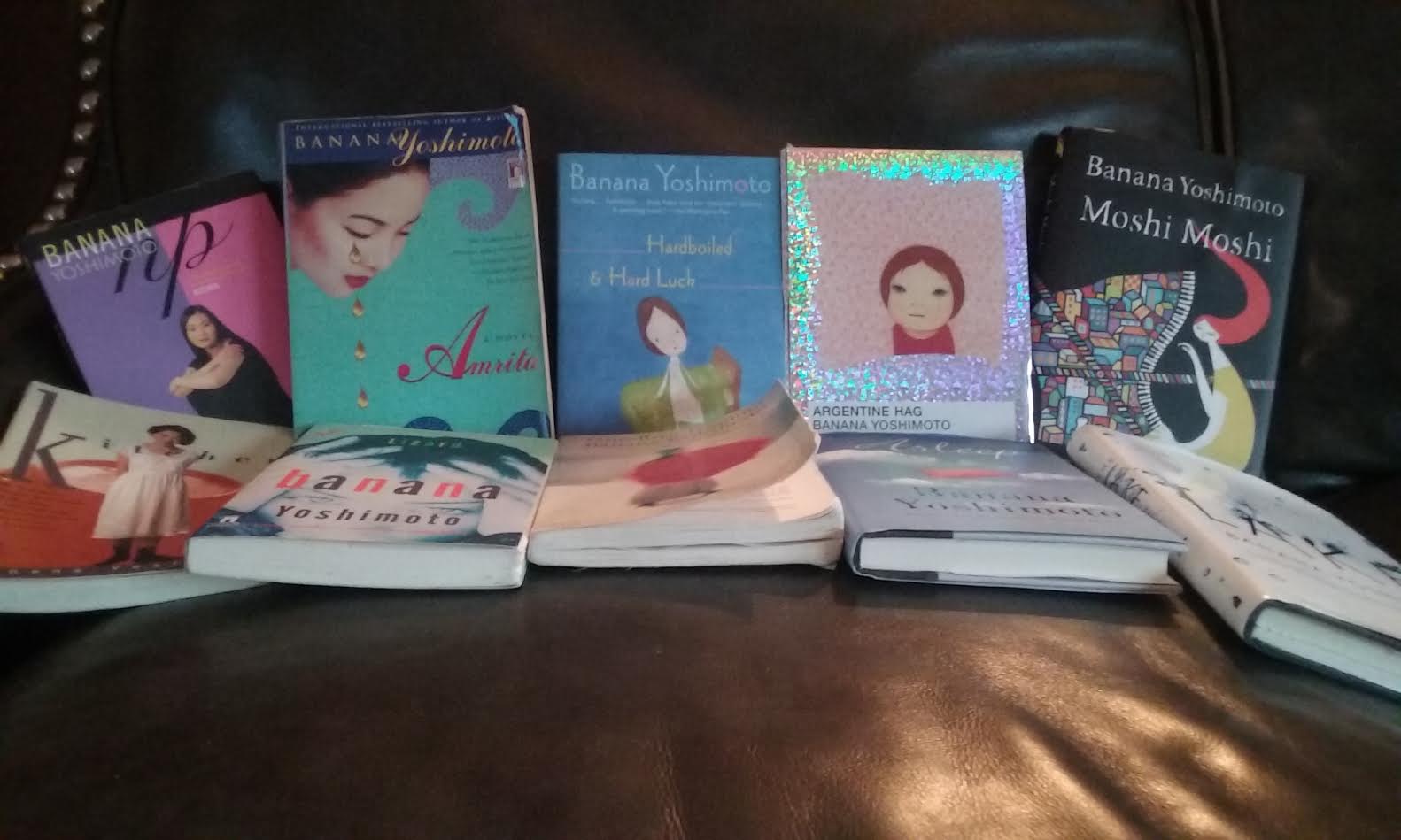
Reading "Moshi Moshi" And Sharing Tea, Grief, Hotels, And Smiles With Banana Yoshimoto


"I nodded and sipped my cocktail. The taste of fresh fruit spread over my tongue.  This was all that being alive meant, really." - From the novel "Moshi Moshi" by Banana Yoshimoto


The first novel I read by Banana Yoshimoto was "Kitchen." It is a short novel about a woman in her twenties dealing with grief. I was also in my twenties at the time, and it hadn't been that many years since I had lost my dad at the age of fifteen. In "Kitchen," lead character, Mikage, has just suffered the loss of her grandmother to whom she had been very close. To deal with her loss, she takes to sleeping on her kitchen floor because the hum of the refrigerator makes her feel less alone. "Kitchen" is what hooked me to Yoshimoto's novels and solidified her as my favorite modern author. Yoshimoto's newest English-translated novel is called "Moshi Moshi," and it continues to display her genius in describing twenty-something women suffering early loss. What is different about Yoshimoto's novels is that although her characters are hurting, each of her novels shows a glimmer of optimism. I haven't come across any other writer who accurately depicts the devastation of dealing with grief while simultaneously describing the protagonist's ability to maintain a positive attitude. Each of her characters finds happiness in the simplest of things. This trait matches Yoshimoto's "deceptively simple" prose, as her writing has often been described. Her language is simple, yet the meanings underlying her novels' themes are deep.


"Moshi Moshi" takes this grief theme full circle from "Kitchen." "Moshi Moshi" is the story of a young woman in her twenties named Yoshe who has just lost her father by carbon monoxide poisoning. Her dad had recently begun a relationship with a bewitching woman without Yoshe and her mom knowing.  This woman wanted to die but needed someone to take along with her, so she coerced Yoshe's dad into a car parked in the forest and poisoned them both.

Yoshe is an only child, just barely a woman, who is living on her own. She is fresh out of culinary school and now has a job helping out in the kitchen of a bistro. Yoshe tries to deal with her grief, and as she is "finally starting to be able to feel the joy in sitting down to a cup of tea or just getting up in the morning," her mom decides she can no longer bear living in the condo the three of them had shared in the town of Meguro. Instead, she wants to move in with Yoshe to the city of Shimokitazawa which has younger residents and many tourists. She tells Yoshe that Shimokitazawa reminds her of the first city she and Yoshe's dad lived in when Yoshe was a baby:

"Back then both your Dad and I were happy, for no particular reason - maybe because we were young, or it was just that kind of age.  We'd shop every day in Yanaka Ginza - we'd get deli food for dinner, savory preserves, roasted rice crackers, and then a cup of tea. If we had time, we'd stop at the traditional dessert parlor and have a beer, or some isobeyaki."

Yoshe realizes that her mom needs this time to heal. Yoshe absorbs herself in her cooking and waitressing work at the bistro and begins dating a customer she meets there named Shintani-Kun. But her grief overwhelms her.  Still, she shows up to work every day at the bistro no matter how badly she feels:

"Even so, come tomorrow morning, I'd be kneading bread dough, boiling water, shredding salad vegetables, mopping the floor. My body would know what to do, and I'd smile and greet customers when they came in."

Pretty soon, Yoshe and Shintani-Kun start going out for drinks after she finishes her workdays at the bistro, and she feels a sense of hope:

"I felt joy. Working at the bistro, Shintani-kun feeling at home there. Seeing my apartment across the street. I knew it wasn't going to last forever - things changed and moved on, and if you thought they could stay the same, they got ruined, like our family had done. Still, I desperately wanted all of this happiness to stay, just the way it was."


My Banana Yoshimoto collection of books on my couch

When your parent dies while you are still in childhood, a part of you remains arrested in that state because the only place you can be with them throughout adulthood is in your memories. I definitely related to the solace Yoshe seeks in her memories that she relays throughout "Moshi Moshi." Yoshe remembers her childhood vacations this way:

"The light from the TV dappling the dark room made me think of family vacations of old. I felt as though I was back in a room in a traditional inn, already asleep, while Mom and Dad watched TV lounging on the mat floor."

I particularly liked this hotel memory because my happiest memories from childhood are the times my mom, dad and brother took family vacations to Disney World or the Poconos, and we had our parents' undivided attention. We explored the parks and swimming pools by day and then shared the same hotel room by night.


Yoshe believes that memories of her dad are etched not only in her heart and mind but also in the places he walked through: "Of course, there were some things that didn't change - the familiar and nostalgic colors and smells, tastes and places in our memories.  But we could no longer relive them as things that were real to our own bodies."

These lines remind me of Walt Whitman's "Leaves of Grass" poems which were a favorite of my dad's. He even wrote his own rock opera in the late 1960's-early 1970's by composing his own versions of Whitman's poems through several original songs, often titled the same as Whitman's poems.  The main theme in "Leaves of Grass" is how we are all connected as entities who live the human experience. This includes all of us now living in the present, those who have lived in the past, and those who will walk this earth in the future. Whitman talks about how all generations have physically walked over the same grounds as each other, and when blades of grass grow, these blades are nourished and grown out from the bodies of our ancestors. There is a connection between past, present and future generations because we walk the same steps over the same parts of earth together. The following line from "Moshi Moshi" reminds me of Whitman and also of my dad:

"I started walking again, and even though I was wearing grown-up shoes on a grown woman's feet, the lightness of my step felt just the same as they had when I'd walked in my favorite childhood sneakers, which Dad had taken me to buy."


My dad and me

As the seasons pass, Yoshe's mom embraces the fact that there are so many young people living in Shimokitazawa, and she seems to be returning to a previous youthful self that Yoshe didn't even know existed.  My mom did that too after my dad died. Suddenly, she started hanging out with friends who were in their twenties, and she listened to pop music on the radio and went out dancing. It makes sense now because she was so young back then: my dad was only forty-one when he died, and my mom just turned forty the next month. I remember one of my mom's friends gave her a birthday card that said: "Life begins at 40," and my mom hung that card up in our kitchen.  But I didn't like that card. I wasn't ready for anyone to have any kind of new life other than the childhood I had grown familiar with.

Yoshi expresses similar thoughts. It appears to her that her mom suddenly doesn't need any help with her grief while Yoshe is still struggling so much. It feels like a blow to her when she finds out her mom has landed a job in a tea shop. Yoshe wants to be happy for her mom but realizes she is initially unable to:

"I'm the one who didn't want Mom to get better, I realized. I was shocked at my own immaturity. I was the one who wanted her to stay at home in my apartment, who wanted to keep my mother to myself.  Now, standing in this shop, she was back in the wider world, among everyone else."

I can relate to those feelings too.  All children believe that even as life changes, and they leave school and move on to work life, at least their family will still remain intact. It was a rude awakening for Yoshe and for me when our lives suddenly changed before we properly reached adulthood.


Yoshe tries to follow her mom's example to move forward, but she is still very vulnerable and not in the proper mindset to enter into a healthy and mature relationship with Shintani-Kun. When she finally allows herself to take the next step in their relationship, she's not really into it: "We're probably going to sleep together now..., but so what? What's it going to change?"

Yoshe's nihilistic attitude is a common example of the depression that often hits young women after a major loss in the family. Your entire world has been turned upside down and everything you thought you believed in as a child has suddenly changed due to that one event. I remember sitting in a movie theater in 1990 watching the film "Sweetie" and relating to one of the lead characters, a woman named Kay. She analyzed everything but felt nothing. She looked for symbolism to try and make sense out of life and find messages in things while performing obsessive rituals. In her case, she was obsessed with trees and cracks in the sidewalk. But her anxiety only increased. I also suffered from obsession, anxiety and a feeling of meaninglessness. Looking back, I see I was still trying to make sense out of life and to heal from my grief. Life is frightening when you have to recover from loss. You long for the security you knew as a child.

At the end of the novel, Yoshe visits the scene in the forest where her father and the woman were found dead in the car. She tells her dad it is alright to let go, and he can be at peace. She realizes that she must now focus on the present. Once you suffer a loss, you always fear it will happen again. It's probably more on your mind than someone who has never experienced a significant loss in their life. But we have to be thankful and mindful of what we have in the present. We don't have to worry every single minute. The people we have in our lives are still here:

"My father was gone now, but my mother was here. I could be with her today, for certain, at least, and hopefully much longer than that. I'm coming home now, Mother - Mother, I'm glad you're here - I'll be coming through the door in a moment."


My mom put this yellow happy face in her car to cheer herself up on cloudy days

While getting ready for the paperback version of "Moshi Moshi" to come out, Banana Yoshimoto lost her own father unexpectedly. For years, people had criticized her for not writing about grief in a realistic way. After all, many of her novels are about losing primary family members, but she had never lost one. I remember after I'd read "Kitchen," I was shocked to learn that she herself had not lost a parent. Yoshimoto says that after she lost her father, she realized that she indeed had been on the right track all those years. She said her own writing in "Moshi Moshi" gave her the answers she now looked for as if she somehow knew what she was going to need to help her heal.


Recently, I posted my Goodreads Review of "Moshi Moshi" and was thrilled when Banana Yoshimoto responded to me and thanked me in English for my "beautiful review!" Previously, she had only communicated to me through emoticons and emojis because she doesn't speak or write in English. But just like how Whitman believed previous generations can communicate with present and future generations through shared experiences, language is not a barrier either. I will forever treasure the time that Banana Yoshimoto sent me this smile:


I'm still dreaming that one day I will take a trip to Japan and meet her in person. Why wouldn't I want to meet my favorite novelist?



Friday, April 1, 2016

Finally - Dad. (Part 1)


I prefer to remember my dad the way he looked as a young man. The way he looked in the pictures I saw of him taken in the 1950's and 1960's. Not when I knew him when he had that wild, curly, 1970's hair that used to reach the roof of his car even though he was only 5'10." In the 1980's, he lost that 70's hair.  Not because of the cancer treatments he started in 1981 (oddly enough, he never lost his hair like the majority of patients do) but rather because the styles changed, just like the best things in life always do.

After he died in 1984, I took out his college graduation picture and made a conscious effort that any time I thought of him, I'd only think of how he looked in the 1950's and 1960's. Somehow, it made thinking about him less sad.

My father only walked this earth for 41 years, and I only knew him for about one decade of those if you count the years I was an old enough child to have a clear memory of him. A few decades later, he has become an almost mythical figure to me, and I have to rely a lot on what people older than I am can remember, and I'm always anxious to hear stories about him. Luckily, my relatives and his friends are always more than happy to share what they remember of him with me.

One of my favorites comes from my mother's first cousin, Carol. My mom is an only child who grew up in Brooklyn, New York, and every summer to escape the City, she and my grandmother spent the entire summer in Scranton, Pennsylvania, with her my grandmother's sister who is Carol's mom. My grandfather joined them on weekends. When my mom and dad became serious, she brought him along on one of the visits to meet Carol and her sister, Barbara, who were like sisters to her. Carol told me about the first time she "almost" met my dad. She said she went out to her country backyard to meet him where he had climbed a tree and was just sitting at the top it, enjoying the country air. She told me that when she spotted him all the way up there, she thought: "Well, I guess we're not going to be meeting him today."

Even though my father had what many people would consider a short life, he did a lot in those 41 years. He was a Language Arts teacher for 17 years at Prall Intermediate School, I.S.27, on Staten Island, New York, and he was also a singer and songwriter. He enjoyed teaching and often brought in his song lyrics to have his students analyze them as assignments.  One of the projects he had done in the late 1960's or early 1970's was an album based on Walt Whitman's "Leaves of Grass" poetry book. Whitman was considered pretty "out there" for his day so he self-published and paid for "Leaves of Grass'" first edition and even did most of the typesetting. So basically, Whitman joins the ranks of today's indie writers like myself (or on my bad days, I choose to think of it this way). What my father did with Whitman's "Leaves of Grass" is kind of like what Kate Bush did years later when she wanted to use James Joyce's Molly Bloom monologue from his novel, "Ulysses," as lyrics for one of her new songs and wasn't granted permission. Instead, she wrote "The Sensual World"  and just changed the words, writing her own version of the original prose, keeping in line with the feeling of the words, which in the end is all that really matters - what feelings pieces of music bring to its listeners.  

After my father died, I went through every single loose leaf paper he had in his bedroom dresser drawer, and there were tons of them. It took me months to go through them all, but every weekend when my mom and brother were out with their respective friends, my 15 year old self grabbed another pile from his drawer, sat on my living room swivel chair in front of the TV, and read through every single word. When I read the lyrics based on Whitman's work, I hadn't yet read the original "Leaves of Grass" that they came from. As a grieving teen, I don't think I was really ready for it. It wouldn't have impacted me the way it did when I finally picked up the book several years later. When I read through "Leaves of Grass," I was amazed, and I could see what the appeal of the book was for my dad. It is a celebration of life. It was written for people who enjoy sitting at the top of trees all by themselves enjoying nature around them. I imagined my father reading Whitman in college and embracing his days as a young man, enjoying this earth while it was still his.

My father was a well-liked person because he accepted everyone as being the same as him. He felt a connection with others and with nature around him so I can easily understand his identifying with "Leaves of Grass." Below is an excerpt from Walt Whitman's "Song of Myself" which is part of "Leaves of Grass":


“I celebrate myself, and sing myself,

And what I assume you shall assume,
For every atom belonging to me as good belongs to you."


My dad wrote this song version of Whitman's "Song of Myself":


My dad wrote at least 9 songs based on "Leaves of Grass." Once I read the original book, I was happy it moved me as much as it moved him because there was now another reminder I could forever have of him because these reminders keep his memory alive to me on those days when I really miss him. My whole life has been a quest to recapture what I can remember of him. Whitman wrote:


“Failing to fetch me at first, keep encouraged. Missing me one place, search another. I stop somewhere waiting for you.” 


Whitman's "Leaves of Grass" is both a celebration of life and also a celebration of nature. He believed we should enjoy the little things in life and embrace the natural world that was given to us. His words are affirmation that every human being is connected to one another regardless of generation or even century of time.  He believed human life was carried on THROUGH nature because every generation walks the same green earth. He meant this figuratively AND literally, proclaiming that human beings once deceased eventually are "reborn" again through the growth of the grass beneath future generations' feet.  This passage below is simply beautiful and is one of my favorites from "Leaves of Grass": 


"What do you think has become of the young and old men? 

And what do you think has become of the women and children? 

They are alive and well somewhere, 
The smallest sprout shows there is really no death, 
And if ever there was it led forward life, and does not wait at the 
end to arrest it, 
And ceas'd the moment life appear'd. 

All goes onward and outward, nothing collapses, 
And to die is different from what any one supposed, and luckier.” 


That last line brings me comfort. I like to imagine my dad is in a happier place even though he can't be here physically with us. I know that I titled this blog entry "Part 1," and eventually I'll write a Part 2, but I have no idea when. Processing the loss of my dad has taken me a long time. In fact, it was not too long ago that I could finally display his school teacher picture in my house which is the picture I have that looks most like the way he looked during the years I knew him. So like I said, there will be a Part 2 one day. In the meantime, I, and hopefully now you, will celebrate Whitman.


Dad and Grandma in the 1970's

Saturday, March 7, 2015

Someone Who Gets Me


My mom and I get along well now, but that's because we're very different.  We don't see our own faults staring back at us from each other's eyes. But I also don't think she gets where I'm coming from, and I'd accepted that years ago. When we did our Myers-Briggs Type Indicator which is a personality test developed by a mother/daughter psychologist team and based on Carl Jung's theories, my mom's results were ESFJ which is the most popular personality type, yet my results were INFJ which is the least popular personality type. Emily Dickinson is thought to have been an INFJ so that gives some indication of what my mom was dealing with while raising me. My dad never took the test, but I believe he would have tested as an extrovert (the "E" in the four-letter Indicator stands for Extrovert, and the "I" stands for Introvert). He was a musician who played in a club band, and when he wasn't performing music, teaching or tutoring, he still always wanted to be out of the house. I can't remember him even once saying, "You know, I'd really prefer to stay at home tonight" or "I need my alone time." That spells extrovert because as an introvert, I find myself saying that at least twenty times a day.

So where did I get my introvert gene? I look to my grandmother -  my mom's mother. She was definitely an introvert, and we used to hang at home together a lot when I was growing up. She didn't really have any outside friends and rarely had people over her house which was downstairs from ours. She didn't want to be involved in the ladies' groups at her church and definitely didn't want to bond with my grandfather's sisters who lived nearby: She was German, and they were Italian, and she believed they always ostracized her because of that. But I don't think that was the reason. They just didn't get her. Probably because her personality was different: She liked to stay home and study the Bible and write about it in her notebooks. They liked to meet in groups to coffee klatch.

The only person my grandmother used to seem to really enjoy talking about was her younger brother, my great-uncle, Richard. Her face always lit up when she told me stories about the two of them growing up in Pennsylvania. She said they'd climb mountains to pick "huckleberries." He was creative like my grandmother and used to paint pictures of people or things that interested him. He painted my mom when she was sixteen, and in it, she lounged on a bed with a bunch of brightly-colored pillows. He always used very bright colors, a lot of pinks and light blues, and often painted the cherry blossoms he saw when he traveled to Washington D.C.

Uncle Richard had dinner at my grandmother's apartment in Brooklyn every Sunday where she had moved to from Pennsylvania and now lived with my grandfather and my mom who was still a child. He always brought along what now would be described as his "partner," a man named Bill who was about twenty years older than he was. My mom said that back in the fifties, these relationships were usually not spoken of. She said it eventually clicked in as she got older that Bill was more than just a friend to Uncle Richard.

Several years later, when Bill died, my Uncle Richard was distraught. First he took up with another man, also named "Bill," but this time, Bill was the younger one. That relationship didn't work out, and soon afterwards, Uncle Richard retired from his office job in Manhattan and moved to Texas.

I only met my Uncle Richard once in my life when he visited us when I was nine.  He stayed downstairs with my grandparents for about a week, and I didn't like him because his sense of humor was extremely sarcastic and what I had considered mean. Nowadays, I would have loved this about him and laughed along, but my nine-year-old little girl brain couldn't appreciate this type of wit. When he asked me if I would be sad when he had to go back home, I answered him honestly and said: "No." Still, he promised me that once he got back home, he'd mail me a Texas girl doll since I loved dolls so much. I watched intensely for the mail for a couple of months but eventually gave up and decided I had been right about him all along.

The only time I ever saw my grandmother break down in tears was when Uncle Richard died. In her younger days, my grandmother was not a woman who had it easy. She suffered two stillborn babies and gave birth to one baby that only lived an hour, yet she never cried or even choked up whenever she told me about them. In his last years, Uncle Richard's health had deteriorated due to alcoholism and probably a broken heart. He moved from Texas back to his hometown in Pennsylvania where my grandmother's sister and cousins still lived. My grandmother's sister said that people sometimes told her they'd seen Uncle Richard wandering around the park or sitting on park benches, looking like a homeless person. Seemed he never really got over losing the older Bill. One night, my grandmother came up our stairs crying, saying she had just gotten a phone call that her brother Richard had died. I always regretted I didn't give Grandma a giant hug right then, but I was a teenager, and I looked for a cue from my older brother who was never really one for expressing his emotions. He didn't move from his spot on the living room couch, so I didn't move from my recliner either. It hadn't been more than a year or two after our dad had died so neither of us were the clearest thinkers at the time. But my grandmother didn't seem to mind. I think she was in her own world. I believe if it had bothered her that I didn't hug her, she would have told me in the next few days. She had always been very verbal regarding any situation where she felt she'd been wronged, so I think she would have mentioned it. It doesn't mean I don't still regret it. But overall, I'm sure she did understand where I was coming from that night because she was one of those few people in the world who truly gets me.