Showing posts with label novels. Show all posts

Monday, March 16, 2026

My Novel Taming Jaguars Is Finished!!!


Jasmine, Patsy, and Vera accompany me everywhere. They join me when I take a walk, help me do the dishes, cook baked ziti with me, and listen when I play the piano. After a handful of years, this is how I got to know them, and now that my fifth novel, "Taming Jaguars," is finished, it's time to send them off into the world. 

Jasmine is the "I" character in Taming Jaguars. It is summertime, and the story begins when at age forty-nine, she moves into the beach house owned by her new boyfriend, Rex, in the fictitious town of Cape Castle. Rex is Jasmine's first serious boyfriend since her marriage ended with a shocking confession over a decade ago. She is perpetually filled with anxiety that her relationship with Rex will not work out, so she spends the summer self-medicating with Chardonnay and through the healing scents of the ocean's sea salt. At first, Taming Jaguars was supposed to focus on Jasmine and Rex's burgeoning relationship, but after a year of outlines and sketches of my first few chapters, I realized I'd rather explore her friendship with two of my female characters, Patsy and Vera. I wanted to learn more about their personalities and histories because I found these unique and gutsy older women fascinating. 

Patsy is a blue-eyed blonde spending another summer living in her faded musician boyfriend's beach house. She is forty-four years old, and she ignores the ticking of her biological clock, preferring to focus on enjoying the hedonistic temptations in life. She brings her closest Cape Castle friend, Vera, into the mix who is a youthful seventy-nine-year-old with no qualms about wearing her bikini top every time she relaxes in the beach town. Throughout my novel, Vera sets out to help Patsy and Jasmine with their youthful dramas despite harboring a spicy secret of her own.

Now that the drafts are finished, my next step is spreading the word on social media. When I self-published my novels, Bliss, Bliss, Bliss  (2011) and Iggy Gorgess (2014), I connected with writers, editors, and indie publishers through Twitter, but now that Twitter is gone, I'm mostly on my Facebook Author Page, Instagram, and my Goodreads Author Page. Recently, I've discovered Substack, yet another website where writers can post notes and quotes from their novels.

Since Taming Jaguars is not yet a printed book, I am working on a one-page synopsis and author's bio to submit to independent publishers hoping to find someone who will help me get Jasmine, Patsy, and Vera into the hands and minds of readers.

Although Taming Jaguars mostly focuses on older women, my character Mel is an Instagram model in her early twenties, and the disdain Jasmine and Patsy have for her is often humorous. Here is a short excerpt that features Mel, Jasmine, and Patsy meeting Vera at the spa's indoor swimming pool:


            Mel changed from her white terrycloth robe into a skimpy, pink and tan bikini. I couldn't figure out where she had gotten a bikini?

            “Umm,” she said. “I should have told you both to bring bikinis today. I always carry one in my purse.”

            “That's resourceful,” Vera said.

            “But why would it be 'resourceful' to carry a bikini in your purse?” Patsy asked.

            “Because we are the inhabitants of a beach town.” 

            “It's silly,” Patsy said. “I always know when I'm going for a swim. I don't have many pop-up bikini moments to surprise me!”

            I laughed loudly, but Mel just shrugged.

           “Oh, don't be callous,” Vera said. “If you girls had carried bikinis in your purses today, you and Jasmine would be in the water with us right now instead of kicking your legs about at the edge of the pool! 


Thank you for reading a bit about my journey writing my fifth novel, Taming Jaguars. Stay tuned for more excerpts at the following links: 

https://www.facebook.com/chrissibliss/ 

https://www.instagram.com/christabelgorgess/?hl=en

https://www.goodreads.com/author/show/5232496.Chrissi_Sepe

https://substack.com/@chrissisepe?


Photo by Ralph Crane


Monday, May 22, 2023

Channeling My Inner Starr Quality


Me during the time period Maurice Starr approached me at Tower Records.

Last month, I streamed "The New Edition Story" on Paramount Plus, and it sparked a memory of the time I met Maurice Starr while working at Tower Records Boston in 1990. Starr discovered the 1980's boy band New Edition before he created the astronomically successful New Kids on the Block. When I was in my early teens, I solidly listened to New Edition's first two albums and sang the songs around my house.  One of my favorites had the lines:  "Shake it/Don't break it/It took your mother nine months to make it," and it drove my dad crazy! Seven years later, I was standing at the entrance of Tower, flipping through a Miles Davis biography, when Maurice Starr approached me.  If he had been Ronnie, Bobby, Ricky, Ralph, or Mike, I would have recognized him.  But instead, he was their behind-the-scenes producer, and I didn't recognize him at all.  He asked me if I liked Miles Davis, and I said that I didn't know anything about him and that's why I was interested in reading this book.  He also asked me how the Peter Wolf solo album was doing, and I told him whatever I could remember off the top of my head about its sales.  Suddenly a man walked up to me and asked, "Do you know you're talking to a really important guy right now?"  I turned to Maurice and asked, "Who ARE you?!"  He answered, "I'm Maurice Starr,"  to which I exclaimed: "No, you're not!"  So he pulled out his driver's license and showed me.  It had a different name on it, but it also said "a/k/a Maurice Starr," so then I believed him, and his identity was further confirmed to me a few days later when I saw his picture on the cover of one of my free Boston magazines.  Maurice and I chatted a little while longer, and I told him I was a Berklee College of Music student and that I was interested in working as a singer and songwriter.  The next thing I knew, he wrote his phone number down on a little piece of paper and told me to call him.

But I didn't! 

I should have because it was my dream to get a record contract, but I was too shy and scared to go and audition for him.  I was more of a songwriter and instrumentalist and less of an entertainer and performer.  I missed my chance.  A few months later, I saw Maurice Starr  interviewed on MTV.  The interviewer asked him what made him choose to work with certain people over others.  He answered that he noticed a little something special in those people, making them stand out from the rest.  I felt he must have spotted a quality like that in me.  

For years, I regretted not using that little piece of paper to call Maurice Starr.  All I did was Scotch tape it into my notebook journal.  Eventually, I learned to accept that singing and dancing to pop music just wasn't me.  Growing content with our limitations comes easier with age.  It would be tempting to sit around and sulk and ask myself: "Why didn't I jump at the chance? I was in my prime then!"  But what good would that do me now, and what does it really mean to be in our prime anyway?  Everyone constantly says that women over the age of forty are no longer in their "prime," but what if being in our  prime doesn't mean what society tells us it means?  What if having more confidence and self-awareness is what it really means to be in our prime? Maurice Starr noticed something in me when I was in my early twenties, and that special something hasn't gone away.  I may not sing and dance or have a record contract, but I write novels and they fulfill me. The secret to staying in our prime is to channel our own inner "Starr" qualities, and instead of dwelling on what we can't do, we should remind ourselves what we CAN do.  

Lena Dunham's Instagram post on New Year's Eve positively resonated with me. She proposed we forget about making New Year's resolutions because they keep us focused on our failures. Instead, she suggests we: “Give in to who you are and what your actual gifts are, your true powers, and let go of the compare and contrast.”  I think this is good advice.  This year, instead of making more demands on myself to clean the house more and exercise more, how about I just be me?


Me on the Willowbrook Park Carousel in Staten Island - Present Day


Friday, December 6, 2019

Play It As It Lays


Me at Spring Lake, NJ

In Joan Didion's 1970 novel, "Play It as It Lays," lead character Maria is slowly losing her mind and unraveling through flashbacks told in very short chapters. According to Google, the term "Play it as it lays" means: "Take what you get, and figure it out, and make the best of it so that you can move forward." I'd never heard the expression before, so after reading it, I came to my own conclusions about what the phrase might mean, and that is: "Take it as it comes, just let each day unfold the way it wants to, and make no plans." Unlike Maria, who recalls several tragic events throughout the novel, my interpretation of the phrase is more suitable to mundane, everyday life.  Letting each day unfold and making no plans is a chill way of living.  I never followed it in my youth. I always planned, and waited, and definitely tried to control things. But these days, I realize how little control I have, so I find myself "taking things as they come" more often than ever before.


Me, Poolside in Canada   

"In Maria's own garden the air smelled of jasmine and the water in the pool was 85°. The water in the pool was always 85° and it was always clean."


Now that I'm older,  I never go to bed early enough. I guess it's because I'm more aware of the passage of time and how quickly it goes. It's like I don't want to miss anything. I stay up until midnight watching "The Twilight Zone" and "Alfred Hitchcock Hour," then have to wake up at 5:30 a.m. for work. I can fall asleep easily but often wake up in the middle of the night and have trouble getting back to sleep. My solution to daytime sleepiness is napping. First, I nap on the ferry on the way to work, then once at home, I nap anywhere I can think of. I used to sleep on the couch a lot, but now that I have my two-year-old Shih-Tzu, I can't because she won't let me. She seems to think it breaks routine,  so she paws at me and at the pillow as if to say: "You are not supposed to be sleeping on the couch!" So I try and sneak a nap on the recliner when she isn't paying attention. In "Play It as It Lays," Maria has trouble sleeping and finds that she can only fall asleep, and stay asleep, outside beside her swimming pool, lying on the lounge chairs along it. I think that in a larger sense, Maria has a feeling of unrest that goes beyond not sleeping. She doesn't feel comfortable anywhere and is unable to relax or let her guard down in order to enter a proper sleep. The act of sleeping outside on a pool chair resonated with me. I hate not being able to sleep, and if I found that sleeping on a chair in my backyard beside a swimming pool was the only way I could get some sleep, I would do it too, just like Maria.


                                                                                      Me and my Shih-Tzu


"Maria was listening to someone talk and every now and then she would hear herself making what she thought was an appropriate response but mostly she was just swaying slightly with the music and wondering where her drink was..."


We all, at times, find our minds wandering off when people talk to us. Often, I'll find myself drifting into different thoughts while someone is telling me a story. But suddenly, I'll see their animated expression or I'll notice a slight pause in conversation, and I'll usually respond with a "Wow" or an "Oh that's crazy." Otherwise, I'll just nod my head in agreement and hope my response was not way off. Maria has lost control in this scene and can't plan her responses as people often do in social situations.  Throughout the book, she is increasingly unable to adopt a persona, and by this point in her life, she is tiring of "the game," and through no other choice, she is only able to be her authentic self. She is real, but it is killing her. Throughout the story, she can only "play it as it lays," just like in this party scene, until she can escape with her drink.  It's exhausting trying to live as your truest self in a world where so many people work hard to perfect their outward personalities and control their responses, and you're over there taking every statement at face value and missing the inside jokes and the hidden innuendos. People don't want to take themselves as they are. Instead, they want to create the kind of person they think they should be. I think it's exhausting on both sides.


"Always when I play back my father's voice, it is with a professional rasp, it goes as it lays, don't do it the hard way.  My father advised me that life itself was a crap game: it was one of two lessons I learned as a child.  The other was that overturning a rock was apt to reveal a rattlesnake."

Me and my Dad. He used to love gambling on the horses.

Maria's dad is the one who advises her to "play it as it lays" at the end of the book. He says life is a crap game. He keeps on investing his money in shaky business deals, and keeps on losing, but he never loses his positivity and optimism. He advises Maria to relinquish control.

My assessment is that life can sometimes make you messed up like Maria:  There are times you only want a drink, and other times, you have insomnia because you are aware of the passage of time and how quickly it all goes.  But you have to realize you can't control these things. You have to learn to "play it as it lays" and do the best you can with what you've got because, really, you have no other choice, and most of the time, that's perfectly OK.


“I am what I am. To look for reasons is beside the point.” 


Joan Didion (brainpickings.org)


Tuesday, January 1, 2019

Zip Zip Zinging In The New Year


It's New Year's, and to me that means watching "The Twilight Zone" marathon or re-watching Henry Jaglom's movie, "New Year's Day." It also means watching the Ball drop on TV from Times Square in New York City at midnight, wishing it were still an apple like it was during the 1980's. I can remember New Year's Eve in the '80's more than I can in any other decade. I'd watch Dick Clark's New Year's Rockin' Eve, and when 1984 passed into 1985, I realized that from this point on, every year would now be a year my dad would never see. But that's a downer! Truth is, I see each New Year as a year full of promise. 2019 will be the year I'll finish the first draft of my latest novel. I've been having a hard time getting it off the ground because it's too close to me. It's my mind focused on serious things, such as living as a woman in the Trump era. My characters have a lot to say, but all I want to do is escape with a glass of Chardonnay and a plate of fried shrimp.


Hopefully, I'll push my fears away and get into a groove with what will be my fifth novel. The problem with buckling down with a novel is that it leaves little time to work on shorter stories and to give them the attention they deserve. I'd love to keep submitting and seeing my stories posted on the Web because that's such a thrill, but sometimes, writing a good short story can take as many months of rewriting and editing as a short novel can. I see 2019 mostly as the year I'll write another novel, but I'm also excited that later this year, one of my short stories will appear in an Anthology, so I'll have to let that sustain me until I can devote the kind of time that quality short stories deserve.

So here's to 2019! Here's to remembering friends who didn't make it out of 2018 but who remain in our memories along with all the music we'd listened to with them, the glasses of wine we drank together and all those lengthy discussions of life.  Let's read, talk, and give a toast to 2019! My books aren't going to write themselves, and as much as I want to escape, I also need to express the things that weigh heavily on my mind. I want to give something back like my favorite writer, Anais Nin, did when she reluctantly went deep inside herself to bring out what we often suppress. Reading helps all of us bring our own hidden thoughts to the surface so we can feel like we're never truly alone.


Monday, July 9, 2018

I'm Celebrating That Summer Feeling! (Oh and more of my writing being published!)


Summer is finally here! It's my favorite season because it's the time of year when I feel the most free. Something about it being hot all the time reminds me of being a kid and playing with my friends in the street when the days seemed like they'd never end. The way I feel freedom these days is through my writing. This summer, I am honored to have three of my short stories included in an upcoming Anthology called "Howls from the Underground" which is being released by an independent publisher called Screamin' Skull Press. I couldn't be more excited! Here are short descriptions of my three short stories:

1. "Beer and Sunlight"

This is the longest short story I have in the Anthology. It takes place in the early 1990's, and it is about the unique friendship and relationship between a young woman and an older man. The illustration at the top of this blog entry is a picture I found in my writing sketchbook from my initial notes of the story.  A short time later, I did a psychological quiz from one of my books where you had to draw the sun, a tree, a house, a river, and a snake. When I drew the house and the sun, I drew the sun shining over the house in the same way I had drawn the sun over the bottle of Heineken beer in this illustration. The quiz said that the house symbolizes yourself and the sun symbolizes your father. I suppose I could have drawn the sun way above the house, as you often see in children's drawings, as a circle having short rays extending around it. But I've never drawn the sun that way. I've always drawn it the way it is here, radiating over the beer bottle. Possibly, the memory of my dad encompasses everything in my life.


2. "We Love to Watch Zee Cockroaches"

This story is about an Austrian woman who uses "Z's" in her speech because she is unable to use the "th" sound we use in English. She has a Spanish boyfriend, and the two of them entertain an American couple in their rather odd apartment. She offers the couple straight vodka in a shot glass with a glass of water on the side and insists that this was never her original idea: “You know, we never drink vodka zis way till we meet you," she tells them. "We never have straight. Wiz ice and juice before.” But the vodka drinking is the least unusual thing about her living situation.


and

"I'm Sexy AF"

This story is my take on Instagram "models" and the general degradation and dumbing down of our society thanks to fads like the Kardashians. Reality TV and filtered photos aren't real. I'm very much looking forward to the day that all of this self aggrandizement goes away.


In addition to "Howls from the Underground," I am working on my fifth novel. I'm looking forward to writing it this summer but have no idea when I'll finish it.  I don't even know if I'll release it independently as I did my first two novels: "Iggy Gorgess" and "Bliss, Bliss, Bliss." I still fantasize that someday I'll publish a blockbuster novel. But right now, I'm content with being an indie writer. Sometimes I wonder if I resist making commercial novels my goal because I don't want to sound like everybody else?  In my mind, the appeal of commercial novels to the majority of people is the same thing as how most people identify with music like the Beatles and Joni Mitchell. Maybe my novels and short stories speak more to the primal parts of ourselves and would resonate better with passionate, wild people who prefer a musician like Brian Wilson during his "Smile" period or every song that Laura Nyro recorded on her own? The best scenario would be to appeal to both sets of people, similar to the way Anne Rice's vampire books are commercial but also literary. But those books are rare. I just hope to someday find an editor who will understand me or an agent who will know exactly where to place me. In the meantime, I'm perfectly satisfied with being labeled as an underground, independent writer, and I just aim to get my writing read by as many people as possible.


The other thing that makes me feel free is swimming in the ocean.  Last summer, I went to Florida but didn't get to swim in the ocean because I went to the beach during a thunderstorm!  This summer, I need to get myself into the ocean so I plan to go to a New Jersey beach or to Coney Island. I'll just pretend I'm in a more exotic locale. Fantasy is another amazing vehicle for feeling free. I love to just imagine and live vicariously through others. I'm going to do this by watching the entire series of "Parts Unknown" by Anthony Bourdain. I literally was JUST getting into his show when he committed suicide. I still don't understand it. How could someone who gets to travel the world, eat the best food, and drink the best liquor -- all while getting paid for it -- not want to live this life anymore? I know from reading articles in the wake of his death that he had been fighting "demons" which nobody else could really understand.  So I just want to honor the legacy he left us. I plan to sit with a glass of wine and a plate of cheese and crackers and celebrate his life, reveling in that feeling of freedom I always strive for during summer.

Thursday, September 14, 2017

I Choose Writing (Over Wine, Opiates, Laudanum...)


When I'm upset, if there is a choice between having a glass of wine or writing my thoughts down on paper, I'll always forgo the wine and instead find a pen to write my feelings down on paper. I've released my emotions through writing for many years now.  I call this habit "Therapeutic Writing." I just let all my words flow out in a stream of consciousness until my mind is finally less foggy.

As a teenager, this essential outpouring of feelings most often took the form of song lyrics, stories and poetry. But in my early twenties, I was given a gift of a blank journal with inspirational quotes on each page called a "Book of Days." At the same time, I'd been indulging in reading my first Diaries of Anais Nin. Inspired by Anais, I decided to write in my "Book of Days" daily, under each labeled day. By the end of the year, I filled the book up completely, even if some days only contained one sentence. I was amazed at how there was always SOMETHING I could come up with to write once I formed the habit of sitting down every day. I believe this is how I developed the "necessity" to write.

These days, therapeutic writing is no longer a conscious habit. Instead, it is now a sense of urgency where as soon as I feel emotional about something, I just HAVE to get it down onto paper. Even if it's on bits of scrap paper that I tear up afterwards, just the act of emptying my thoughts from my mind through my hand makes me feel so much better.


A coworker once told me that my emotions are all at the surface. I asked her if this was good or bad. She said it was good. She said it meant I was in touch with my emotions. I know that when I get upset, my thoughts are completely ruled by my emotions. Most of the time when I have a desperate need to write, I am either angry or very confused. Somehow, the act of writing my emotions down allows my brain to understand what I'm feeling. Even if I can't solve the problem, I do gain a sense of clarity, and I don't stop writing until the familiar feeling of relief comes over me. Suddenly, something that seemed insurmountable just minutes earlier has now become clear, and I'm finally calm. I am able to write down the facts of my situation and to identify the fears that are behind these emotions.

Speaking of coworkers, years ago, I noticed that two of my coworkers seemed constantly upset. They were very negative in general and always conflicted about decisions they had to make. So for Christmas, I gave both of them blank journals and told them about my very essential, daily writing habit. I suggested they write something in it every day, even if it's just a sentence, just so they can develop the habit. I explained that in no time, they will be able to use their journal as a mental medicine that will help them think clearly about what is positive in their lives and to identify their inner thoughts in order to enable them to make decisions. Sadly, I don't think either of them took me up on it. Maybe they needed an expert in the field to guide them and to confirm my beliefs about the benefits of therapeutic writing. I believe that the book I'm reading now, "Writing For Bliss," by Diana Raab, Ph.D. would have convinced them!


I met Dr. Raab through our devotion to Anais Nin because we both contributed writing pieces to Volume 13 of the Anais Nin Literary Journal "A Cafe In Space." Another thing we have in common is that both of us use the word "Bliss" in our titles! My first novel's title, "Bliss, Bliss, Bliss," is based on a quote that has the word "Bliss" in it several times and is from "The Early Diary of Anais Nin, Volume 4." Dr. Raab's new book is a great starting point to learn how to use writing to heal and to release the usual everyday tensions and stressors in a healthy way through writing rather than engaging in destructive outlets.


Dr. Raab describes the importance of journal writing in these quotes from "Writing For Bliss":


"A journal, diary, or notebook - whatever you choose to call it - can play many roles.  It can serve as a vehicle for self-expression, a tool for clarity, a repository for observations, and a container for thoughts.  A journal may also be a powerful tool for comfort during difficult times...Journal writing can be as calming and grounding as meditation is.  It can orientate you and stabilize your emotions."


I highly recommend Dr. Raab's step by step guide, "Writing For Bliss," which is extremely thorough and includes numerous exercises to get you in the habit of therapeutic writing. It is a good way to get real with yourself and to confront painful memories from the past. It helps you to learn to write from your heart, which is where the truth is, rather than from your mind. It also helps get you started on writing your own poetry and memoirs, if you've ever considered doing that.

Basically, I don't know what I would do if I didn't have writing to release my tensions and emotions. It's truly amazing how something so simple and cheap can heal so much!


Wednesday, May 10, 2017

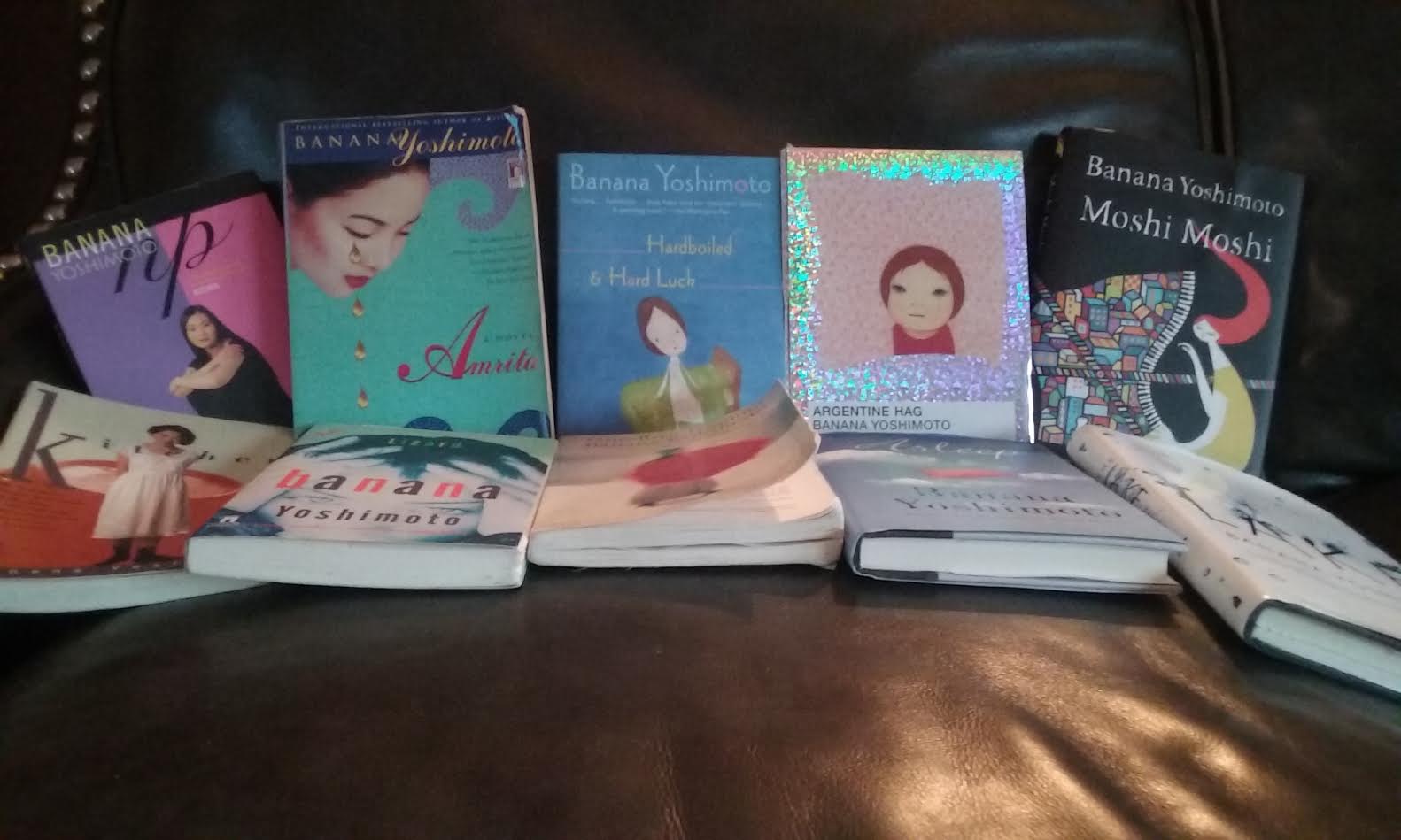
Reading "Moshi Moshi" And Sharing Tea, Grief, Hotels, And Smiles With Banana Yoshimoto


"I nodded and sipped my cocktail. The taste of fresh fruit spread over my tongue.  This was all that being alive meant, really." - From the novel "Moshi Moshi" by Banana Yoshimoto


The first novel I read by Banana Yoshimoto was "Kitchen." It is a short novel about a woman in her twenties dealing with grief. I was also in my twenties at the time, and it hadn't been that many years since I had lost my dad at the age of fifteen. In "Kitchen," lead character, Mikage, has just suffered the loss of her grandmother to whom she had been very close. To deal with her loss, she takes to sleeping on her kitchen floor because the hum of the refrigerator makes her feel less alone. "Kitchen" is what hooked me to Yoshimoto's novels and solidified her as my favorite modern author. Yoshimoto's newest English-translated novel is called "Moshi Moshi," and it continues to display her genius in describing twenty-something women suffering early loss. What is different about Yoshimoto's novels is that although her characters are hurting, each of her novels shows a glimmer of optimism. I haven't come across any other writer who accurately depicts the devastation of dealing with grief while simultaneously describing the protagonist's ability to maintain a positive attitude. Each of her characters finds happiness in the simplest of things. This trait matches Yoshimoto's "deceptively simple" prose, as her writing has often been described. Her language is simple, yet the meanings underlying her novels' themes are deep.


"Moshi Moshi" takes this grief theme full circle from "Kitchen." "Moshi Moshi" is the story of a young woman in her twenties named Yoshe who has just lost her father by carbon monoxide poisoning. Her dad had recently begun a relationship with a bewitching woman without Yoshe and her mom knowing.  This woman wanted to die but needed someone to take along with her, so she coerced Yoshe's dad into a car parked in the forest and poisoned them both.

Yoshe is an only child, just barely a woman, who is living on her own. She is fresh out of culinary school and now has a job helping out in the kitchen of a bistro. Yoshe tries to deal with her grief, and as she is "finally starting to be able to feel the joy in sitting down to a cup of tea or just getting up in the morning," her mom decides she can no longer bear living in the condo the three of them had shared in the town of Meguro. Instead, she wants to move in with Yoshe to the city of Shimokitazawa which has younger residents and many tourists. She tells Yoshe that Shimokitazawa reminds her of the first city she and Yoshe's dad lived in when Yoshe was a baby:

"Back then both your Dad and I were happy, for no particular reason - maybe because we were young, or it was just that kind of age.  We'd shop every day in Yanaka Ginza - we'd get deli food for dinner, savory preserves, roasted rice crackers, and then a cup of tea. If we had time, we'd stop at the traditional dessert parlor and have a beer, or some isobeyaki."

Yoshe realizes that her mom needs this time to heal. Yoshe absorbs herself in her cooking and waitressing work at the bistro and begins dating a customer she meets there named Shintani-Kun. But her grief overwhelms her.  Still, she shows up to work every day at the bistro no matter how badly she feels:

"Even so, come tomorrow morning, I'd be kneading bread dough, boiling water, shredding salad vegetables, mopping the floor. My body would know what to do, and I'd smile and greet customers when they came in."

Pretty soon, Yoshe and Shintani-Kun start going out for drinks after she finishes her workdays at the bistro, and she feels a sense of hope:

"I felt joy. Working at the bistro, Shintani-kun feeling at home there. Seeing my apartment across the street. I knew it wasn't going to last forever - things changed and moved on, and if you thought they could stay the same, they got ruined, like our family had done. Still, I desperately wanted all of this happiness to stay, just the way it was."


My Banana Yoshimoto collection of books on my couch

When your parent dies while you are still in childhood, a part of you remains arrested in that state because the only place you can be with them throughout adulthood is in your memories. I definitely related to the solace Yoshe seeks in her memories that she relays throughout "Moshi Moshi." Yoshe remembers her childhood vacations this way:

"The light from the TV dappling the dark room made me think of family vacations of old. I felt as though I was back in a room in a traditional inn, already asleep, while Mom and Dad watched TV lounging on the mat floor."

I particularly liked this hotel memory because my happiest memories from childhood are the times my mom, dad and brother took family vacations to Disney World or the Poconos, and we had our parents' undivided attention. We explored the parks and swimming pools by day and then shared the same hotel room by night.


Yoshe believes that memories of her dad are etched not only in her heart and mind but also in the places he walked through: "Of course, there were some things that didn't change - the familiar and nostalgic colors and smells, tastes and places in our memories.  But we could no longer relive them as things that were real to our own bodies."

These lines remind me of Walt Whitman's "Leaves of Grass" poems which were a favorite of my dad's. He even wrote his own rock opera in the late 1960's-early 1970's by composing his own versions of Whitman's poems through several original songs, often titled the same as Whitman's poems.  The main theme in "Leaves of Grass" is how we are all connected as entities who live the human experience. This includes all of us now living in the present, those who have lived in the past, and those who will walk this earth in the future. Whitman talks about how all generations have physically walked over the same grounds as each other, and when blades of grass grow, these blades are nourished and grown out from the bodies of our ancestors. There is a connection between past, present and future generations because we walk the same steps over the same parts of earth together. The following line from "Moshi Moshi" reminds me of Whitman and also of my dad:

"I started walking again, and even though I was wearing grown-up shoes on a grown woman's feet, the lightness of my step felt just the same as they had when I'd walked in my favorite childhood sneakers, which Dad had taken me to buy."


My dad and me

As the seasons pass, Yoshe's mom embraces the fact that there are so many young people living in Shimokitazawa, and she seems to be returning to a previous youthful self that Yoshe didn't even know existed.  My mom did that too after my dad died. Suddenly, she started hanging out with friends who were in their twenties, and she listened to pop music on the radio and went out dancing. It makes sense now because she was so young back then: my dad was only forty-one when he died, and my mom just turned forty the next month. I remember one of my mom's friends gave her a birthday card that said: "Life begins at 40," and my mom hung that card up in our kitchen.  But I didn't like that card. I wasn't ready for anyone to have any kind of new life other than the childhood I had grown familiar with.

Yoshi expresses similar thoughts. It appears to her that her mom suddenly doesn't need any help with her grief while Yoshe is still struggling so much. It feels like a blow to her when she finds out her mom has landed a job in a tea shop. Yoshe wants to be happy for her mom but realizes she is initially unable to:

"I'm the one who didn't want Mom to get better, I realized. I was shocked at my own immaturity. I was the one who wanted her to stay at home in my apartment, who wanted to keep my mother to myself.  Now, standing in this shop, she was back in the wider world, among everyone else."

I can relate to those feelings too.  All children believe that even as life changes, and they leave school and move on to work life, at least their family will still remain intact. It was a rude awakening for Yoshe and for me when our lives suddenly changed before we properly reached adulthood.


Yoshe tries to follow her mom's example to move forward, but she is still very vulnerable and not in the proper mindset to enter into a healthy and mature relationship with Shintani-Kun. When she finally allows herself to take the next step in their relationship, she's not really into it: "We're probably going to sleep together now..., but so what? What's it going to change?"

Yoshe's nihilistic attitude is a common example of the depression that often hits young women after a major loss in the family. Your entire world has been turned upside down and everything you thought you believed in as a child has suddenly changed due to that one event. I remember sitting in a movie theater in 1990 watching the film "Sweetie" and relating to one of the lead characters, a woman named Kay. She analyzed everything but felt nothing. She looked for symbolism to try and make sense out of life and find messages in things while performing obsessive rituals. In her case, she was obsessed with trees and cracks in the sidewalk. But her anxiety only increased. I also suffered from obsession, anxiety and a feeling of meaninglessness. Looking back, I see I was still trying to make sense out of life and to heal from my grief. Life is frightening when you have to recover from loss. You long for the security you knew as a child.

At the end of the novel, Yoshe visits the scene in the forest where her father and the woman were found dead in the car. She tells her dad it is alright to let go, and he can be at peace. She realizes that she must now focus on the present. Once you suffer a loss, you always fear it will happen again. It's probably more on your mind than someone who has never experienced a significant loss in their life. But we have to be thankful and mindful of what we have in the present. We don't have to worry every single minute. The people we have in our lives are still here:

"My father was gone now, but my mother was here. I could be with her today, for certain, at least, and hopefully much longer than that. I'm coming home now, Mother - Mother, I'm glad you're here - I'll be coming through the door in a moment."


My mom put this yellow happy face in her car to cheer herself up on cloudy days

While getting ready for the paperback version of "Moshi Moshi" to come out, Banana Yoshimoto lost her own father unexpectedly. For years, people had criticized her for not writing about grief in a realistic way. After all, many of her novels are about losing primary family members, but she had never lost one. I remember after I'd read "Kitchen," I was shocked to learn that she herself had not lost a parent. Yoshimoto says that after she lost her father, she realized that she indeed had been on the right track all those years. She said her own writing in "Moshi Moshi" gave her the answers she now looked for as if she somehow knew what she was going to need to help her heal.


Recently, I posted my Goodreads Review of "Moshi Moshi" and was thrilled when Banana Yoshimoto responded to me and thanked me in English for my "beautiful review!" Previously, she had only communicated to me through emoticons and emojis because she doesn't speak or write in English. But just like how Whitman believed previous generations can communicate with present and future generations through shared experiences, language is not a barrier either. I will forever treasure the time that Banana Yoshimoto sent me this smile:


I'm still dreaming that one day I will take a trip to Japan and meet her in person. Why wouldn't I want to meet my favorite novelist?


Tuesday, November 1, 2016

It's Perfect To Be A Messy Novelist


"I want to be decadent. I want to eat hot dogs and write novels instead of perfect short stories."

I remember writing this in my early twenties. I was a brand new writer, and I desperately wanted to get published. I worked as a volunteer for a literary magazine where my job was to organize the writers and prepare them to read at launch parties the magazine threw when they released each new issue. I'd also offered to emcee the events because I knew the publisher's girlfriend hated doing it. I'd never seen anyone as thrilled as she when she got the news she was off the hook! But even though I was official Emcee and named in the masthead, I couldn't actually get my own stories in the magazine! Each time I submitted, all I got were encouraging words to try again. I was a creative writing student, following advice from my teachers, and couldn't understand what I was doing wrong! Finally, I showed my brother my short stories, and he suggested I try a more traditional literary magazine, as he felt this one was wildly experimental.  I could have searched further, but instead, I decided to take a break from writing short stories and began work on my first novel. The thrill of seeing my own story in a magazine would have to wait.


When I sit down to write a short story, I often wind up writing something similar to a chapter of a novel. This is because I enjoy writing longer works where I can spend more quality time with my characters. I long to explore their needs, desires and growth. My characters' personal progress and evolution over time are what propel my books forward. However, when I write a short story, it is my "idea" that is first and foremost. This is difficult because I have to constantly come up with amazing ideas. Ray Bradbury did this better and more frequently than any other fiction writer. It is beyond me how he wrote so many short stories and came up with so many brilliant ideas. His mind was constantly filled with greatness! But when it came to his most famous novel, "Fahrenheit 451," I wasn't as impressed, and I feel he was better at the short story form.


In short stories, every single word must be carefully chosen to move the story forward. For me, that makes writing short stories feel more like business than fun!  In my literary novels, I can go wild. l can play with words, and I get to hang out with my characters because the length permits me to do so. I can go off on tangents and know that even if these tangents remain in the final edit, readers won't mind because they are in it for the long haul. My former writing teacher said that short stories are expected to be read in one sitting, but novels are read chapter by chapter, night after night. This permits more wandering around since readers expect that they will be putting the book down, then picking it up again, over and over, as opposed to everything being wrapped up neatly at the end of their sitting.

Maybe novels are truer to life than short stories are. Life is messy. Words aren't always perfectly chosen or perfectly executed. It's possible that novelists are more accepting of imperfection than short story writers. This could explain why certain writers prefer one format over the other. I've never expected life to be perfect, or rather, I've learned over the years that it is impossible to be perfect. My house, my writing, my cooking, and all aspects of my life, will never be perfect. I know others disagree with me. They're constantly gritting their teeth, comparing themselves to others who they assume are perfect. It's a disaster if they burn their cooking or have a less than pristine house when guests come over. I'd related to that kind of thinking when I was younger and when I was involved in the writing community, writing short stories that I expected to get published upon completion. But when I got frustrated with my pile of rejection letters that was getting closer and closer to 100, I sat down and expanded my favorite short stories into a novel. A few years later, I did the same thing and wrote another novel. Then years after that, with two independently-published novels under my belt, I began work on my current novel. I don't know why, but I am enjoying the process of writing this novel more than I have any of my others. People ask me, "So are you nearly done? When are you going to publish it?" But I'm not even thinking of that. "Not yet," I tell them. Because right now, I'm having way too much fun.

I've given up hot dogs since my twenties, but I still gel with the idea of being "decadent" and writing novels. I'm not saying I'm unambitious. Of course, I want to get my latest novel published. I'm also working on a couple of short stories (which started out as flash fiction stories but, of course, are now extending into longer pieces of fiction which may branch out into novels one day too), and I do want to submit them and try to get them published. But I feel the main reason to ever write fiction is to enjoy the process and not just what results at the end. Maybe that's the way life should be lived too.


Saturday, August 2, 2014

My Love Letter To Writing


Yes, I'm in love with writing. I couldn't survive without it.  Flannery O'Connor once said: "I write because I don't know what I think until I read what I say." That's exactly it. My mind is an emotional mess until I write my thoughts down. Afterwards, I feel better, less emotional, less confused, and I have an enormous sense of relief.

My mom was the first person to suggest I become a writer. I was 8 years old. It wasn't because she recognized talent in me, and it didn't stem from anything positive. It was because I was driving her insane with my phobia. There was a huge northeastern snowstorm that year, and I had read a news story about a boy who got buried in the snow in his yard and hadn't been found until a month later. The several feet tall snow drifts in our backyard hung around the entire winter, and I was terrified that the same thing would happen to me. I remembered every detail from that news story and kept on replaying it in my head: how the mailman found him because his mitten was sticking out from the snow; how the picture of the side of his house that looked like a barn had an "X" marked on it near the spot of the snow where he was found; how they used the word "vanished" in the article; and how everyone thought he was somewhere in the neighborhood, but he had been in the front yard all along. Every day I asked my mom if that was going to happen to me. She listened to me recount the details in the article for her, and one day, she finally said: "You should become a writer. There's got to be something positive you could do with all that misery stuck in your head!"

My mom's advice came in handy when I was 14.  My father was very sick, and my two best friends from school had turned against me.  I hated school and hated life and couldn't wait for the year to be over.  So I created a 30 year-old woman named Nazd to hang out with. She had long brown hair, brown eyes, wore a long, beige, raincoat and had her nails painted that neutral color you never see anymore.  We went everywhere together. My novel-to-be was simply titled "Nazd." As often as I could, I'd lock my bedroom door, put on Prince music, and write about Nazd with my same red pen on sheets of loose-leaf paper. Nazd was wise and said little.  She wasn't a chatterbox with her feelings always out on display.  She had all the answers. My world was falling apart, but I had Nazd as a shoulder to lean on.

In high school, I sat in the back of class and began a screenplay on tiny scraps of paper.  The action takes place in one day where a young woman sits in a dimly-lit Brooklyn apartment as an older man tells her about a doomed couple he knew years ago named Jimmy and Diana.  Jimmy often visited Diana in her Brooklyn brownstone, but her parents were against the relationship because they were wealthy, and Jimmy was poor. He was also heavily involved with drugs and eventually hanged himself. Diana was so distraught that she left home, left life, and became a bag lady on the street.  In the last scene, the woman leaves the dark apartment into the bright broad daylight and walks onto the street, crossing paths with a woman whose purse has fallen to the ground and opened up, exposing tons of junk.  She helps her, and when the woman looks up, she gives her a wide smile. She looks world-weary, but her smile is youthful.  She picks up her purse and walks away, leaving the main character to believe she has just bumped into the real Diana.

Luckily, as I wrote on my scraps during class, I had a knack for being tuned into whatever the lesson was about and was always able to quickly replay my teacher's question in my mind and answer it. I once read that creative people are unable to shut off the sounds going on around them.  I can be engrossed in a conversation at the diner but can still hear that one ring of the little bell from clear across the room signaling our food is ready which always fascinates whoever I'm eating with. 

But that's what makes writing even more necessary for me. I've trained myself over the years to now use writing to turn off all those extra sounds going on around me and instead to escape and break free from the rest of the world for a little while.  I figure that's okay, as long as I'm always able to come back and not be found one day sitting in a chair, muttering to myself, like Nicole Kidman playing Virginia Woolf in "The Hours" movie: The kids are pointing at her and laughing, and she's oblivious:  "Mrs. Dalloway said she would buy the flowers herself," she suddenly says out of nowhere. Mesmerized.


Sunday, June 1, 2014

"I'm Terrified."


Recently, the author/reader site Goodreads e-mailed me requesting I provide a question for author Michael Cunningham's upcoming interview in their next newsletter. I've read two of his books, "The Hours" and "Specimen Days," and they are among my favorites. "The Hours" was made into a movie with David Hare as screenwriter and Stephen O'Hare as director.

The question request from Goodreads got me thinking about "The Hours" movie which takes place in three different time periods involving three different, yet connected, women. The first plot involves real-life writer Virginia Woolfe and takes place in 1923 while she writes her novel "Mrs. Dalloway." The second plot takes place in 1951 and has Laura Brown reading the novel "Mrs. Dalloway." The third plot's lead character is Clarissa who is living a life similar to Clarissa in the "Mrs. Dalloway" book because she too is getting ready to host a party and she continuously finds herself focusing on mundane matters, like the details of her party, rather than facing her real-life problems. I've always felt that the Laura Brown character, played by Julianne Moore, got the least attention in the public's reception of the movie, yet her character is the one who moved me the most.

Laura Brown is a housewife whose son is always following her around. She finds this difficult to deal with because she is an introvert with a comprehensive interior life. She is an avid reader which makes her comparable to creative artists who usually have a constant running monologue in their minds where they build their own story plots or obsessively mull over an idea they're trying to figure out. Having a child or anyone interrupt this inner monologue can be unbearable at times. People like Laura Brown are often not interacting with the world around them which is hard for those who don't have this steady dialogue in their heads to understand. When they need to be, they are fully focused on the tasks at hand, but as soon as they are able to, they once again become completely disconnected to the world around them. They are focusing on their monologues, and it's painful for them to be pulled out when they're not yet ready to go. So between her son always watching her, and her husband always lavishing attention on her, she often feels the need to escape. Her husband seems to think she is perfect, and the problem with someone thinking everything you do is perfect is that it's unbelievable. No one is perfect.  This impossible perceived standard Laura lives under causes her to feel anxious and often like a failure.

An example of this is when she tries to bake a cake for her husband's birthday.  It comes out completely lopsided, and she is so devastated, she throws it into the garbage. Yet she knows that her husband would have loved it anyway no matter how awful it looked.  She and her son bake him another cake, but by now, she's had it.  She leaves the cake in the kitchen for him and takes her son to a neighbor's, claiming she has a hair appointment. Instead, Laura drives to a hotel planning to read more of Mrs. Dalloway and then to take pills and kill herself.  She feels she is smothering, and she needs to escape so she can just be alone, but she can't go through with it.

Later that night, Laura is in the bathroom talking through the door to her husband who is in the bed.  She mentions her friend's upcoming operation. He talks to her about it from the bed, but he has no idea she is breaking down and crying in there after he hears her say, "I'm terrified." That's the downside to having a rich interior life. You may be able to entertain yourself and be able to escape through reading books, but nobody ever has any idea of the catastrophic storm that goes on inside of you. Laura does wind up leaving her family and living on her own in Canada. I doubt Laura wanted to be this way, and she probably hated herself for it, but she couldn't fight nature.

I did come up with a couple of questions for Michael Cunningham's Goodreads interview, but neither of them had to do with Laura Brown.  If I did have a question about Laura Brown for him, it would be: "Do you think that if Laura Brown had written books instead of reading them, it would have enabled her to find that escape she so desperately yearned for?"


Sunday, March 2, 2014

Iggy's New York (and my dream about a Middle-Eastern taxi driver)


The idea for this blog post came to me in a dream I had this morning:  I am in a taxi with a good-looking Middle-Eastern man who won't tell me which country he's from. He's been my driver for the past few days, and I sit in the front seat with him. I realize I'm wearing two different earrings today. One is a silver treble clef and the other is a triangular-shaped earring with an original drawing of Alice in Wonderland pasted onto it. They're both real earrings I have, but I never wear them mismatched. I tell him that the Alice earring is handmade and that I bought it years ago in Greenwich Village at an outdoor flea market back when New York City was cool. I tell him that the New York City he lives in is not the same one that existed when I used to shop at the outdoor flea markets. I say that my best friend, Ania, and I used to take the subway to the Village every Saturday and that New York City was gritty and dangerous back then. There were needles in the streets. That there were many places Ania and I would not go to even during the day.  I say that there are pockets of New York City that are dangerous these days, but back then, the pockets were everywhere. But I say that even with the danger, I still prefer the New York City of years ago. Everything was alive in those days. There was passion on the streets:  people break-dancing, playing music through their boom boxes, and no one was afraid to shout and speak their own minds.  I say that is the character that came out from the boroughs. I tell him that nowadays, New Yorkers are from Texas, Alabama, Europe, and the Middle East. I don't want to insult him, but I also want to be honest. He just listens and watches me without saying a word.

When I wake up, I realize I miss that New York. It's the same Greenwich Village I've written about in my upcoming "Iggy Gorgess" novel.  Iggy's New York takes place in the late 1980's. He hangs out with the homeless in Washington Square Park. He works at a punk clothing store where postcards of Bauhaus and all the great 1980's punk bands are displayed. He eats hot dogs on the street and doesn't care how dirty the carts are that he gets them from. That's how Manhattan was back then. People just let loose and didn't care. There was more crime back then, sure. But most of the time, people bonded together in the struggle. You didn't get reprimanded by a bystander if your voice was too loud while walking down the street. You didn't complain when you had to walk 20 blocks before you could find a public restroom. And if you were lucky enough to find one, you didn't care that it was so filthy you couldn't graze your hand against the walls or the seat.  You were just happy enough you finally found one and didn't have to hold it in on the graffiti-filled subway on the way home. You didn't expect New York to comply with your demands and to bend for you. It was New York, and you adapted to the City's ways.

Maybe that's what my dream is trying to tell me: To go with the flow of my life and grab what I can from it rather than waiting around for life to fall into place according to my particular demands and expectations.  Or maybe it's telling me that my "Iggy" novel would best be marketed to Middle Eastern taxi drivers.