Showing posts with label films. Show all posts

Wednesday, October 20, 2021

Madonna Is Here To Disturb The Peace


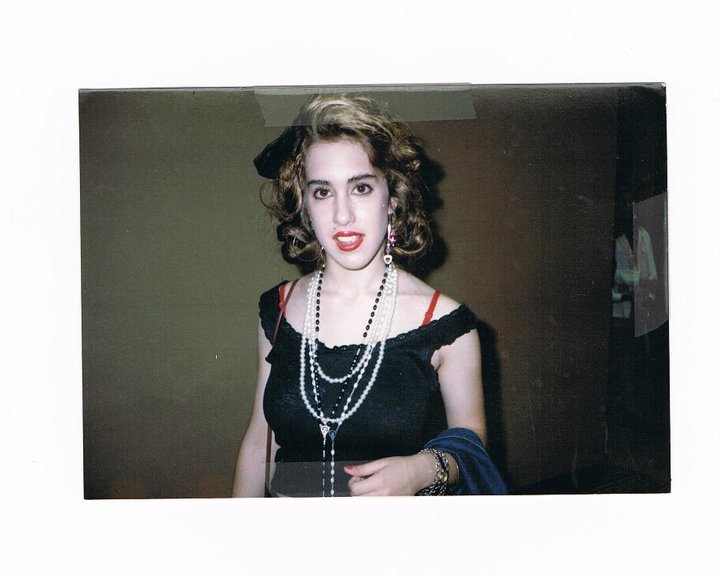
Me as a teen, dressed up as Madonna, when I auditioned for a Pepsi commercial


Recent picture of Madonna I have framed on my desk


"Artists are here to disturb the peace." This James Baldwin quote is the theme behind Madonna's new concert/art film, "Madame X."   Many of the late novelist's quotes are visible behind the musicians and dancers as they perform in "Madame X," and Madonna adds one of her own when she says, "We aren't here to be popular, we're here to be free." 

The first time I heard Madonna's music, I was a teenager growing up in Staten Island, New York, and the song "Physical Attraction" came on my bedroom radio.  I thought "Madonna" was an all-female soul group, but then I saw her on Dick Clark's "American Bandstand" show and was surprised she was one person!  When Clark asked her what she aspired to, she answered, "I want to rule the world." I thought she sounded arrogant, but it turns out she was right.  Shortly after that, I watched her perform "Like a Virgin" live on the MTV Video Music Awards, and her fame just skyrocked.  Suddenly, girls and teenagers wanted to be Madonna and started dressing up like her. I did this too one time when I auditioned for a Pepsi commercial, hence the top photo in this blog.  I didn't get the commercial, but I did make it past the first round, and it was fun to spend the day dressed as Madonna!


I still have my clipping of Madonna in "Time" magazine - May 27, 1985

A couple of years later, I was off to college.  When I met my college bestie, Lauren, we bonded over the surprising discovery that we both chose to go to Berklee College of Music because "'Til Tuesday" singer/songwriter Aimee Mann went there.  By that point, I thought it wasn't cool to like Madonna anymore.  Instead, Aimee Mann was the type of cool punk-pop singer I wanted to be.  Even so, one night, I admitted to Lauren that I "sort of still liked Madonna."  Lauren said there was nothing wrong with that and told me she liked Madonna too!  I felt at that moment, I was never going to grow out of liking Madonna.  In my mind, she was now officially here to stay.

While still at Berklee, I got a job at Tower Records.  One day, I was stocking one of my sections in the back of the Rock/Pop floor when Madonna's "Vogue" video came on a TV that was above my head. It was the first time I had ever seen it, and I was mesmerized at what a celebration of music and art it was! Sometimes, I still get teary-eyed when I hear "Vogue" because it reminds me of that moment I first saw the video, crouching in the middle of the Tower Records floor.  It takes me back to that time period in my life, living on my own for the first time and working to support myself in my own apartment.  Madonna's music has been with me at many stages of my life, and when an artist has been around for so long, each song jogs a different memory.  


I also saved my article of Madonna in NYC's "Daily News Magazine" - June 2, 1985

Earlier this month, in anticipation of "Madame X," I rewatched Madonna's first concert movie, "Truth or Dare," from 1991. When I later watched "Madame X," I noticed a vast difference between today's Madonna and the Madonna of thirty years ago.  The Madonna of "Madame X" is a wiser Madonna.  It is reflected in her music.  "Truth or Dare" is a concert film filled with pop music, and the lyrics are focused on herself. On the "Madame X" album, her lyrics are socially conscious, and the songs incorporate several different styles of music from different parts of the world. Her song "Batuka" was written in the style of Batuque music which is from Cape Verde and is considered one of its oldest music forms.  Batuque music was created by women and was always played by women.  My favorite part of the "Madame X" film is when she performs her song "Batuka" with an all-female band of drummers ranging in ages from teenagers to older women.  Batuque music was banned by the church because drumming was considered "rebel" music, yet somehow it survived and is still played by women today.  As Madonna says in "Madame X," "Women are powerful." 

There is a joke in the "Truth or Dare" movie that backup singer/dancer Niki Haris makes, saying there will be a Madonna "Like a Virgin" tour in 2025.  Now, we are only four years away from 2025, and Madonna is still touring in her early sixties!  Performers like Madonna and The Rolling Stones are sometimes criticized for still rocking out in their later years.  Even more troubling to some is the fact that Madonna is dating a man thirty-six years younger than she is.  This is another thing she has in common with The Rolling Stones, as singer Mick Jagger has been dating much younger women for many years. Maybe Madonna and Mick Jagger date such young people because they need a partner who matches their amazing energy? 

Madonna proves to us every day that older women are meant to be celebrated instead of being put out to pasture.  I love how the "Madame X" movie begins with a montage of Madonna's sexual moments of controversy throughout her entire career, and at the end of the montage, Madonna says that what is actually the most controversial thing about her is that she stuck around.  


Madonna and her boyfriend, Ahlamalik Williams, celebrating her 62nd birthday in Jamaica (usmagazine.com)


Tuesday, May 31, 2016

What If Anais Nin Was A Social Media Queen?


Social media has been good for Anais Nin! Twitter has facilitated a huge surge in her popularity due to her many quotes being tweeted on a nearly daily basis.  But what if social media existed in the 1930's? What if Anais, her lover Henry Miller, and his wife, June, all had the internet and their complex interactions were not recorded in letters but instead in Facebook statuses and Tweets?

The first magazine ever devoted to Anais Nin was called "Under the Sign of Pisces," which she described as "A Cafe In Space" because writers and readers could connect through reading the magazine which was the next best thing to meeting in person as they did in the cafes of Paris. I feel like the internet in general is a cafe in space because it's a place where people can "meet" and talk to each other regularly. But where does it exist? Technically, only in space.

After reading nearly every Anais Nin diary that exists, I'm convinced Anais would LOVE the internet! It would be her thing! But I also believe it would have added to her turbulence during those Miller/June years, because they'd have loved it too, and she would have to keep up with THEIR social media activity in addition to her own!

Henry's wife, June, lived in New York while Henry lived in Paris. Anais found June to be a fascinating person, and whenever June returned to Paris to visit Henry, she'd often spend time alone with Anais. Of course, June didn't know her husband was having a love affair with Anais. Regardless, June was a naturally flirtatious person and soon Anais was under June's spell as well.

Henry's apartment was not far from Anais and her husband Hugo's house at Louveciennes. By the way, Anais' husband, Hugo, would either not have been on social media at all or his involvement would have been very limited because he would have been way too busy with his job at the bank. As Anais said in "Henry and June," the brilliant 1990 indie film which dramatized their relationships: "You are even beginning to SMELL like the bank!" This physical separation between Henry and June would have taken on a different meaning if they had use of the internet. Even more so, the relationship between Anais and June. They would be internet buddies, and I believe their regular internet chats would have kept them in constant contact and made them closer than they ever were in real life. The internet would have ensured that they never lost touch as they did once June and Henry split up.

For Henry, social media would be his playground: thousands upon thousands of scantily clad to naked young women for him to not only look at but also to interact with. As much as Anais tried to accept Henry's life outside her own - not just with June but also in relation to his penchant for frequenting street prostitutes - Henry's social media activity would drive her crazy because it would be right in her face, 24 hours a day, 7 days a week. There'd be no end to her speculation about how many of these women whose Tweets he favorited, whose Facebook statuses he liked, and whom she could see chatting with him publicly would also be involved in his private life behind her back too. I can just imagine the subtweets:


Anais Nin @anaisensorcelled
Tomorrow I shall plunge myself face-down into my make-up palette. Surely, this is the look you prefer since clown faces are the only ones you follow.


As you can see above, Anais' Twitter handle would be "Anaisensorcelled." We all know "ensorcelled" was one of her favorite words and one which she used frequently in her diaries. She also would like the fact that it means "to enchant" or "to bewitch."  She'd be great at the selfie game (the pictures for this entry are what I surmise would be closest to the selfies Anais would take of herself and post. Just imagine one of her arms extended to take the selfie as opposed to hanging down at her side). Since Anais preferred mental connections with the men she was attracted to, she would keep her public account sexy, yet tasteful. She wouldn't post nudes, or near-naked pictures of herself in her bra and underwear. Anais was more of a "sexy-in-private" person. Although an extremely sexual person, she wouldn't have wanted to be DEFINED by her body. She would have identified herself as a writer first and foremost and would want to be treated that way. Having strange men post comments like: "Hey, chicky, I love your hot ass," would grate on her nerves.

While Anais would use social media to promote her writing, the internet would enable June to quit the dance hall forever and to start a lucrative business as a Cam Girl. June would not use her own name on Twitter as Anais did. She would drop her last name, "Miller," because she wouldn't want the men who were paying for her cam girl services to know too much about her. She'd simply be "June" with an xxoo after it for kisses and hugs to make her name look more cutesy and good for business.


                Maria de Medeiros, Fred Ward and Uma Thurman in "Henry and June" film


But on Facebook, June would use her full real name because all of their Facebook accounts would be private, and they'd already personally know all their Facebook friends in real life. All these friends they connected with on Facebook wouldn't know of the affair between Anais and Henry nor would they have known that June was a Cam Girl. Anais would interact very little with Henry but would instead put her friendship with June front and center. Here is the Facebook status for Anais and June, posted the morning after they spent a night out on the town alone together on one of June's visits from New York to Louveciennes:


Feeling: Loved (imagine the happy face with smiling eyes and two hearts above the eyes and one under the face):

"Had a blissful time with June Miller last night!  I learned so much from her even though she thinks I am the teacher!  We talked until midnight!  We talked all about her wonderful husband, Henry, who is SO lucky to have her!  Dinner was amazing -- the Anjou was flowing, and I couldn't have asked for a more perfect evening if I tried!  Thank you, June! And thank you, Henry, for allowing me to "borrow" her!"


So, as I said, Anais would LOVE social media and would embrace it the same way she did all the voluminous letters she wrote to those she loved over the years. But I think it may just have changed the course of history. As I said earlier, I believe she and June would have never lost contact, especially through Facebook. She would never lose touch with Henry either. Because just by logging in, he would always be there.


The tradition of Anais Nin's Literary Journal "A Cafe In Space" is still alive! My essay: "Anais Nin - A Recipe for Immortality" is featured in its newest volume of the magazine, Volume 13, available in both Paperback and Kindle at Amazon.Com:

http://www.amazon.com/Cafe-Space-Anais-Literary-Journal/dp/0988917076/


Monday, February 22, 2016

My Book Review Of Amy Koppelman's Latest Novel "Hesitation Wounds"


A couple of months ago, I spent the afternoon watching a new movie I'd known nothing about which was based on the novel "I Smile Back." Sarah Silverman played the lead role, and her performance, plus the script, completely drew me in.  I instantly became fascinated by the author of the book. This is how I discovered Amy Koppelman! My favorite authors are the ones who write in deceptively simple language about the everyday things we often overlook -- the tea kettle boiling; the wind chimes gently rocking in the breeze, etc. Yet underneath their simple words are the deepest, most potent, emotions few human beings have the guts to bring to the surface, let alone write about. My short list of these writers include diarist Anais Nin and novelist Banana Yoshimoto. They have been my favorites for years. I'm so excited to finally add a third writer to my club, and this is Amy Koppelman. Here is my book review of her latest novel, "Hesitation Wounds."

Hesitation Wounds” is the story of Dr. Susanna Seliger who treats patients with severe depression by administering shock treatment therapy. For many years, she has shuffled through life by keeping herself closed off and ignoring her emotions which is why this work suits her. She doesn't believe in talk therapy and doesn't want her patients to confide in her. She just wants to buzz their feelings out of them. But everything changes when she treats Jim for whom the shock treatments don't seem to work. Talking to Jim takes her out of her shell and, in turn, forces her to face her grief over her brother, Daniel, who died when she and Daniel were both teens. “Hesitation Wounds” is mostly a dialog between Suze and her late brother. Many times, it reads like a letter to him. Throughout the book, Suze recounts moments from their life together. Many memories are pleasant. She recalls the summer when they hung outdoors with their friends, listening to the boom box, lying down and staring into the black city sky:

It's the end of summer now. We are on our backs, arms and legs touching. We gaze at the moon. Margo thinks the moon is hanging especially low. It wants to shake your hand.”

But other times, the details of his tragic and somewhat reckless death creep through.

Her patient, Jim reminds her of Daniel. They both have similar builds and voices. Speaking of Jim elicits constant thoughts of death in her because he is suicidal. Just before he is about to receive another round of electric shock treatments which he has no faith will work, he asks her to tell him a story about what his life will be like six years from now. Koppelman's account through Suze of what a day in the life of a future, happily-adjusted, family man, Jim, will be like is beautiful and cinematic. It truly moved me, and I hope there will be a film version of “Hesitation Wounds” someday to see this passage unfold in pictures.

While most books depict grief by showing the event, having the mourner cry it out, completely traumatized, then describe them on the pathway to healing, Koppleman's portrayal of the grief experience is not like this.  Grieving is not interpreted as overblown and dramatic. It is simple and matter of fact. But it's the facts that people have the most trouble facing. Grief does not get better over time but rather you learn to function better. As Koppelman explains, every day you are reminded of the person you lost through the mundane things around you. She asks: “What would Dan think of cell phones?” This sentence hit home for me because my father died in 1984, and with every new technology that comes out, I'm reminded of him: “What would Dad think of laptops? Social media? The internet?” This is truly what grief is all about: Your thoughts on a daily basis. In Koppelman's stream-of-consciousness dialog to Daniel, she writes:

Things I forgot to ask: I forgot to ask you why you didn't like egg in your fried rice...how it was we began eating potato chips with ketchup, who your favorite Beatle was...”

Hesitation Wounds” reminds us that life is about the little things. Besides grief, it is about depression and the simpler things most of us take for granted but can cause a person suffering from depression to get completely bogged down by. Every movement, interaction and inner thought becomes a feat of near impossibility, leading to exhaustion. Suze's depression is primarily caused by many years of unresolved grief. Here is how Suze has learned to survive her crippling thoughts of grief:

I turn away. Memory is like this for me now. I can turn away from it. I repeat this thought out loud, as if the mere act of saying it, like an incantation, will transform the idea into reality. And because it's true. I can do this now.”

She stops and adds:

Most of the time.”

Because that's how you move forward from grief. You just choose to forget. You don't heal completely, but you learn to live.


To order Amy Koppelman's "Hesitation Wounds" go to 

https://www.goodreads.com/book/show/25622463-hesitation-wounds

http://www.amazon.com/Hesitation-Wounds-Novel-Amy-Koppelman/dp/1468312189/ref=sr_1_1?s=books&ie=UTF8&qid=1456144245&sr=1-1&keywords=amy+koppelman+hesitation+wounds


Sunday, June 1, 2014

"I'm Terrified."


Recently, the author/reader site Goodreads e-mailed me requesting I provide a question for author Michael Cunningham's upcoming interview in their next newsletter. I've read two of his books, "The Hours" and "Specimen Days," and they are among my favorites. "The Hours" was made into a movie with David Hare as screenwriter and Stephen O'Hare as director.

The question request from Goodreads got me thinking about "The Hours" movie which takes place in three different time periods involving three different, yet connected, women. The first plot involves real-life writer Virginia Woolfe and takes place in 1923 while she writes her novel "Mrs. Dalloway." The second plot takes place in 1951 and has Laura Brown reading the novel "Mrs. Dalloway." The third plot's lead character is Clarissa who is living a life similar to Clarissa in the "Mrs. Dalloway" book because she too is getting ready to host a party and she continuously finds herself focusing on mundane matters, like the details of her party, rather than facing her real-life problems. I've always felt that the Laura Brown character, played by Julianne Moore, got the least attention in the public's reception of the movie, yet her character is the one who moved me the most.

Laura Brown is a housewife whose son is always following her around. She finds this difficult to deal with because she is an introvert with a comprehensive interior life. She is an avid reader which makes her comparable to creative artists who usually have a constant running monologue in their minds where they build their own story plots or obsessively mull over an idea they're trying to figure out. Having a child or anyone interrupt this inner monologue can be unbearable at times. People like Laura Brown are often not interacting with the world around them which is hard for those who don't have this steady dialogue in their heads to understand. When they need to be, they are fully focused on the tasks at hand, but as soon as they are able to, they once again become completely disconnected to the world around them. They are focusing on their monologues, and it's painful for them to be pulled out when they're not yet ready to go. So between her son always watching her, and her husband always lavishing attention on her, she often feels the need to escape. Her husband seems to think she is perfect, and the problem with someone thinking everything you do is perfect is that it's unbelievable. No one is perfect.  This impossible perceived standard Laura lives under causes her to feel anxious and often like a failure.

An example of this is when she tries to bake a cake for her husband's birthday.  It comes out completely lopsided, and she is so devastated, she throws it into the garbage. Yet she knows that her husband would have loved it anyway no matter how awful it looked.  She and her son bake him another cake, but by now, she's had it.  She leaves the cake in the kitchen for him and takes her son to a neighbor's, claiming she has a hair appointment. Instead, Laura drives to a hotel planning to read more of Mrs. Dalloway and then to take pills and kill herself.  She feels she is smothering, and she needs to escape so she can just be alone, but she can't go through with it.

Later that night, Laura is in the bathroom talking through the door to her husband who is in the bed.  She mentions her friend's upcoming operation. He talks to her about it from the bed, but he has no idea she is breaking down and crying in there after he hears her say, "I'm terrified." That's the downside to having a rich interior life. You may be able to entertain yourself and be able to escape through reading books, but nobody ever has any idea of the catastrophic storm that goes on inside of you. Laura does wind up leaving her family and living on her own in Canada. I doubt Laura wanted to be this way, and she probably hated herself for it, but she couldn't fight nature.

I did come up with a couple of questions for Michael Cunningham's Goodreads interview, but neither of them had to do with Laura Brown.  If I did have a question about Laura Brown for him, it would be: "Do you think that if Laura Brown had written books instead of reading them, it would have enabled her to find that escape she so desperately yearned for?"


Tuesday, March 5, 2013

"We Saw Your Boobs" (Was Seth MacFarlane's Oscar Song Sexist?)


Last week's Oscars were hosted by "Family Guy" creator, Seth MacFarlane.  I enjoy "Family Guy," and when Seth MacFarlane was featured on an overhead screen singing his controversial song, "We Saw Your Boobs," I thought it was funny. In the song, he rattled off names of actresses and the films they appeared topless in.  He mentioned Halle Berry in "Monster's Ball," Marisa Tomei in "The Wrestler," and Nicole Kidman in "Eyes Wide Shut."

Some of the reviewers claimed that MacFarlane's song was sexist and that he made other sexist remarks during the broadcast.  I can't judge the rest of the show because at 9:00 p.m., I switched to HBO to watch "Girls." Speaking of which, Lena Dunham, the creator/writer/director/lead actress/brilliant person of "Girls" spoke out against MacFarlane's song, saying it didn't help to further the cause of feminism, but then, of course, shortly afterward, she dropped out of the conversation by saying: "Now I've said something murky about women's lib, and will return to eating edamame/thinking about moving to Austin like I always do!" One of the complaints I heard was that many of the movies he mentioned contained rape scenes, however, I've seen all the movies I've named above and those nude scenes were definitely not rape scenes.

These actresses and many current big-name actresses chose to go topless in order to further their movie careers.   Did they expect nobody to ever mention it again once they'd reached their goals? Why? Sarah Jessica Parker refuses to do nudity, but other actresses either feel they have to or realize they'll reach their goals faster if they just do it early on in their careers. Still, other actresses, like Ashley Judd, have claimed they enjoy doing nude scenes. Regardless of whether or not an actress does a nude scene and regardless of the reasons she does them, these actresses are adults, and I refuse to believe that women are children who need protection from their own decisions and that they must be treated with kid gloves just in case we "mention" the fact that they once performed nude scenes onscreen.

At one point during the song, MacFarlane referred to Charlize Theron in "Monster." After he said her name, the camera panned over to note her reaction, and she looked visibly upset. But when the clip was finished, MacFarlane performed a different number, and Theron suddenly appeared onstage dancing to it. Obviously, her stunned reaction was staged, and she was as much in on the joke as he was. Why, then, were women's groups and other actresses who weren't even mentioned in the song speaking out against it, saying that MacFarlane was sexist by performing such a number?

I believe it is because we still live in a "man's" world where it is OK for women to behave in an indecent or slutty manner as long as it is considered an indiscretion, a past mistake, and that now they are sorry.  We can't accept the fact that sometimes women behave opportunistically, that they mean to do the things they do, they'd do them again, and they are not sorry. Apparently, many people believe that if a woman once took off her top during an early film of hers, but now she is famous and doesn't choose to do nude scenes anymore, Seth MacFarlane is not supposed to draw our attention to these movies anymore.  They are now big stars, and he is wrong to bring it out into the open.  MacFarlane did not lie, he didn't reveal things that he found out in a sneaky manner, he didn't commit any crimes, and he didn't even commit slander.  These movies are forever available for rent. You can Google them, and they are included in these actresses' bios.  All he did was sing a song about them.

I think that if reviewers or the general public have a problem with MacFarlane's "Boobs" song, they should ask themselves exactly why it is the song bothers them,  and once they figure out the reason, they should just go back to eating Edamame and maybe considering a move to Austin.