Showing posts with label life. Show all posts

Monday, May 25, 2020

Be Careful What You Wish For


I spent the entire month of January working on a new short story. I edited it and cut it down drastically to adhere to the word count requirements for a submission call.  That meant putting aside the novel I've been writing for the past two years. By February, I knew it was time to get back to the novel, but I always found some reason to procrastinate. I was too exhausted from working all day, or on my days off, I was too agitated from being around people at the grocery store or overly irritated from waiting on a long line at the bank.  I always seemed to need another a break before I had to wake up and do it all over again tomorrow. I told myself: "If I could just have a few weeks home, I could really dive into this novel, make a dent in it, and finish a first draft. I just need a big bulk of time at home." Then, of course, March rolled along, and this wasn't at all what I'd wished for!


I worked my last day in Manhattan on March 16th, and on my walk home from the train station, I realized it would be a long time before I could go into the City again. After reading a few news stories and watching Governor Cuomo's press conferences, I predicted that the earliest I would be back to work was July 1st. This made me sad because I liked being in the City.  I loved eating my lunch in cafes and the hustle and bustle of walking outdoors.  I even enjoyed hurrying around to make the train and ferry connections.  I went to bed feeling awful. But the next morning, I woke up from a dream that I'd met a male stranger (a made-up one I didn't recognize from real life), and in the dream, the chase was so exciting, and I couldn't wait to see how things would unfold.  Then the next night, I had the same dream but with a different mystery man. The third night, same thing, yet another unknown man.  Why was I having pleasant dreams when all the news around me was so tragic, and nearly the entire planet had just been forced into quarantine with terrible fears of this new virus?


Possibly because subconsciously, I was excited about the idea of finally having enough time to do my writing at home. As a natural born introvert, I've always spent most of my time at home.  I crave alone time. I long to write. But even though I was home, the state of the world was tragic and scary, and I found it difficult to concentrate on my novel. I was fortunate enough to be able to earn money from home, and the only thing I feared particularly about being in quarantine was running out of things I needed. Luckily, home deliveries of food and chocolate, non-food essentials and, of course, liquor, kept those fears in check.  So, as long as I stayed home and didn't have to worry about catching the virus, I felt okay.  But many of my friends and people talking about quarantine on TV weren't feeling okay at all. I could understand their continued anxiety and their depression if they were out of work and struggling with money, but many of them were either also working from home or being supported by someone who was.  They just couldn't get used to the idea of being indoors and not being out in the world, but I had adjusted. I tried to figure out why.


My best theory is because as a writer, the joy and satisfaction I feel is not related to being out among other people but rather in challenging myself.  Creative writing is not dependent on crowd interaction.  I think if a person's art is dependent on outside validation and applause, then being quarantined must be extremely difficult.  Another theory is that as an introvert, I gain energy by being indoors whereas extroverts are energized by being outdoors. I believe that my extrovert friends' lack of energy has slowed some of them down into a deep depression.

On a more positive note, judging by what I see on social media and TV, it seems that many people, both artists and non-artists, although somewhat depressed and anxious, are trying to make the best of quarantine by doing things they wouldn't have time for if they were out in the world right now. I'm checking off the same things that they are: I've already made homemade pizza and baked brownies; I've binged new series on Hulu like "Dollface" and "High Fidelity"; I've watched as many indie movies as I can find on Pluto TV; and I regularly watch "Cuomo Prime Time" so I can laugh at the banter between the Cuomo brothers. On weekends, I go for walks in the neighborhood or to the harbor. I've also cut my Shih-Tzu dog's bangs and often hang out with her on the deck when weather permits.

The best part of my quarantine is that I'm finally getting some writing done. I've started a brand new short story and have been working on it nearly every day which is a regularity I could never achieve before the quarantine. I'm entertaining myself and keeping up my writing chops, but I still can't really dive into the novel! I can't make a dent in it, and I haven't gotten close to finishing its first draft. Maybe the key to being comfortable in quarantine is to lower our expectations. I'm not making great progress on the novel, but I have started a new short story that wouldn't exist if I hadn't been put into quarantine.  Overall, the most important thing any of us can do is to try and stay as healthy as possible and do our part to keep others healthy as well.  We won't be indoors forever.  Time always passes much more quickly than we wished it had, and sometimes, we need to be careful of what we wish for.


Friday, December 6, 2019

Play It As It Lays


Me at Spring Lake, NJ

In Joan Didion's 1970 novel, "Play It as It Lays," lead character Maria is slowly losing her mind and unraveling through flashbacks told in very short chapters. According to Google, the term "Play it as it lays" means: "Take what you get, and figure it out, and make the best of it so that you can move forward." I'd never heard the expression before, so after reading it, I came to my own conclusions about what the phrase might mean, and that is: "Take it as it comes, just let each day unfold the way it wants to, and make no plans." Unlike Maria, who recalls several tragic events throughout the novel, my interpretation of the phrase is more suitable to mundane, everyday life.  Letting each day unfold and making no plans is a chill way of living.  I never followed it in my youth. I always planned, and waited, and definitely tried to control things. But these days, I realize how little control I have, so I find myself "taking things as they come" more often than ever before.


Me, Poolside in Canada   

"In Maria's own garden the air smelled of jasmine and the water in the pool was 85°. The water in the pool was always 85° and it was always clean."


Now that I'm older,  I never go to bed early enough. I guess it's because I'm more aware of the passage of time and how quickly it goes. It's like I don't want to miss anything. I stay up until midnight watching "The Twilight Zone" and "Alfred Hitchcock Hour," then have to wake up at 5:30 a.m. for work. I can fall asleep easily but often wake up in the middle of the night and have trouble getting back to sleep. My solution to daytime sleepiness is napping. First, I nap on the ferry on the way to work, then once at home, I nap anywhere I can think of. I used to sleep on the couch a lot, but now that I have my two-year-old Shih-Tzu, I can't because she won't let me. She seems to think it breaks routine,  so she paws at me and at the pillow as if to say: "You are not supposed to be sleeping on the couch!" So I try and sneak a nap on the recliner when she isn't paying attention. In "Play It as It Lays," Maria has trouble sleeping and finds that she can only fall asleep, and stay asleep, outside beside her swimming pool, lying on the lounge chairs along it. I think that in a larger sense, Maria has a feeling of unrest that goes beyond not sleeping. She doesn't feel comfortable anywhere and is unable to relax or let her guard down in order to enter a proper sleep. The act of sleeping outside on a pool chair resonated with me. I hate not being able to sleep, and if I found that sleeping on a chair in my backyard beside a swimming pool was the only way I could get some sleep, I would do it too, just like Maria.


                                                                                      Me and my Shih-Tzu


"Maria was listening to someone talk and every now and then she would hear herself making what she thought was an appropriate response but mostly she was just swaying slightly with the music and wondering where her drink was..."


We all, at times, find our minds wandering off when people talk to us. Often, I'll find myself drifting into different thoughts while someone is telling me a story. But suddenly, I'll see their animated expression or I'll notice a slight pause in conversation, and I'll usually respond with a "Wow" or an "Oh that's crazy." Otherwise, I'll just nod my head in agreement and hope my response was not way off. Maria has lost control in this scene and can't plan her responses as people often do in social situations.  Throughout the book, she is increasingly unable to adopt a persona, and by this point in her life, she is tiring of "the game," and through no other choice, she is only able to be her authentic self. She is real, but it is killing her. Throughout the story, she can only "play it as it lays," just like in this party scene, until she can escape with her drink.  It's exhausting trying to live as your truest self in a world where so many people work hard to perfect their outward personalities and control their responses, and you're over there taking every statement at face value and missing the inside jokes and the hidden innuendos. People don't want to take themselves as they are. Instead, they want to create the kind of person they think they should be. I think it's exhausting on both sides.


"Always when I play back my father's voice, it is with a professional rasp, it goes as it lays, don't do it the hard way.  My father advised me that life itself was a crap game: it was one of two lessons I learned as a child.  The other was that overturning a rock was apt to reveal a rattlesnake."

Me and my Dad. He used to love gambling on the horses.

Maria's dad is the one who advises her to "play it as it lays" at the end of the book. He says life is a crap game. He keeps on investing his money in shaky business deals, and keeps on losing, but he never loses his positivity and optimism. He advises Maria to relinquish control.

My assessment is that life can sometimes make you messed up like Maria:  There are times you only want a drink, and other times, you have insomnia because you are aware of the passage of time and how quickly it all goes.  But you have to realize you can't control these things. You have to learn to "play it as it lays" and do the best you can with what you've got because, really, you have no other choice, and most of the time, that's perfectly OK.


“I am what I am. To look for reasons is beside the point.” 


Joan Didion (brainpickings.org)


Friday, July 12, 2019

Bingeing Bourdain

Photo by John Reardon from article on theguardian.com

Last month, we celebrated "Bourdain Day" to honor Anthony Bourdain - the former chef, writer, and star of the TV shows "No Reservations" and "Parts Unknown." In these two series, he traveled to different parts of the world to have meals with the locals, or sometimes he brought a friend or fellow chef with him to eat in different restaurants. June 25th was chosen as Bourdain Day by his friends and fans because that was his birthday.  Tragically, June is also the month he took his own life last year, however, the motto for Bourdain Day is "Get out and live," and I think that's a better way to remember him.

Last summer, I binge-watched "Parts Unknown," so this summer I decided to binge-watch "No Reservations."  I watch his shows to escape. I'm not traveling this summer so I like to see all the faraway places he goes to. Many are around oceans and have vacation vibes to them. But he also visits poverty-stricken places and never hesitates to sit down for a meal at a family's home and eat the same things they do. I enjoy listening to his monologues during the shows. He explains each place's history and his own feelings about how the meals taste and how the people treat him and each other.

Bourdain was definitely a storyteller. He philosophized about life. I particularly enjoyed the Vietnam episode of "No Reservations" where he spoke about the desire to move there for a year to write his own novel. I think a big part of the allure of his shows for me is that I like people who write. I like and relate to people who can tell stories.

My only criticism about his shows is his obsession with eating meat. He constantly talked about wanting to eat meat, and we'd have to watch him eat meat, and sometimes we even had to sit through watching the locals trap pigs and other animals so they could slaughter them, all while Bourdain observed and told us about it. As a person who doesn't eat land animals at all, I hate these segments.  But actually, for meat-eaters, I think it's essential that they show the entire procedure that goes into eating meat so people can learn. Otherwise, they are just cooking and eating the packages of plastic-wrapped red squiggles that they pick up at the supermarket. Even though Bourdain ate so much meat, at least he saw first hand how the animals were killed rather than how the usual meat-eater just turns a blind eye and doesn't want to think about the fact that it is an animal they are eating as opposed to a cooked red squiggle.  I'm not a vegan (although I wish I were), and I still eat fish. My reasoning is that I can handle watching people catch fish and then cooking them so I'm being realistic about where my food comes from.

In addition to eating tons of meat on these shows, Bourdain also eats fruits, vegetables, noodles, and desserts. Oh, and if you happen to binge-watch his shows, notice how many times he mentions eating "sea urchins." He seems to eat sea urchins in about every other episode!

So this summer, I'm again living vicariously through Bourdain's travels and meals. It's devastating that even though he traveled the world and seemed to have a job he really loved, he still couldn't get over his depression. It got me thinking: Even though I love how much of a realist Bourdain was, maybe too much reality isn't good?  Considering how he left us, it seems it wasn't good for him.  Sometimes we need to turn that blind eye - like the meat-eaters do during dinner - in order to survive.  Escaping is good for us. Or more accurately, it's necessary.

IMDB.Com


With President Barack Obama (Vox.Com)


Monday, July 9, 2018

I'm Celebrating That Summer Feeling! (Oh and more of my writing being published!)


Summer is finally here! It's my favorite season because it's the time of year when I feel the most free. Something about it being hot all the time reminds me of being a kid and playing with my friends in the street when the days seemed like they'd never end. The way I feel freedom these days is through my writing. This summer, I am honored to have three of my short stories included in an upcoming Anthology called "Howls from the Underground" which is being released by an independent publisher called Screamin' Skull Press. I couldn't be more excited! Here are short descriptions of my three short stories:

1. "Beer and Sunlight"

This is the longest short story I have in the Anthology. It takes place in the early 1990's, and it is about the unique friendship and relationship between a young woman and an older man. The illustration at the top of this blog entry is a picture I found in my writing sketchbook from my initial notes of the story.  A short time later, I did a psychological quiz from one of my books where you had to draw the sun, a tree, a house, a river, and a snake. When I drew the house and the sun, I drew the sun shining over the house in the same way I had drawn the sun over the bottle of Heineken beer in this illustration. The quiz said that the house symbolizes yourself and the sun symbolizes your father. I suppose I could have drawn the sun way above the house, as you often see in children's drawings, as a circle having short rays extending around it. But I've never drawn the sun that way. I've always drawn it the way it is here, radiating over the beer bottle. Possibly, the memory of my dad encompasses everything in my life.


2. "We Love to Watch Zee Cockroaches"

This story is about an Austrian woman who uses "Z's" in her speech because she is unable to use the "th" sound we use in English. She has a Spanish boyfriend, and the two of them entertain an American couple in their rather odd apartment. She offers the couple straight vodka in a shot glass with a glass of water on the side and insists that this was never her original idea: “You know, we never drink vodka zis way till we meet you," she tells them. "We never have straight. Wiz ice and juice before.” But the vodka drinking is the least unusual thing about her living situation.


and

"I'm Sexy AF"

This story is my take on Instagram "models" and the general degradation and dumbing down of our society thanks to fads like the Kardashians. Reality TV and filtered photos aren't real. I'm very much looking forward to the day that all of this self aggrandizement goes away.


In addition to "Howls from the Underground," I am working on my fifth novel. I'm looking forward to writing it this summer but have no idea when I'll finish it.  I don't even know if I'll release it independently as I did my first two novels: "Iggy Gorgess" and "Bliss, Bliss, Bliss." I still fantasize that someday I'll publish a blockbuster novel. But right now, I'm content with being an indie writer. Sometimes I wonder if I resist making commercial novels my goal because I don't want to sound like everybody else?  In my mind, the appeal of commercial novels to the majority of people is the same thing as how most people identify with music like the Beatles and Joni Mitchell. Maybe my novels and short stories speak more to the primal parts of ourselves and would resonate better with passionate, wild people who prefer a musician like Brian Wilson during his "Smile" period or every song that Laura Nyro recorded on her own? The best scenario would be to appeal to both sets of people, similar to the way Anne Rice's vampire books are commercial but also literary. But those books are rare. I just hope to someday find an editor who will understand me or an agent who will know exactly where to place me. In the meantime, I'm perfectly satisfied with being labeled as an underground, independent writer, and I just aim to get my writing read by as many people as possible.


The other thing that makes me feel free is swimming in the ocean.  Last summer, I went to Florida but didn't get to swim in the ocean because I went to the beach during a thunderstorm!  This summer, I need to get myself into the ocean so I plan to go to a New Jersey beach or to Coney Island. I'll just pretend I'm in a more exotic locale. Fantasy is another amazing vehicle for feeling free. I love to just imagine and live vicariously through others. I'm going to do this by watching the entire series of "Parts Unknown" by Anthony Bourdain. I literally was JUST getting into his show when he committed suicide. I still don't understand it. How could someone who gets to travel the world, eat the best food, and drink the best liquor -- all while getting paid for it -- not want to live this life anymore? I know from reading articles in the wake of his death that he had been fighting "demons" which nobody else could really understand.  So I just want to honor the legacy he left us. I plan to sit with a glass of wine and a plate of cheese and crackers and celebrate his life, reveling in that feeling of freedom I always strive for during summer.

Wednesday, May 10, 2017

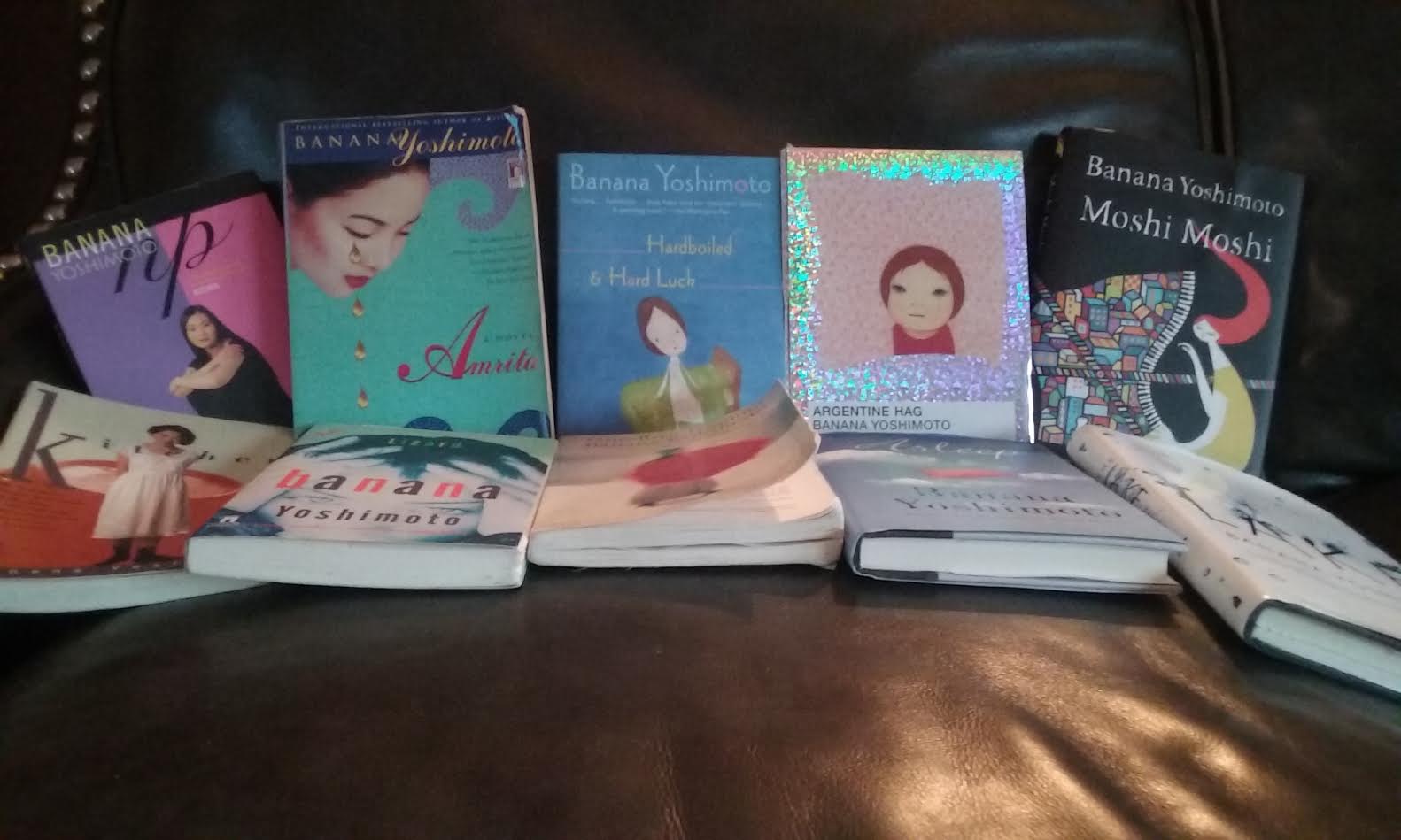
Reading "Moshi Moshi" And Sharing Tea, Grief, Hotels, And Smiles With Banana Yoshimoto


"I nodded and sipped my cocktail. The taste of fresh fruit spread over my tongue.  This was all that being alive meant, really." - From the novel "Moshi Moshi" by Banana Yoshimoto


The first novel I read by Banana Yoshimoto was "Kitchen." It is a short novel about a woman in her twenties dealing with grief. I was also in my twenties at the time, and it hadn't been that many years since I had lost my dad at the age of fifteen. In "Kitchen," lead character, Mikage, has just suffered the loss of her grandmother to whom she had been very close. To deal with her loss, she takes to sleeping on her kitchen floor because the hum of the refrigerator makes her feel less alone. "Kitchen" is what hooked me to Yoshimoto's novels and solidified her as my favorite modern author. Yoshimoto's newest English-translated novel is called "Moshi Moshi," and it continues to display her genius in describing twenty-something women suffering early loss. What is different about Yoshimoto's novels is that although her characters are hurting, each of her novels shows a glimmer of optimism. I haven't come across any other writer who accurately depicts the devastation of dealing with grief while simultaneously describing the protagonist's ability to maintain a positive attitude. Each of her characters finds happiness in the simplest of things. This trait matches Yoshimoto's "deceptively simple" prose, as her writing has often been described. Her language is simple, yet the meanings underlying her novels' themes are deep.


"Moshi Moshi" takes this grief theme full circle from "Kitchen." "Moshi Moshi" is the story of a young woman in her twenties named Yoshe who has just lost her father by carbon monoxide poisoning. Her dad had recently begun a relationship with a bewitching woman without Yoshe and her mom knowing.  This woman wanted to die but needed someone to take along with her, so she coerced Yoshe's dad into a car parked in the forest and poisoned them both.

Yoshe is an only child, just barely a woman, who is living on her own. She is fresh out of culinary school and now has a job helping out in the kitchen of a bistro. Yoshe tries to deal with her grief, and as she is "finally starting to be able to feel the joy in sitting down to a cup of tea or just getting up in the morning," her mom decides she can no longer bear living in the condo the three of them had shared in the town of Meguro. Instead, she wants to move in with Yoshe to the city of Shimokitazawa which has younger residents and many tourists. She tells Yoshe that Shimokitazawa reminds her of the first city she and Yoshe's dad lived in when Yoshe was a baby:

"Back then both your Dad and I were happy, for no particular reason - maybe because we were young, or it was just that kind of age.  We'd shop every day in Yanaka Ginza - we'd get deli food for dinner, savory preserves, roasted rice crackers, and then a cup of tea. If we had time, we'd stop at the traditional dessert parlor and have a beer, or some isobeyaki."

Yoshe realizes that her mom needs this time to heal. Yoshe absorbs herself in her cooking and waitressing work at the bistro and begins dating a customer she meets there named Shintani-Kun. But her grief overwhelms her.  Still, she shows up to work every day at the bistro no matter how badly she feels:

"Even so, come tomorrow morning, I'd be kneading bread dough, boiling water, shredding salad vegetables, mopping the floor. My body would know what to do, and I'd smile and greet customers when they came in."

Pretty soon, Yoshe and Shintani-Kun start going out for drinks after she finishes her workdays at the bistro, and she feels a sense of hope:

"I felt joy. Working at the bistro, Shintani-kun feeling at home there. Seeing my apartment across the street. I knew it wasn't going to last forever - things changed and moved on, and if you thought they could stay the same, they got ruined, like our family had done. Still, I desperately wanted all of this happiness to stay, just the way it was."


My Banana Yoshimoto collection of books on my couch

When your parent dies while you are still in childhood, a part of you remains arrested in that state because the only place you can be with them throughout adulthood is in your memories. I definitely related to the solace Yoshe seeks in her memories that she relays throughout "Moshi Moshi." Yoshe remembers her childhood vacations this way:

"The light from the TV dappling the dark room made me think of family vacations of old. I felt as though I was back in a room in a traditional inn, already asleep, while Mom and Dad watched TV lounging on the mat floor."

I particularly liked this hotel memory because my happiest memories from childhood are the times my mom, dad and brother took family vacations to Disney World or the Poconos, and we had our parents' undivided attention. We explored the parks and swimming pools by day and then shared the same hotel room by night.


Yoshe believes that memories of her dad are etched not only in her heart and mind but also in the places he walked through: "Of course, there were some things that didn't change - the familiar and nostalgic colors and smells, tastes and places in our memories.  But we could no longer relive them as things that were real to our own bodies."

These lines remind me of Walt Whitman's "Leaves of Grass" poems which were a favorite of my dad's. He even wrote his own rock opera in the late 1960's-early 1970's by composing his own versions of Whitman's poems through several original songs, often titled the same as Whitman's poems.  The main theme in "Leaves of Grass" is how we are all connected as entities who live the human experience. This includes all of us now living in the present, those who have lived in the past, and those who will walk this earth in the future. Whitman talks about how all generations have physically walked over the same grounds as each other, and when blades of grass grow, these blades are nourished and grown out from the bodies of our ancestors. There is a connection between past, present and future generations because we walk the same steps over the same parts of earth together. The following line from "Moshi Moshi" reminds me of Whitman and also of my dad:

"I started walking again, and even though I was wearing grown-up shoes on a grown woman's feet, the lightness of my step felt just the same as they had when I'd walked in my favorite childhood sneakers, which Dad had taken me to buy."


My dad and me

As the seasons pass, Yoshe's mom embraces the fact that there are so many young people living in Shimokitazawa, and she seems to be returning to a previous youthful self that Yoshe didn't even know existed.  My mom did that too after my dad died. Suddenly, she started hanging out with friends who were in their twenties, and she listened to pop music on the radio and went out dancing. It makes sense now because she was so young back then: my dad was only forty-one when he died, and my mom just turned forty the next month. I remember one of my mom's friends gave her a birthday card that said: "Life begins at 40," and my mom hung that card up in our kitchen.  But I didn't like that card. I wasn't ready for anyone to have any kind of new life other than the childhood I had grown familiar with.

Yoshi expresses similar thoughts. It appears to her that her mom suddenly doesn't need any help with her grief while Yoshe is still struggling so much. It feels like a blow to her when she finds out her mom has landed a job in a tea shop. Yoshe wants to be happy for her mom but realizes she is initially unable to:

"I'm the one who didn't want Mom to get better, I realized. I was shocked at my own immaturity. I was the one who wanted her to stay at home in my apartment, who wanted to keep my mother to myself.  Now, standing in this shop, she was back in the wider world, among everyone else."

I can relate to those feelings too.  All children believe that even as life changes, and they leave school and move on to work life, at least their family will still remain intact. It was a rude awakening for Yoshe and for me when our lives suddenly changed before we properly reached adulthood.


Yoshe tries to follow her mom's example to move forward, but she is still very vulnerable and not in the proper mindset to enter into a healthy and mature relationship with Shintani-Kun. When she finally allows herself to take the next step in their relationship, she's not really into it: "We're probably going to sleep together now..., but so what? What's it going to change?"

Yoshe's nihilistic attitude is a common example of the depression that often hits young women after a major loss in the family. Your entire world has been turned upside down and everything you thought you believed in as a child has suddenly changed due to that one event. I remember sitting in a movie theater in 1990 watching the film "Sweetie" and relating to one of the lead characters, a woman named Kay. She analyzed everything but felt nothing. She looked for symbolism to try and make sense out of life and find messages in things while performing obsessive rituals. In her case, she was obsessed with trees and cracks in the sidewalk. But her anxiety only increased. I also suffered from obsession, anxiety and a feeling of meaninglessness. Looking back, I see I was still trying to make sense out of life and to heal from my grief. Life is frightening when you have to recover from loss. You long for the security you knew as a child.

At the end of the novel, Yoshe visits the scene in the forest where her father and the woman were found dead in the car. She tells her dad it is alright to let go, and he can be at peace. She realizes that she must now focus on the present. Once you suffer a loss, you always fear it will happen again. It's probably more on your mind than someone who has never experienced a significant loss in their life. But we have to be thankful and mindful of what we have in the present. We don't have to worry every single minute. The people we have in our lives are still here:

"My father was gone now, but my mother was here. I could be with her today, for certain, at least, and hopefully much longer than that. I'm coming home now, Mother - Mother, I'm glad you're here - I'll be coming through the door in a moment."


My mom put this yellow happy face in her car to cheer herself up on cloudy days

While getting ready for the paperback version of "Moshi Moshi" to come out, Banana Yoshimoto lost her own father unexpectedly. For years, people had criticized her for not writing about grief in a realistic way. After all, many of her novels are about losing primary family members, but she had never lost one. I remember after I'd read "Kitchen," I was shocked to learn that she herself had not lost a parent. Yoshimoto says that after she lost her father, she realized that she indeed had been on the right track all those years. She said her own writing in "Moshi Moshi" gave her the answers she now looked for as if she somehow knew what she was going to need to help her heal.


Recently, I posted my Goodreads Review of "Moshi Moshi" and was thrilled when Banana Yoshimoto responded to me and thanked me in English for my "beautiful review!" Previously, she had only communicated to me through emoticons and emojis because she doesn't speak or write in English. But just like how Whitman believed previous generations can communicate with present and future generations through shared experiences, language is not a barrier either. I will forever treasure the time that Banana Yoshimoto sent me this smile:


I'm still dreaming that one day I will take a trip to Japan and meet her in person. Why wouldn't I want to meet my favorite novelist?


Tuesday, November 1, 2016

It's Perfect To Be A Messy Novelist


"I want to be decadent. I want to eat hot dogs and write novels instead of perfect short stories."

I remember writing this in my early twenties. I was a brand new writer, and I desperately wanted to get published. I worked as a volunteer for a literary magazine where my job was to organize the writers and prepare them to read at launch parties the magazine threw when they released each new issue. I'd also offered to emcee the events because I knew the publisher's girlfriend hated doing it. I'd never seen anyone as thrilled as she when she got the news she was off the hook! But even though I was official Emcee and named in the masthead, I couldn't actually get my own stories in the magazine! Each time I submitted, all I got were encouraging words to try again. I was a creative writing student, following advice from my teachers, and couldn't understand what I was doing wrong! Finally, I showed my brother my short stories, and he suggested I try a more traditional literary magazine, as he felt this one was wildly experimental.  I could have searched further, but instead, I decided to take a break from writing short stories and began work on my first novel. The thrill of seeing my own story in a magazine would have to wait.


When I sit down to write a short story, I often wind up writing something similar to a chapter of a novel. This is because I enjoy writing longer works where I can spend more quality time with my characters. I long to explore their needs, desires and growth. My characters' personal progress and evolution over time are what propel my books forward. However, when I write a short story, it is my "idea" that is first and foremost. This is difficult because I have to constantly come up with amazing ideas. Ray Bradbury did this better and more frequently than any other fiction writer. It is beyond me how he wrote so many short stories and came up with so many brilliant ideas. His mind was constantly filled with greatness! But when it came to his most famous novel, "Fahrenheit 451," I wasn't as impressed, and I feel he was better at the short story form.


In short stories, every single word must be carefully chosen to move the story forward. For me, that makes writing short stories feel more like business than fun!  In my literary novels, I can go wild. l can play with words, and I get to hang out with my characters because the length permits me to do so. I can go off on tangents and know that even if these tangents remain in the final edit, readers won't mind because they are in it for the long haul. My former writing teacher said that short stories are expected to be read in one sitting, but novels are read chapter by chapter, night after night. This permits more wandering around since readers expect that they will be putting the book down, then picking it up again, over and over, as opposed to everything being wrapped up neatly at the end of their sitting.

Maybe novels are truer to life than short stories are. Life is messy. Words aren't always perfectly chosen or perfectly executed. It's possible that novelists are more accepting of imperfection than short story writers. This could explain why certain writers prefer one format over the other. I've never expected life to be perfect, or rather, I've learned over the years that it is impossible to be perfect. My house, my writing, my cooking, and all aspects of my life, will never be perfect. I know others disagree with me. They're constantly gritting their teeth, comparing themselves to others who they assume are perfect. It's a disaster if they burn their cooking or have a less than pristine house when guests come over. I'd related to that kind of thinking when I was younger and when I was involved in the writing community, writing short stories that I expected to get published upon completion. But when I got frustrated with my pile of rejection letters that was getting closer and closer to 100, I sat down and expanded my favorite short stories into a novel. A few years later, I did the same thing and wrote another novel. Then years after that, with two independently-published novels under my belt, I began work on my current novel. I don't know why, but I am enjoying the process of writing this novel more than I have any of my others. People ask me, "So are you nearly done? When are you going to publish it?" But I'm not even thinking of that. "Not yet," I tell them. Because right now, I'm having way too much fun.

I've given up hot dogs since my twenties, but I still gel with the idea of being "decadent" and writing novels. I'm not saying I'm unambitious. Of course, I want to get my latest novel published. I'm also working on a couple of short stories (which started out as flash fiction stories but, of course, are now extending into longer pieces of fiction which may branch out into novels one day too), and I do want to submit them and try to get them published. But I feel the main reason to ever write fiction is to enjoy the process and not just what results at the end. Maybe that's the way life should be lived too.


Friday, April 1, 2016

Finally - Dad. (Part 1)


I prefer to remember my dad the way he looked as a young man. The way he looked in the pictures I saw of him taken in the 1950's and 1960's. Not when I knew him when he had that wild, curly, 1970's hair that used to reach the roof of his car even though he was only 5'10." In the 1980's, he lost that 70's hair.  Not because of the cancer treatments he started in 1981 (oddly enough, he never lost his hair like the majority of patients do) but rather because the styles changed, just like the best things in life always do.

After he died in 1984, I took out his college graduation picture and made a conscious effort that any time I thought of him, I'd only think of how he looked in the 1950's and 1960's. Somehow, it made thinking about him less sad.

My father only walked this earth for 41 years, and I only knew him for about one decade of those if you count the years I was an old enough child to have a clear memory of him. A few decades later, he has become an almost mythical figure to me, and I have to rely a lot on what people older than I am can remember, and I'm always anxious to hear stories about him. Luckily, my relatives and his friends are always more than happy to share what they remember of him with me.

One of my favorites comes from my mother's first cousin, Carol. My mom is an only child who grew up in Brooklyn, New York, and every summer to escape the City, she and my grandmother spent the entire summer in Scranton, Pennsylvania, with her my grandmother's sister who is Carol's mom. My grandfather joined them on weekends. When my mom and dad became serious, she brought him along on one of the visits to meet Carol and her sister, Barbara, who were like sisters to her. Carol told me about the first time she "almost" met my dad. She said she went out to her country backyard to meet him where he had climbed a tree and was just sitting at the top it, enjoying the country air. She told me that when she spotted him all the way up there, she thought: "Well, I guess we're not going to be meeting him today."

Even though my father had what many people would consider a short life, he did a lot in those 41 years. He was a Language Arts teacher for 17 years at Prall Intermediate School, I.S.27, on Staten Island, New York, and he was also a singer and songwriter. He enjoyed teaching and often brought in his song lyrics to have his students analyze them as assignments.  One of the projects he had done in the late 1960's or early 1970's was an album based on Walt Whitman's "Leaves of Grass" poetry book. Whitman was considered pretty "out there" for his day so he self-published and paid for "Leaves of Grass'" first edition and even did most of the typesetting. So basically, Whitman joins the ranks of today's indie writers like myself (or on my bad days, I choose to think of it this way). What my father did with Whitman's "Leaves of Grass" is kind of like what Kate Bush did years later when she wanted to use James Joyce's Molly Bloom monologue from his novel, "Ulysses," as lyrics for one of her new songs and wasn't granted permission. Instead, she wrote "The Sensual World"  and just changed the words, writing her own version of the original prose, keeping in line with the feeling of the words, which in the end is all that really matters - what feelings pieces of music bring to its listeners.  

After my father died, I went through every single loose leaf paper he had in his bedroom dresser drawer, and there were tons of them. It took me months to go through them all, but every weekend when my mom and brother were out with their respective friends, my 15 year old self grabbed another pile from his drawer, sat on my living room swivel chair in front of the TV, and read through every single word. When I read the lyrics based on Whitman's work, I hadn't yet read the original "Leaves of Grass" that they came from. As a grieving teen, I don't think I was really ready for it. It wouldn't have impacted me the way it did when I finally picked up the book several years later. When I read through "Leaves of Grass," I was amazed, and I could see what the appeal of the book was for my dad. It is a celebration of life. It was written for people who enjoy sitting at the top of trees all by themselves enjoying nature around them. I imagined my father reading Whitman in college and embracing his days as a young man, enjoying this earth while it was still his.

My father was a well-liked person because he accepted everyone as being the same as him. He felt a connection with others and with nature around him so I can easily understand his identifying with "Leaves of Grass." Below is an excerpt from Walt Whitman's "Song of Myself" which is part of "Leaves of Grass":


“I celebrate myself, and sing myself,

And what I assume you shall assume,
For every atom belonging to me as good belongs to you."


My dad wrote this song version of Whitman's "Song of Myself":


My dad wrote at least 9 songs based on "Leaves of Grass." Once I read the original book, I was happy it moved me as much as it moved him because there was now another reminder I could forever have of him because these reminders keep his memory alive to me on those days when I really miss him. My whole life has been a quest to recapture what I can remember of him. Whitman wrote:


“Failing to fetch me at first, keep encouraged. Missing me one place, search another. I stop somewhere waiting for you.” 


Whitman's "Leaves of Grass" is both a celebration of life and also a celebration of nature. He believed we should enjoy the little things in life and embrace the natural world that was given to us. His words are affirmation that every human being is connected to one another regardless of generation or even century of time.  He believed human life was carried on THROUGH nature because every generation walks the same green earth. He meant this figuratively AND literally, proclaiming that human beings once deceased eventually are "reborn" again through the growth of the grass beneath future generations' feet.  This passage below is simply beautiful and is one of my favorites from "Leaves of Grass": 


"What do you think has become of the young and old men? 

And what do you think has become of the women and children? 

They are alive and well somewhere, 
The smallest sprout shows there is really no death, 
And if ever there was it led forward life, and does not wait at the 
end to arrest it, 
And ceas'd the moment life appear'd. 

All goes onward and outward, nothing collapses, 
And to die is different from what any one supposed, and luckier.” 


That last line brings me comfort. I like to imagine my dad is in a happier place even though he can't be here physically with us. I know that I titled this blog entry "Part 1," and eventually I'll write a Part 2, but I have no idea when. Processing the loss of my dad has taken me a long time. In fact, it was not too long ago that I could finally display his school teacher picture in my house which is the picture I have that looks most like the way he looked during the years I knew him. So like I said, there will be a Part 2 one day. In the meantime, I, and hopefully now you, will celebrate Whitman.


Dad and Grandma in the 1970's

Monday, February 22, 2016

My Book Review Of Amy Koppelman's Latest Novel "Hesitation Wounds"


A couple of months ago, I spent the afternoon watching a new movie I'd known nothing about which was based on the novel "I Smile Back." Sarah Silverman played the lead role, and her performance, plus the script, completely drew me in.  I instantly became fascinated by the author of the book. This is how I discovered Amy Koppelman! My favorite authors are the ones who write in deceptively simple language about the everyday things we often overlook -- the tea kettle boiling; the wind chimes gently rocking in the breeze, etc. Yet underneath their simple words are the deepest, most potent, emotions few human beings have the guts to bring to the surface, let alone write about. My short list of these writers include diarist Anais Nin and novelist Banana Yoshimoto. They have been my favorites for years. I'm so excited to finally add a third writer to my club, and this is Amy Koppelman. Here is my book review of her latest novel, "Hesitation Wounds."

Hesitation Wounds” is the story of Dr. Susanna Seliger who treats patients with severe depression by administering shock treatment therapy. For many years, she has shuffled through life by keeping herself closed off and ignoring her emotions which is why this work suits her. She doesn't believe in talk therapy and doesn't want her patients to confide in her. She just wants to buzz their feelings out of them. But everything changes when she treats Jim for whom the shock treatments don't seem to work. Talking to Jim takes her out of her shell and, in turn, forces her to face her grief over her brother, Daniel, who died when she and Daniel were both teens. “Hesitation Wounds” is mostly a dialog between Suze and her late brother. Many times, it reads like a letter to him. Throughout the book, Suze recounts moments from their life together. Many memories are pleasant. She recalls the summer when they hung outdoors with their friends, listening to the boom box, lying down and staring into the black city sky:

It's the end of summer now. We are on our backs, arms and legs touching. We gaze at the moon. Margo thinks the moon is hanging especially low. It wants to shake your hand.”

But other times, the details of his tragic and somewhat reckless death creep through.

Her patient, Jim reminds her of Daniel. They both have similar builds and voices. Speaking of Jim elicits constant thoughts of death in her because he is suicidal. Just before he is about to receive another round of electric shock treatments which he has no faith will work, he asks her to tell him a story about what his life will be like six years from now. Koppelman's account through Suze of what a day in the life of a future, happily-adjusted, family man, Jim, will be like is beautiful and cinematic. It truly moved me, and I hope there will be a film version of “Hesitation Wounds” someday to see this passage unfold in pictures.

While most books depict grief by showing the event, having the mourner cry it out, completely traumatized, then describe them on the pathway to healing, Koppleman's portrayal of the grief experience is not like this.  Grieving is not interpreted as overblown and dramatic. It is simple and matter of fact. But it's the facts that people have the most trouble facing. Grief does not get better over time but rather you learn to function better. As Koppelman explains, every day you are reminded of the person you lost through the mundane things around you. She asks: “What would Dan think of cell phones?” This sentence hit home for me because my father died in 1984, and with every new technology that comes out, I'm reminded of him: “What would Dad think of laptops? Social media? The internet?” This is truly what grief is all about: Your thoughts on a daily basis. In Koppelman's stream-of-consciousness dialog to Daniel, she writes:

Things I forgot to ask: I forgot to ask you why you didn't like egg in your fried rice...how it was we began eating potato chips with ketchup, who your favorite Beatle was...”

Hesitation Wounds” reminds us that life is about the little things. Besides grief, it is about depression and the simpler things most of us take for granted but can cause a person suffering from depression to get completely bogged down by. Every movement, interaction and inner thought becomes a feat of near impossibility, leading to exhaustion. Suze's depression is primarily caused by many years of unresolved grief. Here is how Suze has learned to survive her crippling thoughts of grief:

I turn away. Memory is like this for me now. I can turn away from it. I repeat this thought out loud, as if the mere act of saying it, like an incantation, will transform the idea into reality. And because it's true. I can do this now.”

She stops and adds:

Most of the time.”

Because that's how you move forward from grief. You just choose to forget. You don't heal completely, but you learn to live.


To order Amy Koppelman's "Hesitation Wounds" go to 

https://www.goodreads.com/book/show/25622463-hesitation-wounds

http://www.amazon.com/Hesitation-Wounds-Novel-Amy-Koppelman/dp/1468312189/ref=sr_1_1?s=books&ie=UTF8&qid=1456144245&sr=1-1&keywords=amy+koppelman+hesitation+wounds


Sunday, November 9, 2014

We All Think We're Marilyn Monroe


Everyone hopes to be remembered after they die. The first famous person I was aware of who had died but was still being talked about years later is Marilyn Monroe. My dad was obsessed with her, so I knew who she was pretty much from birth. We had a large mirror of her face in my parents' bedroom, and I remember playing with a small, plastic, inflatable pillow that said "Some Like It Hot" in the backseat of my dad's car.  My parents' bedroom was strewn with books about her mysterious death (my dad believed she was murdered because she threatened to tell of her affair with Robert Kennedy which would have ruined his political career). He wore a silver Marilyn Monroe belt buckle and had a black T-shirt with a gold iron-on of her face. He said she died when she was 36, and I said that was old, but he assured me that was indeed very young.

Marilyn Monroe left a legacy of her many films, and her image is still seen on virtually everything from shower curtains to cell phone cases to clocks -- 52 years after her death! Even in her wildest dreams, I don't think Marilyn ever imagined people would still be looking at her pictures and talking about her so many years after she died. Although she was famous, she only lived to 36, and she probably was too busy living to spend much time thinking about what her legacy might someday be. But it seems like nowadays, everyone I know who is 36, and even younger, can't stop planning for the end of their lives. Some have jobs that promise a pension once they reach their retirement ages, and they spend their lives in seeming anticipation: Each day, they get up for work and count the days until Friday. Then they count the weeks until the next month because those months will lead to their two-week vacations, and from there, they count the years leading to when they know they can retire and collect their pensions.

After that, since most people aren't legendary film actresses like Marilyn Monroe, they live out their last years wondering what their legacy might be and who will remember them. This is probably why grandparents like to tell their grandchildren their millions of stories so they feel a piece of them will remain alive as each generation retells these stories.  Marilyn Monroe never had any children, but she had her films to live on after her. The rest of us live through our own children and younger family members who keep our memories alive.  High schools keep yearbooks forever, and whole towns remember who came before them: who ran the shops, who lived in which houses, and so on.  It's important to us that people still talk about us after we're gone.

But maybe it's better to stop all this planning and just enjoy today? Waiting for it, and planning for it, and expecting to be remembered, seems a bit self-important.  True, most people will be remembered. But I can't help thinking about all those news stories about earthquakes or other natural disasters hitting somewhere far away from us, wiping out entire towns and its inhabitants in a matter of minutes.  Are these people any less important than we are?