Showing posts with label poetry. Show all posts

Monday, July 25, 2022

The Poem I Wrote As A Love Letter To My Vocal Cords


My Dad singing with his cover band "Beach Road" in the 1970's

In April 2016, I wrote a blog entry entitled, "Finally - Dad. (Part 1)."  I said that it was very difficult to write about my dad who died when I was fifteen but that eventually I would write more entries about him.  So here we are, six years later, with Part 2. In Part 1, I wrote about my dad's love of Walt Whitman's poetry and said that he wrote his own version of Whitman's collection of poems, "Leaves of Grass,"  by changing the words and setting the poems to music. Here in Part 2, I would like to share a poem that I wrote years ago, "Lifedream," and the story behind it. 

Even though my dad was a talented songwriter, his true love was singing.  His favorite singer was Teddy Pendergrass whose albums he often played at family gatherings, exclaiming, "Listen how Teddy sings this note! Nobody can sing like Teddy!" This prompted teasing from my aunt who told him, "You talk about him like he's your friend! 'Hey Teddy, let's go outside and play ball!'" My dad loved Pendergrass, but he judged other singers very harshly, and I could never understand why.  They all sounded good to me, and I figured that since they were on TV, they had to be good!  I never had the courage to actually sing in front of my dad.  Instead, I blared albums on my record player and sang along with my favorite singers at the time, Donna Summer and Diana Ross, behind the closed door of my bedroom.  I'll never forget the thrill I had on a car ride with my mom on the way to applepicking when she mentioned that my dad told her he had heard me singing in my room, and if I studied, I had the potential of becoming a really good singer.  My dad didn't throw singing compliments around lightly, so the joy I felt at that moment was monumental.  I immediately enrolled in singing lessons and continued them even after he died.  I knew singing was the closest I could be to him, and it was a way to make him proud of me. When I turned eighteen, I moved to Boston to study singing and songwriting at Berklee College of Music. I needed to know what truly made a singer good or bad.  Otherwise, I feared I'd become one of those singers that my dad would have hated!

College life and living in the dorms were not kind to my voice.  The stuffiness of the dorm rooms exacerbated my allergies, and the beer drinking and late nights roaming the halls screaming and being silly made my voice hoarse.  At one point, I was limited to a three-note range.  My voice teacher recommended an ear, nose and throat specialist to examine my vocal cords.  The diagnosis wasn't good. I had the beginnings of vocal nodules, simply called "nodes," which are benign growths on the vocal cords that develop when people abuse their voices.  The struggle to heal my voice was difficult and depressing. I stopped drinking beer and staying up late.  I stopped singing and screaming in the hallways.   But I kept on writing.  The following poem, "Lifedream," is a metaphorical poem I wrote to my vocal cords, expressing my sadness and disappointment and my fear that my voice would never come back:


"Lifedream"

I will shelter you like a thin sheet of ice./Put you in a tiny box./Preserve you till I'm ready.  

No, I'd never give you up./Never give up skating.

But you and I don't think alike./Never meant to hurt you./And up until the end of time,/I'll never give up skating. 

But maybe I can't save the ice./My body crushed and crumbling through./If I can't live my life on ice,/I'll never love you true.

I will shelter you and hold you tight./Together we will move.

If I fall through this sheet of ice,/My life's dream I will lose.


Slowly, my vocal range came back.  In fact, my voice teacher told me she had never seen anyone overcome vocal damage to the extent that I was able to with no outside medical treatment. But I still felt I would never be able to sing as well as my dad would have wanted me to.  Anytime I had a late night or was run down, my sensitivity to hoarseness acted up.  My voice teacher also told me that my speaking voice was harsh and very different from my singing voice.  She said you must speak the same way that you sing but that trying to speak in a way that wasn't natural to me might change my personality. I didn't want to do that, and eventually, I just decided that if I couldn't sing as well as my dad, there was no use in singing at all.  It all turned out okay though because I'm happy now writing novels.  Plus, it's been beautiful to rediscover my poem and to remember those days when singing was so meaningful to me.


Monday, March 29, 2021

My Unintentional Evolution To Unique Artist


Me at the Walt Whitman Exhibit at New York Public Library, NYC 


When I was in elementary school at P.S. 53, either third or fourth grade, my teacher asked us to analyze the Harry Chapin song, "Flowers are Red."  These were the days before the Internet, and I didn't even ask my parents to help.  Actually, I thought I would have no problem figuring out the meaning of this simple song, so I just read it and analyzed it the way I was sure Chapin meant it.  I forget exactly what I wrote, but I said that the color red symbolizes something, and the color green symbolizes something else, etc.  After the assignments were graded, our teacher presented two essays to the class.  One essay was the correct interpretation of the song, and the other was the one that she said she wanted to show us because it was so creative and unique.  Mine was the creative essay, and I was embarrassed when the teacher read it to the class because I felt like a failure.  I wish I still had that essay today, but I threw it away after class because I didn't want to remember that feeling of not being able to comprehend the assignment the way everyone else was able to.  

At 18, I was a songwriting student at Berklee College of Music, and I resisted following the advice of my teachers who taught us formulas to use while writing. I had already studied piano since I was 6, so I just took to the keys and composed my own way.   At the time, I thought my songs were great.  In total, I have written nearly 100 songs and recorded at least half of these, all between the ages of 16 and 21.  However, years later, when I listened to a CD of several of them, I noticed how similar many of them sound to each other.  Although I utilized different key signatures, I often used the same chord progressions. Still, I think they are catchy. They are sometimes melodic, sometimes dissonant, and they don't sound like anybody else's. I like my art to be unique.  My songs sound like me: upbeat with singing that is slightly off-key. During that same period, I worked at Tower Records in Boston.  One day, a coworker of mine told me about the rock band he just joined, and as he explained their typical "rock band of the moment" style to me, I had a revelation.  Why even bother putting in the work with the band when they weren't creating anything new?  It made no sense to me to make the effort when his band was just going to sound like everybody else's.

In my early twenties, I shifted from writing songs to writing stories because I felt confined by the songwriting format.  I believed the music was more important than the lyrics in songwriting so I focused more on the music, and that made the words of my songs take a backseat.  In turn,  I felt a need to express more and more of my thoughts, but I didn't want wordy songs. My other dilemma was that I couldn't stop rhyming!  The same problem happened in my Women's Writer's Workshop when I wrote rhyming poetry.  My teacher told me people aren't rhyming that much anymore.  Walt Whitman had the opposite problem in his day as the first non-rhyming poet.  He got rejected by publishers and had to publish "Leaves of Grass," his masterpiece, on his own.  That's also what writers who wanted to do something different did in the past: writers like Virginia Woolf and Anais Nin.  Writers still do it today which brings me to mention the independent publishing company, New Pop Lit, run by the very unique and talented writer and publisher, Karl Wenclas.  

New Pop Lit is doing what I've always strived to do which is to create and publish a new type of writing.  Why not invent something new? They keep it clear and relatable.  They don't just mimic what everyone else is doing.  Just like how the MFA creative writing programs grind out identical writers, Berklee can grind out identical songwriters which wasn't the songwriter I wanted to be.  I am proud to have my writing featured in two of New Pop Lit's zeens: "Zeenith" and "Literary Fan Magazine." New Pop Lit's zeens redefine the Literary Journal.  They are "technicolor literary journals" and feature really cool artwork as prominently as their stories, articles, novel excerpts, and poetry. They make literary journals fun to read. They bring uniqueness back to the writing business.  Because what is the point of spending all this time writing if you're just going to sound like everybody else?


You can find unique, original and talented writers and artists featured at NewPopLit.Com and purchase their zeens at NewPopLit.Com/Shop/.


Friday, April 1, 2016

Finally - Dad. (Part 1)


I prefer to remember my dad the way he looked as a young man. The way he looked in the pictures I saw of him taken in the 1950's and 1960's. Not when I knew him when he had that wild, curly, 1970's hair that used to reach the roof of his car even though he was only 5'10." In the 1980's, he lost that 70's hair.  Not because of the cancer treatments he started in 1981 (oddly enough, he never lost his hair like the majority of patients do) but rather because the styles changed, just like the best things in life always do.

After he died in 1984, I took out his college graduation picture and made a conscious effort that any time I thought of him, I'd only think of how he looked in the 1950's and 1960's. Somehow, it made thinking about him less sad.

My father only walked this earth for 41 years, and I only knew him for about one decade of those if you count the years I was an old enough child to have a clear memory of him. A few decades later, he has become an almost mythical figure to me, and I have to rely a lot on what people older than I am can remember, and I'm always anxious to hear stories about him. Luckily, my relatives and his friends are always more than happy to share what they remember of him with me.

One of my favorites comes from my mother's first cousin, Carol. My mom is an only child who grew up in Brooklyn, New York, and every summer to escape the City, she and my grandmother spent the entire summer in Scranton, Pennsylvania, with her my grandmother's sister who is Carol's mom. My grandfather joined them on weekends. When my mom and dad became serious, she brought him along on one of the visits to meet Carol and her sister, Barbara, who were like sisters to her. Carol told me about the first time she "almost" met my dad. She said she went out to her country backyard to meet him where he had climbed a tree and was just sitting at the top it, enjoying the country air. She told me that when she spotted him all the way up there, she thought: "Well, I guess we're not going to be meeting him today."

Even though my father had what many people would consider a short life, he did a lot in those 41 years. He was a Language Arts teacher for 17 years at Prall Intermediate School, I.S.27, on Staten Island, New York, and he was also a singer and songwriter. He enjoyed teaching and often brought in his song lyrics to have his students analyze them as assignments.  One of the projects he had done in the late 1960's or early 1970's was an album based on Walt Whitman's "Leaves of Grass" poetry book. Whitman was considered pretty "out there" for his day so he self-published and paid for "Leaves of Grass'" first edition and even did most of the typesetting. So basically, Whitman joins the ranks of today's indie writers like myself (or on my bad days, I choose to think of it this way). What my father did with Whitman's "Leaves of Grass" is kind of like what Kate Bush did years later when she wanted to use James Joyce's Molly Bloom monologue from his novel, "Ulysses," as lyrics for one of her new songs and wasn't granted permission. Instead, she wrote "The Sensual World"  and just changed the words, writing her own version of the original prose, keeping in line with the feeling of the words, which in the end is all that really matters - what feelings pieces of music bring to its listeners.  

After my father died, I went through every single loose leaf paper he had in his bedroom dresser drawer, and there were tons of them. It took me months to go through them all, but every weekend when my mom and brother were out with their respective friends, my 15 year old self grabbed another pile from his drawer, sat on my living room swivel chair in front of the TV, and read through every single word. When I read the lyrics based on Whitman's work, I hadn't yet read the original "Leaves of Grass" that they came from. As a grieving teen, I don't think I was really ready for it. It wouldn't have impacted me the way it did when I finally picked up the book several years later. When I read through "Leaves of Grass," I was amazed, and I could see what the appeal of the book was for my dad. It is a celebration of life. It was written for people who enjoy sitting at the top of trees all by themselves enjoying nature around them. I imagined my father reading Whitman in college and embracing his days as a young man, enjoying this earth while it was still his.

My father was a well-liked person because he accepted everyone as being the same as him. He felt a connection with others and with nature around him so I can easily understand his identifying with "Leaves of Grass." Below is an excerpt from Walt Whitman's "Song of Myself" which is part of "Leaves of Grass":


“I celebrate myself, and sing myself,

And what I assume you shall assume,
For every atom belonging to me as good belongs to you."


My dad wrote this song version of Whitman's "Song of Myself":


My dad wrote at least 9 songs based on "Leaves of Grass." Once I read the original book, I was happy it moved me as much as it moved him because there was now another reminder I could forever have of him because these reminders keep his memory alive to me on those days when I really miss him. My whole life has been a quest to recapture what I can remember of him. Whitman wrote:


“Failing to fetch me at first, keep encouraged. Missing me one place, search another. I stop somewhere waiting for you.” 


Whitman's "Leaves of Grass" is both a celebration of life and also a celebration of nature. He believed we should enjoy the little things in life and embrace the natural world that was given to us. His words are affirmation that every human being is connected to one another regardless of generation or even century of time.  He believed human life was carried on THROUGH nature because every generation walks the same green earth. He meant this figuratively AND literally, proclaiming that human beings once deceased eventually are "reborn" again through the growth of the grass beneath future generations' feet.  This passage below is simply beautiful and is one of my favorites from "Leaves of Grass": 


"What do you think has become of the young and old men? 

And what do you think has become of the women and children? 

They are alive and well somewhere, 
The smallest sprout shows there is really no death, 
And if ever there was it led forward life, and does not wait at the 
end to arrest it, 
And ceas'd the moment life appear'd. 

All goes onward and outward, nothing collapses, 
And to die is different from what any one supposed, and luckier.” 


That last line brings me comfort. I like to imagine my dad is in a happier place even though he can't be here physically with us. I know that I titled this blog entry "Part 1," and eventually I'll write a Part 2, but I have no idea when. Processing the loss of my dad has taken me a long time. In fact, it was not too long ago that I could finally display his school teacher picture in my house which is the picture I have that looks most like the way he looked during the years I knew him. So like I said, there will be a Part 2 one day. In the meantime, I, and hopefully now you, will celebrate Whitman.


Dad and Grandma in the 1970's

Tuesday, March 25, 2014

Loving Dorothy Parker And Learning Not To Give A Damn


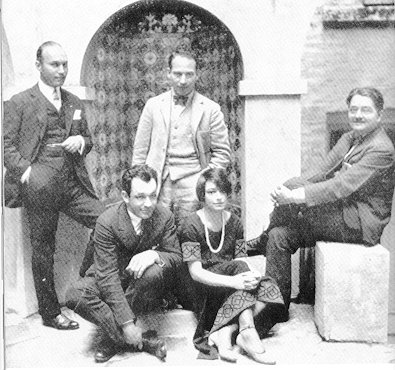
This black and white picture of Dorothy Parker with the pencil in her mouth was pasted to my computer at work for many years. Its caption read: "Dorothy Parker, Master of the Bon Mot." It's true that Dorothy Parker is best known for her witty remarks, both in her personal life and in her book and theater reviews, but she was also a poet and literary writer. Her short story, "Big Blonde," is one of the best short stories I've ever read, and I feel she has been undervalued as a fiction writer. She hung out with mostly men which included fellow writer/critic, Robert Benchley, one of Dorothy's closest friends.  They called themselves members of the "Algonquin Roundtable," a group of writers, critics and actors who got together for lunch every day at the Algonquin Hotel in New York City during the 1920's. Dorothy always held her own while she and these men tried to outdo each other by coming up with the most clever and witty wordplay.  One of Dorothy's most famous on-the-spot witticisms occurred when someone challenged her to use "horticulture" in a sentence. She immediately replied: "You can lead a horticulture but you can't make her think." It was a play on the expression: "You can lead a horse to water but you can't make it drink." In this case, it was leading a whore to culture. Very clever! She was always up for a challenge and never let the men at the Roundtable intimidate her.

But there was one area of Dorothy's life where she didn't always show confidence and that was when dealing with the men she was in love with. A recurring theme of her poetry was her tortured feelings towards these men. Whether it is a new love or a love of many years, men always lead the women who love them into hours of agonizing reflection. Many of these heart-wrenching poems were recited by Jennifer Jason Leigh who brilliantly portrayed Dorothy Parker in the 1990's film "Mrs. Parker and the Vicious Circle." One of the best poems recited in the movie, entitled "Two Volume Novel," was connected to an affair she had with Charles MacArthur played by Matthew Broderick. It broke my heart when he broke her heart: "The sun's gone dim/and The moon's turned black/For I loved him/and He didn't love back." Her relationships often led her into depression and desperation, but she always found a way to turn things around and laugh about them. One of my favorite poems of hers is a famous one called "Resume": "Razors pain you/Rivers are damp/Acids stain you/And drugs cause cramps/Guns aren't lawful/Nooses give/Gas smells awful/You might as well live."


Another thing I love about Dorothy Parker is that she always had dogs in her life. I have a soft spot for dogs and had my own dog, Taffy, for 17 years.  Towards the end of her life, Taffy had Alzheimer's. Yes, dogs can get that too. They run around in circles and cry out at night because they can't remember where they are. I used to sleep with earplugs to escape the howls. I kept her alive for two more years than I really should have because I couldn't bear to lose her. I don't deal with loss very well. Especially when I feel connected to something or someone. Of course you don't want to lose that. How many times in our lives do we really feel a strong connection? Still, I'm waiting to get a dog again. I know I will someday, but not now. Dorothy always had several dogs in her lives. Seems that when she lost one, she immediately replaced it with another, always moving on and looking ahead.

The first night I saw "Mrs. Parker and the Vicious Circle" on TV, I fell asleep because I was watching it in bed with my then-healthy dog. I woke up and saw Dorothy crying by herself. I didn't know what she was crying about, but I imagined she was crying about life and how sad it is. I grabbed my dog and thought about the dog I had growing up, my Cairn Terrier, and how it would be great to go back to being a child again. I always say that the best year of my life was when I was 9 years old. My dad was still alive, and he doted on me.  I got good grades in school, had a lot of friends, and was "going out" with the most popular boy in our class. Nothing compares to the innocence of that time. That was all I really knew and that was all that mattered. But Dorothy wasn't crying about life. She was crying over her best friend, Mr. Benchley's, death. Of course she wasn't crying over something abstract. She had a real reason.

Dorothy wasn't the type to just cry about life. She was tough, and she taught us to lift up our heads and get over it. Kind of like that Elizabeth Taylor quote: "Pour yourself a drink, put on some lipstick, and pull yourself together." That could have been said by Dorothy herself, although Dorothy would have stuck something ironic at the end of it. Trying not to become paralyzed by hypersensitivity is something I struggle with, but when I read Dorothy's poems and think about her courage, I make a conscious effort to just not give a damn:

If I don't drive around the park, I'm pretty sure to make my mark.
If I'm in bed each night by ten, I may get back my looks again.
If I abstain from fun and such,
I'll probably amount to much.
But I shall stay the way I am,
Because I do not give a damn.


Thanks, Dorothy.