Showing posts with label literary journal. Show all posts

Monday, November 11, 2024

Gimme Some Of That DIY, Feel-Good Writing!


The first time I saw a zine was in the late 1980's at Tower Records Bookstore in New York City. It was made of simple, white printer paper by a fan of Kate Bush. It had black and white pictures of Kate that were photocopied and stapled into the magazine. Although not as popular as they once were, DIY zines are still around, and this summer, I stumbled upon a bunch of them at the East Village Zine Fair on St. Mark's Place in NYC. As I checked out the many tables, my eyes caught sight of a particular table run by Quimby's Bookstore in Brooklyn. It had DIY zines that were reminiscent of the zines I used to love to buy so many years ago. Among the teeny-tiny mini zines, I saw a bunch of regular-sized zines by an artist named Jolie Ruin who I recognized because she sells artwork on Etsy. I even had one of her art collages in my Etsy favorites which was a small, art canvas decorated with colorful beads and a quote from a Juliana Hatfield song. I didn't even know she was a zinester and that she published Riot Grrrl-inspired zines!

The simplicity of zines reminds me of my Berklee College of Music days when we all made homemade cassette tapes of our original songs and played them for each other. Sometimes, someone would comment that the recordings of the vocals and instruments should be more slickly produced. I often disagreed. I'd say I rather listen to a guy strumming a guitar and singing lyrics that moved me than a demo of overproduced songs that say nothing and provide nothing original. The passion of three-chord grunge songs of the early 1990's touched so many people, and even today, as soon as you hear the first chords of a Nirvana song, you immediately know it's them.  
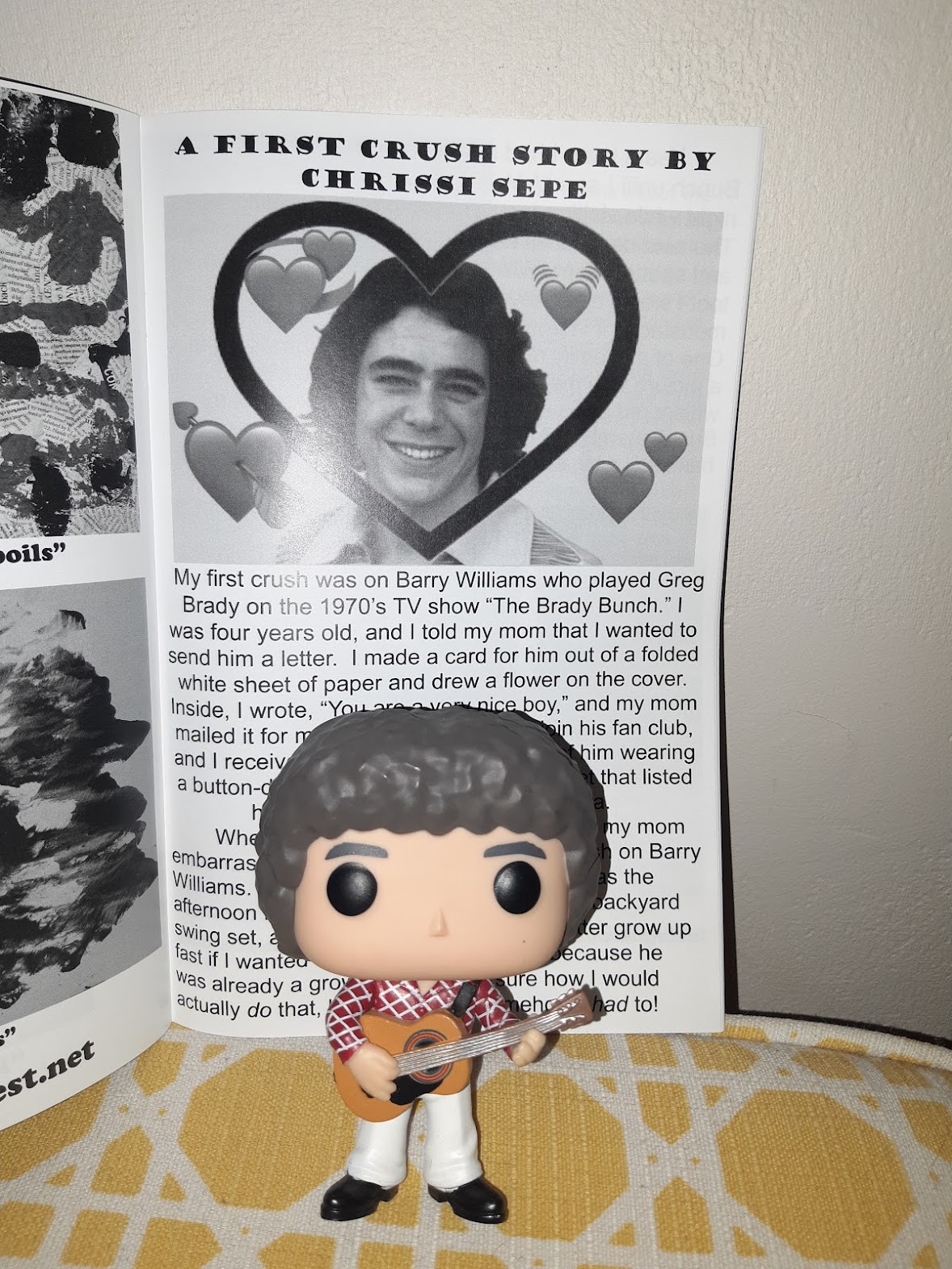

The SlutCake zines include not only Jolie Ruin's writing and art but also from a variety of contributors.  My story about my childhood crush on Barry Williams (Greg Brady of the TV show "The Brady Bunch"), and how I met him years later as an adult, is featured in SlutCake #18 - the Love and Crushes Issue

I've grown tired of reading traditional literary journals because so often the stories have shock value themes and an unusual number of tragic endings. I remember one short story - a contest winner -  entitled, "Ice Cream for Breakfast." The title made it sound like it was a pleasant, let's throw caution to the wind, story but instead it was about the mom regretting she hadn't permitted her little boy to have ice cream for breakfast because she was too busy searching for a cure while he was dying of a disease. What this story did for me was made me never want to read a story like that ever again. I believe that we readers can be inspired by stories with everyday, relatable, topics and don't need to have our worlds annihilated in order to be moved by a piece of writing! 

The "Jolie Ruin" zine section at Quimby's Bookstore in Brooklyn, NYC

Discovering Jolie Ruin's zines and art collages have added new excitement to my writing life. When my first order of zines from Etsy came in, I spent one Saturday afternoon on my bed drinking tea and reading Jolie's "The Escapist Artist" zines from cover to cover. I was intrigued by her journal entries from the early 2000's printed in the zines. She told honest, entertaining, and personal stories from when she was in her early twenties, and they took me back to my own early twenties and to those moments when I too saw indie bands perform at rock clubs and had those same feelings of excitement while watching live music and drinking beer with people my own age. 

This "mini" zine by Jolie Ruin contains raw and honest stories straight from her journal entries of 2005


I bought this issue of The Escapist Artist from Jolie Ruin's Etsy Shop, and she mailed it to me along with a bonus sticker and mini business card


Jolie's Riot Grrrl Press company that she runs with her husband Jamie makes T-shirts with quotes and designs that are clever and funny. After ordering the "Make Zines Not War" T-shirt, I answered the call for models to appear in the upcoming Delia*s-inspired Riot Grrrl Press T-Shirt Catalog!


Zinesters contribute more to pop culture than just printed stories. Jolie Ruin creates DIY art, patches, stickers, and even spoken word cassettes and music. I'd suggest giving zines a try even if you primarily read traditional literature. There's enough in the writing market for every taste and style, so like my t-shirt says: "Make Zines, Not War!" 


My very own Art Collage handmade by Jolie Ruin that I bought from her Ebay store. Some of Jolie Ruin's art collages are featured in the Netflix movie "Moxie!" 

https://www.ebay.com/usr/jolieruin

https://www.etsy.com/shop/JolieRuin


Monday, March 29, 2021

My Unintentional Evolution To Unique Artist


Me at the Walt Whitman Exhibit at New York Public Library, NYC 


When I was in elementary school at P.S. 53, either third or fourth grade, my teacher asked us to analyze the Harry Chapin song, "Flowers are Red."  These were the days before the Internet, and I didn't even ask my parents to help.  Actually, I thought I would have no problem figuring out the meaning of this simple song, so I just read it and analyzed it the way I was sure Chapin meant it.  I forget exactly what I wrote, but I said that the color red symbolizes something, and the color green symbolizes something else, etc.  After the assignments were graded, our teacher presented two essays to the class.  One essay was the correct interpretation of the song, and the other was the one that she said she wanted to show us because it was so creative and unique.  Mine was the creative essay, and I was embarrassed when the teacher read it to the class because I felt like a failure.  I wish I still had that essay today, but I threw it away after class because I didn't want to remember that feeling of not being able to comprehend the assignment the way everyone else was able to.  

At 18, I was a songwriting student at Berklee College of Music, and I resisted following the advice of my teachers who taught us formulas to use while writing. I had already studied piano since I was 6, so I just took to the keys and composed my own way.   At the time, I thought my songs were great.  In total, I have written nearly 100 songs and recorded at least half of these, all between the ages of 16 and 21.  However, years later, when I listened to a CD of several of them, I noticed how similar many of them sound to each other.  Although I utilized different key signatures, I often used the same chord progressions. Still, I think they are catchy. They are sometimes melodic, sometimes dissonant, and they don't sound like anybody else's. I like my art to be unique.  My songs sound like me: upbeat with singing that is slightly off-key. During that same period, I worked at Tower Records in Boston.  One day, a coworker of mine told me about the rock band he just joined, and as he explained their typical "rock band of the moment" style to me, I had a revelation.  Why even bother putting in the work with the band when they weren't creating anything new?  It made no sense to me to make the effort when his band was just going to sound like everybody else's.

In my early twenties, I shifted from writing songs to writing stories because I felt confined by the songwriting format.  I believed the music was more important than the lyrics in songwriting so I focused more on the music, and that made the words of my songs take a backseat.  In turn,  I felt a need to express more and more of my thoughts, but I didn't want wordy songs. My other dilemma was that I couldn't stop rhyming!  The same problem happened in my Women's Writer's Workshop when I wrote rhyming poetry.  My teacher told me people aren't rhyming that much anymore.  Walt Whitman had the opposite problem in his day as the first non-rhyming poet.  He got rejected by publishers and had to publish "Leaves of Grass," his masterpiece, on his own.  That's also what writers who wanted to do something different did in the past: writers like Virginia Woolf and Anais Nin.  Writers still do it today which brings me to mention the independent publishing company, New Pop Lit, run by the very unique and talented writer and publisher, Karl Wenclas.  

New Pop Lit is doing what I've always strived to do which is to create and publish a new type of writing.  Why not invent something new? They keep it clear and relatable.  They don't just mimic what everyone else is doing.  Just like how the MFA creative writing programs grind out identical writers, Berklee can grind out identical songwriters which wasn't the songwriter I wanted to be.  I am proud to have my writing featured in two of New Pop Lit's zeens: "Zeenith" and "Literary Fan Magazine." New Pop Lit's zeens redefine the Literary Journal.  They are "technicolor literary journals" and feature really cool artwork as prominently as their stories, articles, novel excerpts, and poetry. They make literary journals fun to read. They bring uniqueness back to the writing business.  Because what is the point of spending all this time writing if you're just going to sound like everybody else?


You can find unique, original and talented writers and artists featured at NewPopLit.Com and purchase their zeens at NewPopLit.Com/Shop/.


Tuesday, November 1, 2016

It's Perfect To Be A Messy Novelist


"I want to be decadent. I want to eat hot dogs and write novels instead of perfect short stories."

I remember writing this in my early twenties. I was a brand new writer, and I desperately wanted to get published. I worked as a volunteer for a literary magazine where my job was to organize the writers and prepare them to read at launch parties the magazine threw when they released each new issue. I'd also offered to emcee the events because I knew the publisher's girlfriend hated doing it. I'd never seen anyone as thrilled as she when she got the news she was off the hook! But even though I was official Emcee and named in the masthead, I couldn't actually get my own stories in the magazine! Each time I submitted, all I got were encouraging words to try again. I was a creative writing student, following advice from my teachers, and couldn't understand what I was doing wrong! Finally, I showed my brother my short stories, and he suggested I try a more traditional literary magazine, as he felt this one was wildly experimental.  I could have searched further, but instead, I decided to take a break from writing short stories and began work on my first novel. The thrill of seeing my own story in a magazine would have to wait.


When I sit down to write a short story, I often wind up writing something similar to a chapter of a novel. This is because I enjoy writing longer works where I can spend more quality time with my characters. I long to explore their needs, desires and growth. My characters' personal progress and evolution over time are what propel my books forward. However, when I write a short story, it is my "idea" that is first and foremost. This is difficult because I have to constantly come up with amazing ideas. Ray Bradbury did this better and more frequently than any other fiction writer. It is beyond me how he wrote so many short stories and came up with so many brilliant ideas. His mind was constantly filled with greatness! But when it came to his most famous novel, "Fahrenheit 451," I wasn't as impressed, and I feel he was better at the short story form.


In short stories, every single word must be carefully chosen to move the story forward. For me, that makes writing short stories feel more like business than fun!  In my literary novels, I can go wild. l can play with words, and I get to hang out with my characters because the length permits me to do so. I can go off on tangents and know that even if these tangents remain in the final edit, readers won't mind because they are in it for the long haul. My former writing teacher said that short stories are expected to be read in one sitting, but novels are read chapter by chapter, night after night. This permits more wandering around since readers expect that they will be putting the book down, then picking it up again, over and over, as opposed to everything being wrapped up neatly at the end of their sitting.

Maybe novels are truer to life than short stories are. Life is messy. Words aren't always perfectly chosen or perfectly executed. It's possible that novelists are more accepting of imperfection than short story writers. This could explain why certain writers prefer one format over the other. I've never expected life to be perfect, or rather, I've learned over the years that it is impossible to be perfect. My house, my writing, my cooking, and all aspects of my life, will never be perfect. I know others disagree with me. They're constantly gritting their teeth, comparing themselves to others who they assume are perfect. It's a disaster if they burn their cooking or have a less than pristine house when guests come over. I'd related to that kind of thinking when I was younger and when I was involved in the writing community, writing short stories that I expected to get published upon completion. But when I got frustrated with my pile of rejection letters that was getting closer and closer to 100, I sat down and expanded my favorite short stories into a novel. A few years later, I did the same thing and wrote another novel. Then years after that, with two independently-published novels under my belt, I began work on my current novel. I don't know why, but I am enjoying the process of writing this novel more than I have any of my others. People ask me, "So are you nearly done? When are you going to publish it?" But I'm not even thinking of that. "Not yet," I tell them. Because right now, I'm having way too much fun.

I've given up hot dogs since my twenties, but I still gel with the idea of being "decadent" and writing novels. I'm not saying I'm unambitious. Of course, I want to get my latest novel published. I'm also working on a couple of short stories (which started out as flash fiction stories but, of course, are now extending into longer pieces of fiction which may branch out into novels one day too), and I do want to submit them and try to get them published. But I feel the main reason to ever write fiction is to enjoy the process and not just what results at the end. Maybe that's the way life should be lived too.


Tuesday, May 31, 2016

What If Anais Nin Was A Social Media Queen?


Social media has been good for Anais Nin! Twitter has facilitated a huge surge in her popularity due to her many quotes being tweeted on a nearly daily basis.  But what if social media existed in the 1930's? What if Anais, her lover Henry Miller, and his wife, June, all had the internet and their complex interactions were not recorded in letters but instead in Facebook statuses and Tweets?

The first magazine ever devoted to Anais Nin was called "Under the Sign of Pisces," which she described as "A Cafe In Space" because writers and readers could connect through reading the magazine which was the next best thing to meeting in person as they did in the cafes of Paris. I feel like the internet in general is a cafe in space because it's a place where people can "meet" and talk to each other regularly. But where does it exist? Technically, only in space.

After reading nearly every Anais Nin diary that exists, I'm convinced Anais would LOVE the internet! It would be her thing! But I also believe it would have added to her turbulence during those Miller/June years, because they'd have loved it too, and she would have to keep up with THEIR social media activity in addition to her own!

Henry's wife, June, lived in New York while Henry lived in Paris. Anais found June to be a fascinating person, and whenever June returned to Paris to visit Henry, she'd often spend time alone with Anais. Of course, June didn't know her husband was having a love affair with Anais. Regardless, June was a naturally flirtatious person and soon Anais was under June's spell as well.

Henry's apartment was not far from Anais and her husband Hugo's house at Louveciennes. By the way, Anais' husband, Hugo, would either not have been on social media at all or his involvement would have been very limited because he would have been way too busy with his job at the bank. As Anais said in "Henry and June," the brilliant 1990 indie film which dramatized their relationships: "You are even beginning to SMELL like the bank!" This physical separation between Henry and June would have taken on a different meaning if they had use of the internet. Even more so, the relationship between Anais and June. They would be internet buddies, and I believe their regular internet chats would have kept them in constant contact and made them closer than they ever were in real life. The internet would have ensured that they never lost touch as they did once June and Henry split up.

For Henry, social media would be his playground: thousands upon thousands of scantily clad to naked young women for him to not only look at but also to interact with. As much as Anais tried to accept Henry's life outside her own - not just with June but also in relation to his penchant for frequenting street prostitutes - Henry's social media activity would drive her crazy because it would be right in her face, 24 hours a day, 7 days a week. There'd be no end to her speculation about how many of these women whose Tweets he favorited, whose Facebook statuses he liked, and whom she could see chatting with him publicly would also be involved in his private life behind her back too. I can just imagine the subtweets:


Anais Nin @anaisensorcelled
Tomorrow I shall plunge myself face-down into my make-up palette. Surely, this is the look you prefer since clown faces are the only ones you follow.


As you can see above, Anais' Twitter handle would be "Anaisensorcelled." We all know "ensorcelled" was one of her favorite words and one which she used frequently in her diaries. She also would like the fact that it means "to enchant" or "to bewitch."  She'd be great at the selfie game (the pictures for this entry are what I surmise would be closest to the selfies Anais would take of herself and post. Just imagine one of her arms extended to take the selfie as opposed to hanging down at her side). Since Anais preferred mental connections with the men she was attracted to, she would keep her public account sexy, yet tasteful. She wouldn't post nudes, or near-naked pictures of herself in her bra and underwear. Anais was more of a "sexy-in-private" person. Although an extremely sexual person, she wouldn't have wanted to be DEFINED by her body. She would have identified herself as a writer first and foremost and would want to be treated that way. Having strange men post comments like: "Hey, chicky, I love your hot ass," would grate on her nerves.

While Anais would use social media to promote her writing, the internet would enable June to quit the dance hall forever and to start a lucrative business as a Cam Girl. June would not use her own name on Twitter as Anais did. She would drop her last name, "Miller," because she wouldn't want the men who were paying for her cam girl services to know too much about her. She'd simply be "June" with an xxoo after it for kisses and hugs to make her name look more cutesy and good for business.


                Maria de Medeiros, Fred Ward and Uma Thurman in "Henry and June" film


But on Facebook, June would use her full real name because all of their Facebook accounts would be private, and they'd already personally know all their Facebook friends in real life. All these friends they connected with on Facebook wouldn't know of the affair between Anais and Henry nor would they have known that June was a Cam Girl. Anais would interact very little with Henry but would instead put her friendship with June front and center. Here is the Facebook status for Anais and June, posted the morning after they spent a night out on the town alone together on one of June's visits from New York to Louveciennes:


Feeling: Loved (imagine the happy face with smiling eyes and two hearts above the eyes and one under the face):

"Had a blissful time with June Miller last night!  I learned so much from her even though she thinks I am the teacher!  We talked until midnight!  We talked all about her wonderful husband, Henry, who is SO lucky to have her!  Dinner was amazing -- the Anjou was flowing, and I couldn't have asked for a more perfect evening if I tried!  Thank you, June! And thank you, Henry, for allowing me to "borrow" her!"


So, as I said, Anais would LOVE social media and would embrace it the same way she did all the voluminous letters she wrote to those she loved over the years. But I think it may just have changed the course of history. As I said earlier, I believe she and June would have never lost contact, especially through Facebook. She would never lose touch with Henry either. Because just by logging in, he would always be there.


The tradition of Anais Nin's Literary Journal "A Cafe In Space" is still alive! My essay: "Anais Nin - A Recipe for Immortality" is featured in its newest volume of the magazine, Volume 13, available in both Paperback and Kindle at Amazon.Com:

http://www.amazon.com/Cafe-Space-Anais-Literary-Journal/dp/0988917076/