Sunday, September 20, 2015
Goodbye, Louise
On Labor Day, my co-worker, Louise, died after suffering for several months from a horrible illness. I haven't been able to cry about it or even truly process her loss in my mind yet. The only thing I've been sure of is that I need to write about it and to memorialize her in this blog.
Louise and I got off on the wrong foot in June 2000 when I first joined the company I am presently working for. We were both legal secretaries who type for attorneys. Back in 2000, we were still using cassette tapes that the attorneys recorded their voices on and then put the tapes in brown envelopes for us to listen to and type. During my first week, Louise would keep a basket of the tapes I had to do, and what was on the tapes was written on the outside of these envelopes. Of course, I tried to take the envelopes that had the things I wanted to do, like long letters where I could just daydream while typing them rather than taking motions that had 75 billion exhibits that had to be meticulously copied and then delivered to the courthouse. Louise noticed this and didn't appreciate it. "I like to pick and choose too!" she said sarcastically, meaning that since I was the "new kid on the block," I should just be happy to type everything that was in there. She was not happy with me and had no problem expressing it. After a few days of this, I said, "You obviously have a problem with me." You'd think I'd said, "You obviously need to be locked up in a mental institution where they throw away the key," because after our exchange, she refused to talk to me period. Not one word. Not a hello, a goodbye, or even a "thank you" one day when I found her glasses on the floor and had gotten down to pick them up to give them to her. This went on for a year, by the end of which, I had a dream that she and I were talking and became friends. I woke up wishing for that so much but knowing that it would take a miracle for that dream to come true. But shortly after my dream, 911 happened.
Our office is one block from where the World Trade Center terrorist attacks took place. Some of my co-workers watched from our windows and saw people jumping off the Towers. One of my former co-workers, Sally, was so traumatized, she just ran out of our building and walked from our office on downtown Broadway all the way uptown past 101st Street. But Louise and I were both still on our way to work, and our buses turned around. I'll never forget how I felt when I saw smoke and flames coming out from the tops of those beloved Towers in the distance through my bus windows. Our office was uninhabitable for over a month, and when we visited it for the first time about three weeks after the attacks, I saw my sweater still draped over my desk chair, both of which were covered in dust. We realized we had to remain a little longer at our temporary office on Water Street and didn't even want to visit our office again because the electricity was still out and was being run by generators that would shut down the elevators by late afternoon. I knew that Louise was just as shocked and saddened by the Trade Center attacks as I was, so one morning in our Water Street office, I decided to just take a chance and say "Hello" to her. "Hi," she finally said back, her voice still shaken and slightly breathy. That was the moment that my dream came true, and we finally became friends.
Louise was an enigma to everyone at our office. She was fiercely guarded about her personal life, both past and present, but because we used to see each other every day, she began giving me little glimpses into what her life had been and as it was now in the present. For most of the years I'd known her, she was a single woman in her fifties and then sixties who lived alone with her parrot, "Scarlett." She never had any children but told me she had been married once and was now divorced for many years. But even this simple fact was not common knowledge in our firm. Even our prior boss (a male attorney who is now split from our firm but who had worked with Louise for many years) didn't know Louise had once been married. Several years ago, when she had fallen ill and was briefly hospitalized due to a perforated ulcer, he had answered the phone when her friend called to let us know. "Oh, Louise is in the hospital," he told one of my former co-workers. "Yes. Her partner called to let us know." "Her partner?" my co-worker asked, confused. "Yes," he said. "That lady who always calls here for her. I know that she lives alone, but that woman must be her partner! Have you ever heard her speak about any man since she's worked here?" No, I guess she hadn't to him. But to me, she had.
In addition to her divorce, that surprisingly I seemed to be one of the only people to know about, not only did she have a crush on actor Sean Connery, but she often stayed up late at night to watch reruns of "Married With Children" because "young" Al Bundy reminded her of her ex-husband. "Oh, I've seen that actor in other things today," she'd say, "But now he looks very different. I'm talking about young Al Bundy. I love to stay up late and watch him." Her expression softened when she spoke about him. She spoke about "Al" a lot.
Besides looking just like Al Bundy, she told me that her ex-husband used to enjoy going to the racetrack a lot, and the two of them had gone there often and even saw Secretariat win the Triple Crown at Belmont in 1973. She said it was such a thrill to have been there in person! She and I even had a racetrack-oriented joke between us: We all had been having trouble with our computers, and one afternoon, a man named Dan who worked for the computer company, "Corstar," had called about coming to fix them. One of the attorneys named Ed took the phone message and had written down: "Corstar's Dan called." Louise brought me the note from the bulletin board and said, "Look at this. Ed took a phone message, and he wrote 'Corstar's Dan!' I mean, who called us anyway? A racehorse? That's how they name racehorses, you know! Sometimes they use the horse's father's name and then pair it with the name of the horse. That's what this looks like - Corstar's Dan - a racehorse!" She always came up with silly things like this to ease the tension of our law office and to make me laugh.
Louise was thin and tall, always wore plain, comfortable pants and t-shirts, and wore her long brown hair wrapped up in a simple bun. The only make-up she used was concealer, and she had tube after tube of it in all different shades in her work drawer. But again, because she said very little about herself, nobody would have expected how much into hairstyles she was. "I love to go to the beauty supply shop at lunchtime," she told me one afternoon. "When I was younger, I was really into hairstyles." She'd watch hairstyle shows on TV and give me pointers on how to keep my own long hair tangle-free. "The key is to run your fingers through it first, and separate the sections before you use the comb." Thinking about hairstyling, I had gotten her to watch one of my favorite TV shows, "Mad Men," and she liked it and watched the entire Season 1 but lamented: "That Peggy, always wearing her hair in a ponytail! This is supposed to take place in 1960, right? Women did NOT wear their hair in ponytails in 1960!" I explained to her that was the point of Peggy's character in Season 1. She was supposed to be awkward and out-of-style. But Louise was always set in her ways, and she seemed fixated on the idea that they should not have had Peggy's character wearing a ponytail in 1960. I believe that's why she wouldn't continue onto Season 2.
Sometimes, I liked to imagine what Louise had been like as a young woman in the late 1960's through the 1970's. I pictured her lounging around in her apartment, drinking coffee and smoking cigarettes. She told me that back then, she woke up every morning and immediately grabbed for a cigarette, smoked it, then took an aspirin, washing it down with a cup of coffee. In those days, she worked for a law firm she spoke very highly of. I believe it was there that she met the man who I think was probably the love of her life. Again, she only told me snippets, but apparently she had what she described as a secret relationship with one of male partners at the firm, and she told me that part of the thrill was all the "sneaking around" - the idea that people could only guess at what their actual relationship was, but nobody really knew. But "NG," she would say to me, meaning, "No Good!" She said that these things always ended badly, but at the time.....
"I tell you this because you and I have been friends for a long time, right?" So many things Louise said to me were prefaced like this. She was a worrywart who always had a lot of concerns regarding procedures at work and the way she perceived people were treating her. One former attorney she worked with once told me: "Louise is constantly worrying about nonsense!" She and I had a lot of chats about things that bothered us. We always talked about our work, what the attorneys thought about our work, and what our other co-workers thought about us. Sometimes, she'd obsess on something that happened during the day and kept on bringing it up to me again at various times, over and over, reiterating things like: "When I told her she came back late for lunch, I was just joking. I didn't mean to accuse her of coming back late for lunch, it was just a joke. It was because she came back carrying all these bags, saying I've discovered Chambers Street! So I told her she was late. But I didn't mean to say she had done anything wrong by shopping and coming back a few minutes late." Sometimes I vented to her about other people too. She always listened, and when I'd apologize later for my somewhat angry rants, she'd say: "Listen, we're friends. We help each other out."
She often took me even further into her confidence. A few years ago, we sat together during our office Christmas party, and I believe she took the opportunity that I'd had a little too much to drink to tell me a strange story about how years ago, one of her female friends came back to her apartment and made a pass at her. She said she told the woman she was NOT interested in her and to please not do that again. I think she believed I wouldn't remember this story the next day, but even when I'm very drunk, I always remember everything, and I'm always in control of what I'm doing. Of course that didn't prevent me from dropping my pizza bagel onto the floor at the ferry station on my way home from the party. A woman in line behind me ordered the man working behind the counter to get me another one since I'd dropped it. The worker was annoyed, looked me in the eye, and asked, "Was it MY fault that this happened? Or was it YOURS?" "Mine?" I answered feebly. But the woman didn't care, she still ordered the worker to give me another pizza pretzel. I wish I had this woman to walk around with me as my staunch supporter on a daily basis!
Louise had been extremely healthy for many years and had the best attendance out of everyone in our office. Even after her perforated ulcer surgery, she returned to work after a mere three weeks when most people who had that same surgery would have taken at least six. She often told us that we were really her family because outside of the office, she had no family (she and her sister were estranged, and she had only a handful of friends). I think that's why she always wanted to be at work - because it was lonely at home, and she wanted to be with "her family."
Last winter, she left work after being diagnosed with cancer of the esophagus. She had treatment and was in and out of the hospital. One afternoon, she called the office, and I answered it. "I'm so glad you answered and that I got to talk to you!" she said as if she realized this would be our last conversation. I told her how I always think of her when I watch Pat and Jamie on NY1 in the mornings because we both always watched them before we left our house for work, and she and I used to joke about their banter and just about them in general. Then her voice turned serious, and she said, "I wanted to make sure I told you this: That all these little things that used to concern us during the day, all these worries about work and people and all the little problems we used to worry about? Well listen, they just don't matter. Nothing that gets us upset during the day is important. Try not to let those things bother you at all, because after all, it's just not worth it."
Obviously, it's hard to lose a family member, any relative or close friend, but there's something different about losing someone who you've seen almost every day for the past fifteen years that is a special kind of loss that just breaks your heart. They're a part of your everyday routine, and that brings you comfort. It's scary when they go. You just expect them to always be there.
Labels:
9/11,
Al Bundy,
Bliss Bliss Bliss,
co-workers,
dreams,
friends,
Iggy,
Iggy Gorgess,
Law Firm,
Mad Men,
Married With Children,
New York City,
NY1,
September 11,
women,
World Trade Center
Saturday, July 11, 2015
Breaking Free From The Internet Bubble
I've said it before, and I'll say it again: I'm SO glad there was no internet, social media or cell phones when I was in college! Of course, even without these, there was still drama, but at least it was all face to face. There were still people playing head games with each other, there was all the "who was hung up on who," "who loved each other, then hated each other, then loved each other again," but at least it was all in person.
When it comes to social media, most people can take it or leave it. But then there are the extremes: the person who hates the idea and refuses to join anything, and on the other end of the spectrum, there is the person whose entire life revolves around it. This type of person is usually one who thinks that when they meet and chat with strangers on social media, they are being liked for who they really are and that they are not being mistakenly judged based on how they act or look, as they perceive themselves to be when they're in the outside world. Sadly, this is not the case. When strangers chat with each other online, each person is putting his or her very best self forward - similar to co-workers at the office. On public social media sites, you are putting your best, most charming, self out there all the time, but this is not really you, and you are not being liked for being you. Particularly when there are no fights or arguments and no breaking up, then coming back together again. The person on social media is never seeing your ugly side and accepting it and wanting to stay friends despite it. Instead, it is all nice-nice all the time, and that's not a realistic relationship either inside or outside.
Sometimes, these connections can be all-consuming. I once overheard a conversation between two women. One was telling the other that she gets extremely jealous every time she sees the guy she's been chatting with for over a year tweet to other girls on Twitter. "But he's my internet boyfriend!" she exclaimed. "I don't want him to replace me with someone else!" The other woman tried to knock some sense into her: "You're getting angry and crazy and obsessive over one site! There are tons of social media sites. There are chat rooms and even gaming sites where two people who have a common interest in the same game can find themselves in constant contact. How do you know he doesn't have an internet girlfriend on every one of these sites?" "You're right," her friend agreed. "I guess I blocked all that out. I need to feel some sense of control over this situation I have with him, you know? I don't want to lose him from my life." The other woman just shook her head.
For some people, social media can be a time-sucker and an emotion-sucker. It pulls them out of the real world where there are things like the smell of grass and the feel of warm sunshine on your face. You may still be experiencing these things, but when you're constantly looking at your phone, your mind is elsewhere. You're closing out all your other senses. In the case of the woman with the internet boyfriend, it seemed to be a real brain-sucker too. A friend of mine recently got very upset when a friend she'd been chatting with online for a year and a half who she's never met in person suddenly told her that she didn't want to chat with her anymore. "I don't understand," my friend told me. "A few months ago, she told me she was fascinated by how much our minds were alike, and then last night, she told me she didn't want to chat with me anymore because we just don't click." My friend was really devastated by this. I told her that the problem with the internet is there is no tone of voice or facial expression to back up your words. Was her friend lying to her the first time or the second time? One thing I know is that when you see someone's face, you do know what they're thinking because their eyes will tell you all you need to know.
I hope both the woman with the internet boyfriend and my friend can finally escape the pain they've endured over this brain and emotion-sucking bubble they've been trapped in. I'll never know about the woman, but for all of us, it's best to limit the amount of time we spend on the internet. I'll see you one day in the outside world.
Saturday, May 16, 2015
Montage Of Suck
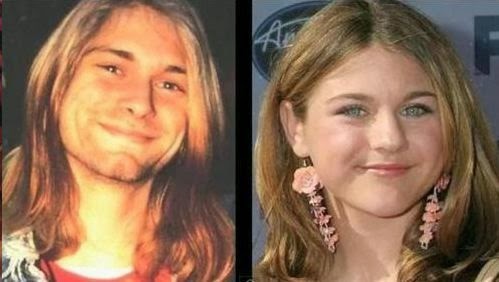
I recently watched "Montage of Heck," the new documentary about Kurt Cobain, the lead singer/songwriter of legendary, early 1990's, grunge band, Nirvana. It was put together by his daughter, Frances Bean Cobain, who was only a year old when Kurt shot himself on April 5, 1994. For Generation X-ers, the exact details of where we were when we found out Kurt died is as ingrained in our minds as the details of President Kennedy's assassination is ingrained in our parents'.
In the early 1990's, I lived in Toronto, Canada. I hated it and couldn't wait to move back to New York. My only saving grace was that I spent most of my hours working at HMV Record Store where I could listen to music and watch videos all day. My introduction to Nirvana was the video "Smells Like Teen Spirit." I didn't know there was anything special about it until my co-workers began obsessing over it, saying how amazing this new band was. We played the video day and night, many times, for many days. It got to the point where I felt that if I had to see that janitor with the mop one more time, I would start needing sedation to finish my shifts.
Torontonians hated Americans. It was that simple. I had thought Canada was our friendly neighbor to the North, but the day I arrived, I saw anti-American sentiment spewing out everywhere. Before HMV, my first job was as cashier at a small Kresge's (one of the last in existence not renamed "K-Mart"). My manager had the same radio station playing near my cash register every day, and every single day, the DJ made at least one anti-American comment, such as "Well, it's a movie made by Americans, so we already know it will be stupid." Eventually, I got so tired of it, I changed the station to an alternative music station which my manager didn't like, but I didn't care because through it, I'd discovered the new British band, Lush!
At HMV, the anti-Americanism continued with my co-workers asking me how I could stand New York "where everyone is just running around with guns in their hands." I informed them that the first time I'd ever seen a gun drawn was last week while I sat inside a Toronto streetcar when the cops pulled out their guns to arrest someone outside on the street in front of us. I did have one co-worker though who actually liked Americans and American culture. His name was Harry, and he told me that the reason why guns were more prevalent in American culture than in Canadian culture is because our "Right to Bear Arms" was implemented so the government couldn't physically take over its people. It enforced the rights of the individual. I know that sounds idealistic, but I'd finally found a friend I could hang out with that didn't make anti-American digs at me any time the term "The States" came up!
One afternoon, my co-worker, Erin, came into HMV saying, "Did you hear? The lead singer of the Cocteau Twins got killed in a plane crash!" About six months later, Harry and I were chatting when he said, "Yeah, one day at my old job, I spread a rumor that the woman from the Cocteau Twins died." He was laughing about it. "That was YOU?!!" I exclaimed. "Yeah," he said. "I got really sick of everybody raving about that stupid band so I made it up." I couldn't believe it! Back then, there was no internet to check facts, so I'd spent that entire day depressed about it!
But I didn't hold that against Harry. I found it pretty funny. Apparently, I must enjoy the company of shit disturbers because they always seem to be around me in one form or another. But most Torontonians were polite to a fault, sometimes to their own detriment. Everyone at HMV ate lunch at this Thai restaurant around the corner called "Salad King." Yes, the food was out-of-this-world delicious, but the owner was pure jerk. Because we were around the corner, HMV staff got a 5% discount, but whenever I ordered my lunch and mentioned the discount, he'd say, "If you keep saying that so loud, I'm not going to give it to you!" The other ridiculous problem I had with him was asking for the grilled cheese. "It's only $2.00!" he'd say. "I can't tie up the lunch crowd's grill for a $2.00 sandwich!" "But it's on the menu board!" I'd say back to no avail. Yet when I told my stories, all of my co-workers sided with Mr. Salad King, all except Harry who said, "One time I asked him to give me another mayonnaise, and he told me 'no,' said too much mayonnaise is bad for you!" Yes, Salad Son-of-a-Bitch.
Now back to Kurt: One afternoon, I was in my kitchen putting down newspaper for my adorable, but poorly house-trained, Yorkie, when I stumbled upon an article reporting Kurt's suicide attempt in Rome. I was shocked, and I said to myself, "Imagine if he died? What a life-changing event that would be for all of us!"
The very next month, I was out on my lunch break with Harry. He had already quit working at HMV, happy to be away from the corporate bullshit which wore us both down eventually, but I remained working there, and he met with me one afternoon. After we ate, he decided to walk back with me to say 'hi' to some other friends he had at the store. As soon as we stepped inside, I heard "Lithium" blaring through the speakers which was the only Nirvana song I really liked. Derek the DJ immediately approached us and said, "Kurt Cobain is dead. Yeah, they don't know all the details, but rumor is he shot himself." WHAT??!! One of the first things I thought about was his wife, Courtney Love, and their daughter, Frances. For the past few days, we had been playing the "Miss World" video from Courtney's band Hole's new album which hadn't even been released yet. And now, every time I'd see her, she'd be a widow.
There's been a lot of Courtney-bashing over the years, but I really like her. She's got guts and will do anything a male rocker will do, including stage-diving into the audience. She's real about herself: both her shortcomings and her strengths. When talking about Kurt, she said: "He didn't have one atom of rock-star ego, and he needed it."
This is the mantra I've taken from that day: "Have guts, be honest and be yourself. Otherwise this world will destroy you."
P.S. The documentary is brilliant. The only thing that SUCKS is that he died before his daughter ever got to know him.
Saturday, March 7, 2015
Someone Who Gets Me
My mom and I get along well now, but that's because we're very different. We don't see our own faults staring back at us from each other's eyes. But I also don't think she gets where I'm coming from, and I'd accepted that years ago. When we did our Myers-Briggs Type Indicator which is a personality test developed by a mother/daughter psychologist team and based on Carl Jung's theories, my mom's results were ESFJ which is the most popular personality type, yet my results were INFJ which is the least popular personality type. Emily Dickinson is thought to have been an INFJ so that gives some indication of what my mom was dealing with while raising me. My dad never took the test, but I believe he would have tested as an extrovert (the "E" in the four-letter Indicator stands for Extrovert, and the "I" stands for Introvert). He was a musician who played in a club band, and when he wasn't performing music, teaching or tutoring, he still always wanted to be out of the house. I can't remember him even once saying, "You know, I'd really prefer to stay at home tonight" or "I need my alone time." That spells extrovert because as an introvert, I find myself saying that at least twenty times a day.
So where did I get my introvert gene? I look to my grandmother - my mom's mother. She was definitely an introvert, and we used to hang at home together a lot when I was growing up. She didn't really have any outside friends and rarely had people over her house which was downstairs from ours. She didn't want to be involved in the ladies' groups at her church and definitely didn't want to bond with my grandfather's sisters who lived nearby: She was German, and they were Italian, and she believed they always ostracized her because of that. But I don't think that was the reason. They just didn't get her. Probably because her personality was different: She liked to stay home and study the Bible and write about it in her notebooks. They liked to meet in groups to coffee klatch.
The only person my grandmother used to seem to really enjoy talking about was her younger brother, my great-uncle, Richard. Her face always lit up when she told me stories about the two of them growing up in Pennsylvania. She said they'd climb mountains to pick "huckleberries." He was creative like my grandmother and used to paint pictures of people or things that interested him. He painted my mom when she was sixteen, and in it, she lounged on a bed with a bunch of brightly-colored pillows. He always used very bright colors, a lot of pinks and light blues, and often painted the cherry blossoms he saw when he traveled to Washington D.C.
Uncle Richard had dinner at my grandmother's apartment in Brooklyn every Sunday where she had moved to from Pennsylvania and now lived with my grandfather and my mom who was still a child. He always brought along what now would be described as his "partner," a man named Bill who was about twenty years older than he was. My mom said that back in the fifties, these relationships were usually not spoken of. She said it eventually clicked in as she got older that Bill was more than just a friend to Uncle Richard.
Several years later, when Bill died, my Uncle Richard was distraught. First he took up with another man, also named "Bill," but this time, Bill was the younger one. That relationship didn't work out, and soon afterwards, Uncle Richard retired from his office job in Manhattan and moved to Texas.
I only met my Uncle Richard once in my life when he visited us when I was nine. He stayed downstairs with my grandparents for about a week, and I didn't like him because his sense of humor was extremely sarcastic and what I had considered mean. Nowadays, I would have loved this about him and laughed along, but my nine-year-old little girl brain couldn't appreciate this type of wit. When he asked me if I would be sad when he had to go back home, I answered him honestly and said: "No." Still, he promised me that once he got back home, he'd mail me a Texas girl doll since I loved dolls so much. I watched intensely for the mail for a couple of months but eventually gave up and decided I had been right about him all along.
The only time I ever saw my grandmother break down in tears was when Uncle Richard died. In her younger days, my grandmother was not a woman who had it easy. She suffered two stillborn babies and gave birth to one baby that only lived an hour, yet she never cried or even choked up whenever she told me about them. In his last years, Uncle Richard's health had deteriorated due to alcoholism and probably a broken heart. He moved from Texas back to his hometown in Pennsylvania where my grandmother's sister and cousins still lived. My grandmother's sister said that people sometimes told her they'd seen Uncle Richard wandering around the park or sitting on park benches, looking like a homeless person. Seemed he never really got over losing the older Bill. One night, my grandmother came up our stairs crying, saying she had just gotten a phone call that her brother Richard had died. I always regretted I didn't give Grandma a giant hug right then, but I was a teenager, and I looked for a cue from my older brother who was never really one for expressing his emotions. He didn't move from his spot on the living room couch, so I didn't move from my recliner either. It hadn't been more than a year or two after our dad had died so neither of us were the clearest thinkers at the time. But my grandmother didn't seem to mind. I think she was in her own world. I believe if it had bothered her that I didn't hug her, she would have told me in the next few days. She had always been very verbal regarding any situation where she felt she'd been wronged, so I think she would have mentioned it. It doesn't mean I don't still regret it. But overall, I'm sure she did understand where I was coming from that night because she was one of those few people in the world who truly gets me.
Saturday, December 20, 2014
Let's Get Real: "Push, Chrissi, Push!"
Having a baby is the most real experience a person can have. It's impossible to not be in the real world when you have no choice but to be aware of your body as it's changing and another body is growing inside of you. Yet people seem to have trouble BEING real about this very human experience.
A few years ago, my BFF and I were reading the entire "Twilight" series by Stefanie Meyer. She finished them way before I did, of course, because she reads fast, and I'm a mind wanderer. But much to my surprise, I did get through all four of them. The last was "Breaking Dawn," and when I finished it, she asked me, "Didn't Bella's whole pregnancy and delivery freak you out? Weren't those sections really hard to read?" Truth is, those sections didn't phase me at all. The female heroine, Bella, gives birth to a half-human/half-vampire baby girl who feeds on Bella's blood during the pregnancy, leaving Bella so weak, emaciated and near death that her spine breaks during the delivery and the baby actually eats her way out while Edward, the vampire dad, bites Bella's stomach open to complete the process of getting the baby out. I guess that since my own daughter was born after 20 hours of labor ending in an emergency C-section, these chapters didn't seem odd to me at all.
Just about everything that could happen while having a baby happened to me and even one thing that doesn't usually happen: After the epidural, my hands went completely numb. I was waiting things out in a room by myself because it would be several hours before I would actually begin the process of giving birth, but when my hands went numb, I got worried. I yelled for the nurse, but no one heard me. Then, when I tried to push the call button, my hands wouldn't move. I pushed my hands up to the button, but they literally would not move to get to the button. It was one of the longest 15 minute periods of my life. When a nurse who just happened to be walking by finally came in, I gave her an angry reaming out which of course I apologized profusely for later.
When it was time to actually deliver my daughter, I had a high fever, I vomited, shivered with chills, and broke the blood vessels in my eyes from so much pushing. The morphine the anesthesiologist gave me just before the C-section was the happiest I'd been, and I thanked him a little too eagerly which I guess made up for my being nasty when he finally did see me about why my hands had gone numb. "I've never seen that happen before," he said. Of course not. Considering he was talking about me and my life, I wasn't at all surprised.
After my daughter was finally born, I had to wait things out in the recovery room. Similar to how Bella's body had been drained of blood, my body was feeling drained of water. I was unimaginably thirsty and was told that the cup of ice chips I was just given could not be given to me again for another two hours. As I lay there, I had the sensation of being left alone again, but this time in the middle of a desert. Although I could move my hands now, I couldn't stop the intense craving for ice chips. I spotted a different nurse nearby and lied and said I was definitely overdue for ice chips, and she gave them to me. My insanity for ice chips was so strong that the the longing in my eyes probably looked no different than Bella's did when she finally recovered from her delivery as a dead, drained human and was changed into a crazed vampire.
I can see why stories of labor would bother my friend who hasn't had a baby yet, but why does the idea of labor bother women who have ALREADY GONE THROUGH labor? Some parenting blogs have criticized that great vagina cake that Reality TV star Snooki made for her co-star JWoww's baby shower. It is a rectangular pink cake with pink icing in the middle that was made into the shape of the outline of a vagina. Snooki said that the cherries resembled the blood and placenta when the baby comes out. There is also a big Kewpie doll head in the center of the cake sticking out of the vagina. I don't find this cake gross at all, I think it's real: When you have a baby naturally, as the vast majority of women do, the baby's big head really DOES come out of your vagina! Not to get political, but I'm reminded of how people don't REALLY want to know how the meat on their plates gets there. If they researched it, they would be uncomfortable with actual images of animals suffering and leading horrible lives only to die by getting their heads bashed in at the slaughterhouse. At least that's how I think they are killed in the slaughterhouse. I'm not about to Google that and stumble upon those images. I'll admit that any semblance of THAT sight, I can't handle, and so I stay away from eating meat because I'm real about how it gets to my plate. However, there are numbers of moms out there who will turn a blind eye to how the meat gets onto their tables yet they're very vocal about the fact that they can't bear to look at Snooki's cake with the pink icing that resembles the vagina that their babies' heads come out of. I think they should just get real.
Now that I've described my ordeal of labor and delivery (not to mention carrying my 21-inch baby in my 5-foot frame where the pain was so bad on my tailbone during that last month that some nights, I just sat moaning on my bedroom rug in whatever position I could to make the pain bearable), you'd think that what I experienced is the reason why I decided to have only one child, but it's not. I would have gone through that again because I was able to survive it once already, so I believe I could survive it again. But the reality of actually bringing a human being into this world and being responsible for its health and happiness is some pretty heady stuff. One child was definitely the most that I could handle. I knew that and was completely real about it.
Sunday, November 9, 2014
We All Think We're Marilyn Monroe
Everyone hopes to be remembered after they die. The first famous person I was aware of who had died but was still being talked about years later is Marilyn Monroe. My dad was obsessed with her, so I knew who she was pretty much from birth. We had a large mirror of her face in my parents' bedroom, and I remember playing with a small, plastic, inflatable pillow that said "Some Like It Hot" in the backseat of my dad's car. My parents' bedroom was strewn with books about her mysterious death (my dad believed she was murdered because she threatened to tell of her affair with Robert Kennedy which would have ruined his political career). He wore a silver Marilyn Monroe belt buckle and had a black T-shirt with a gold iron-on of her face. He said she died when she was 36, and I said that was old, but he assured me that was indeed very young.
Marilyn Monroe left a legacy of her many films, and her image is still seen on virtually everything from shower curtains to cell phone cases to clocks -- 52 years after her death! Even in her wildest dreams, I don't think Marilyn ever imagined people would still be looking at her pictures and talking about her so many years after she died. Although she was famous, she only lived to 36, and she probably was too busy living to spend much time thinking about what her legacy might someday be. But it seems like nowadays, everyone I know who is 36, and even younger, can't stop planning for the end of their lives. Some have jobs that promise a pension once they reach their retirement ages, and they spend their lives in seeming anticipation: Each day, they get up for work and count the days until Friday. Then they count the weeks until the next month because those months will lead to their two-week vacations, and from there, they count the years leading to when they know they can retire and collect their pensions.
After that, since most people aren't legendary film actresses like Marilyn Monroe, they live out their last years wondering what their legacy might be and who will remember them. This is probably why grandparents like to tell their grandchildren their millions of stories so they feel a piece of them will remain alive as each generation retells these stories. Marilyn Monroe never had any children, but she had her films to live on after her. The rest of us live through our own children and younger family members who keep our memories alive. High schools keep yearbooks forever, and whole towns remember who came before them: who ran the shops, who lived in which houses, and so on. It's important to us that people still talk about us after we're gone.
But maybe it's better to stop all this planning and just enjoy today? Waiting for it, and planning for it, and expecting to be remembered, seems a bit self-important. True, most people will be remembered. But I can't help thinking about all those news stories about earthquakes or other natural disasters hitting somewhere far away from us, wiping out entire towns and its inhabitants in a matter of minutes. Are these people any less important than we are?
Saturday, August 2, 2014
My Love Letter To Writing
Yes, I'm in love with writing. I couldn't survive without it. Flannery O'Connor once said: "I write because I don't know what I think until I read what I say." That's exactly it. My mind is an emotional mess until I write my thoughts down. Afterwards, I feel better, less emotional, less confused, and I have an enormous sense of relief.
My mom was the first person to suggest I become a writer. I was 8 years old. It wasn't because she recognized talent in me, and it didn't stem from anything positive. It was because I was driving her insane with my phobia. There was a huge northeastern snowstorm that year, and I had read a news story about a boy who got buried in the snow in his yard and hadn't been found until a month later. The several feet tall snow drifts in our backyard hung around the entire winter, and I was terrified that the same thing would happen to me. I remembered every detail from that news story and kept on replaying it in my head: how the mailman found him because his mitten was sticking out from the snow; how the picture of the side of his house that looked like a barn had an "X" marked on it near the spot of the snow where he was found; how they used the word "vanished" in the article; and how everyone thought he was somewhere in the neighborhood, but he had been in the front yard all along. Every day I asked my mom if that was going to happen to me. She listened to me recount the details in the article for her, and one day, she finally said: "You should become a writer. There's got to be something positive you could do with all that misery stuck in your head!"
My mom's advice came in handy when I was 14. My father was very sick, and my two best friends from school had turned against me. I hated school and hated life and couldn't wait for the year to be over. So I created a 30 year-old woman named Nazd to hang out with. She had long brown hair, brown eyes, wore a long, beige, raincoat and had her nails painted that neutral color you never see anymore. We went everywhere together. My novel-to-be was simply titled "Nazd." As often as I could, I'd lock my bedroom door, put on Prince music, and write about Nazd with my same red pen on sheets of loose-leaf paper. Nazd was wise and said little. She wasn't a chatterbox with her feelings always out on display. She had all the answers. My world was falling apart, but I had Nazd as a shoulder to lean on.
In high school, I sat in the back of class and began a screenplay on tiny scraps of paper. The action takes place in one day where a young woman sits in a dimly-lit Brooklyn apartment as an older man tells her about a doomed couple he knew years ago named Jimmy and Diana. Jimmy often visited Diana in her Brooklyn brownstone, but her parents were against the relationship because they were wealthy, and Jimmy was poor. He was also heavily involved with drugs and eventually hanged himself. Diana was so distraught that she left home, left life, and became a bag lady on the street. In the last scene, the woman leaves the dark apartment into the bright broad daylight and walks onto the street, crossing paths with a woman whose purse has fallen to the ground and opened up, exposing tons of junk. She helps her, and when the woman looks up, she gives her a wide smile. She looks world-weary, but her smile is youthful. She picks up her purse and walks away, leaving the main character to believe she has just bumped into the real Diana.
Luckily, as I wrote on my scraps during class, I had a knack for being tuned into whatever the lesson was about and was always able to quickly replay my teacher's question in my mind and answer it. I once read that creative people are unable to shut off the sounds going on around them. I can be engrossed in a conversation at the diner but can still hear that one ring of the little bell from clear across the room signaling our food is ready which always fascinates whoever I'm eating with.
But that's what makes writing even more necessary for me. I've trained myself over the years to now use writing to turn off all those extra sounds going on around me and instead to escape and break free from the rest of the world for a little while. I figure that's okay, as long as I'm always able to come back and not be found one day sitting in a chair, muttering to myself, like Nicole Kidman playing Virginia Woolf in "The Hours" movie: The kids are pointing at her and laughing, and she's oblivious: "Mrs. Dalloway said she would buy the flowers herself," she suddenly says out of nowhere. Mesmerized.
Subscribe to:
Posts (Atom)


.jpg)