Saturday, November 12, 2022

This Is Not A Post About Chicago


It all started with a beautiful man.  But don't most things start that way?  An attractive person can change your world.  I grew up on 1980's movies where it's usually a male character who falls in love at first sight with a female character and then spends the rest of the movie pursuing her and having thoughts about nothing but her.  Movies like "Valley Girl" when Randy the punk spotted beautiful valley girl, Julie, on the beach and then crashed the preppie party to meet her. Well, I'm not about to crash any parties, but after seeing Robert Lamm of Chicago on their "Live at Tanglewood" concert video from 1970,  I have been consumed by all things Chicago. 


THE video! "Beginnings" from "Chicago - Live at Tanglewood"

A few months ago in August, I flipped my TV channel remote on the Chicago episode of AXS Channel's "Rock Legends" series. I remembered that my former stepfather gave me his "Chicago IX -  Greatest Hits" album on vinyl when I was a teenager.   This was in the 1980's, and until I'd heard this album, I had no idea that Chicago had a full brass section and a singer with a deep voice.  I was only familiar with their videos showing Peter Cetera as their lead singer, a blonde-haired tenor who sang ballads. It was a pleasant surprise to discover this earlier version of Chicago, and I listened to my "Chicago IX" album regularly.  I was told the singer with the deep voice on my album was Terry Kath who died in the 1970's in a gun accident.  My favorite songs on the album were "Make Me Smile," "Call on Me," "Beginnings," and "Feeling Stronger Everyday." 


My new Chicago bracelet set that I asked an Etsy artist to make for me featuring my favorite Chicago song 

After the AXS episode refreshed my memory of how much I loved those songs, I decided to look on YouTube for Chicago videos. I searched for "Beginnings" and stumbled upon the Tanglewood concert.  At first, I assumed the long-haired man getting ready to sing at the microphone was the deceased Terry Kath.  Basically, I just assumed this because I knew he wasn't Peter Cetera.   But right away, I heard him say, "Terry," while looking to his side and gesturing with his hand, so I said to myself, "Oh. This isn't Terry Kath. BUT THEN WHO IS THIS HANDSOME GUY??!!"  I Googled and found out it was Robert Lamm and that he is still alive and STILL good-looking at age seventy-eight. 

Soon I was watching every single Chicago video and documentary I could find.  Not just to see 1970's Robert Lamm but because Chicago's musicianship speaks to me. Even though I consider myself primarily a novelist, at the core of my heart, I am a musician.  When I was five years old, I begged my parents to let me take piano lessons.  They put me off until I was six because they didn't want to waste money on a piano only to have me change my mind.  I didn't change my mind, and I took lessons until I was sixteen. Then, when I was eighteen, I enrolled at Boston's Berklee College of Music.  Watching live Chicago videos during the Terry Kath years of 1970 through 1977 is like being at Berklee again.  Every night I enjoy sitting with a half glass of Chardonnay or a half bottle of Guinness beer with my headphones on and plugged into YouTube.  I am behind in my podcasts and in editing the 2nd draft of my newest novel because I keep watching and listening to Chicago in the 1970's, and it feels so good.


Pin from my Pinterest Board dedicated solely to Chicago's Robert Lamm

One day last month, I was really angry.  Just from the usual, everyday life's frustrations. So at night, I put the entire "Live at Tanglewood" concert into my headphones yet again. Terry Kath's amazing and busy guitar playing and Danny Seraphine's wild, forceful, drumming helped get everything out of me.  It was cathartic and exactly what I needed.  I was able to sleep peacefully that night.

So why do I keep on watching and listening to Chicago? I believe it is because obsessions allow us to distract our minds from the everyday things that are troubling us. Things like the fact that I have only $10 left in my checking account.  Or when I think about how if I carry my mug of tea down the stairs, I may trip and fall and die like Ivana Trump did while carrying her mug of coffee.  Or if something like that doesn't happen to me, and I live another forty years, is the planet going to be half submerged under water by then?  These days, when I have anxious thoughts, I immediately switch them, and instead, I plug into Chicago.

I know that eventually my fascination with Chicago will dim, but I don't want it to yet because I'm having too much fun. I'm excited I'll get to see Chicago play live when they tour the East Coast in April 2023.  But what would be even better is if one night, Robert Lamm could magically step out of that "Chicago - Live at Tanglewood" YouTube video from out of my laptop the same way Jeff Daniels stepped off the movie theater screen in Woody Allen's "The Purple Rose of Cairo!"  If that happened, I could remain in a dream fantasy world forever. Surely, this would be the perfect cure for my anxiety.  If only!


My ticket confirmation to see Chicago.  Robert Lamm is in the middle in white pants.


Monday, July 25, 2022

The Poem I Wrote As A Love Letter To My Vocal Cords


My Dad singing with his cover band "Beach Road" in the 1970's

In April 2016, I wrote a blog entry entitled, "Finally - Dad. (Part 1)."  I said that it was very difficult to write about my dad who died when I was fifteen but that eventually I would write more entries about him.  So here we are, six years later, with Part 2. In Part 1, I wrote about my dad's love of Walt Whitman's poetry and said that he wrote his own version of Whitman's collection of poems, "Leaves of Grass,"  by changing the words and setting the poems to music. Here in Part 2, I would like to share a poem that I wrote years ago, "Lifedream," and the story behind it. 

Even though my dad was a talented songwriter, his true love was singing.  His favorite singer was Teddy Pendergrass whose albums he often played at family gatherings, exclaiming, "Listen how Teddy sings this note! Nobody can sing like Teddy!" This prompted teasing from my aunt who told him, "You talk about him like he's your friend! 'Hey Teddy, let's go outside and play ball!'" My dad loved Pendergrass, but he judged other singers very harshly, and I could never understand why.  They all sounded good to me, and I figured that since they were on TV, they had to be good!  I never had the courage to actually sing in front of my dad.  Instead, I blared albums on my record player and sang along with my favorite singers at the time, Donna Summer and Diana Ross, behind the closed door of my bedroom.  I'll never forget the thrill I had on a car ride with my mom on the way to applepicking when she mentioned that my dad told her he had heard me singing in my room, and if I studied, I had the potential of becoming a really good singer.  My dad didn't throw singing compliments around lightly, so the joy I felt at that moment was monumental.  I immediately enrolled in singing lessons and continued them even after he died.  I knew singing was the closest I could be to him, and it was a way to make him proud of me. When I turned eighteen, I moved to Boston to study singing and songwriting at Berklee College of Music. I needed to know what truly made a singer good or bad.  Otherwise, I feared I'd become one of those singers that my dad would have hated!

College life and living in the dorms were not kind to my voice.  The stuffiness of the dorm rooms exacerbated my allergies, and the beer drinking and late nights roaming the halls screaming and being silly made my voice hoarse.  At one point, I was limited to a three-note range.  My voice teacher recommended an ear, nose and throat specialist to examine my vocal cords.  The diagnosis wasn't good. I had the beginnings of vocal nodules, simply called "nodes," which are benign growths on the vocal cords that develop when people abuse their voices.  The struggle to heal my voice was difficult and depressing. I stopped drinking beer and staying up late.  I stopped singing and screaming in the hallways.   But I kept on writing.  The following poem, "Lifedream," is a metaphorical poem I wrote to my vocal cords, expressing my sadness and disappointment and my fear that my voice would never come back:


"Lifedream"

I will shelter you like a thin sheet of ice./Put you in a tiny box./Preserve you till I'm ready.  

No, I'd never give you up./Never give up skating.

But you and I don't think alike./Never meant to hurt you./And up until the end of time,/I'll never give up skating. 

But maybe I can't save the ice./My body crushed and crumbling through./If I can't live my life on ice,/I'll never love you true.

I will shelter you and hold you tight./Together we will move.

If I fall through this sheet of ice,/My life's dream I will lose.


Slowly, my vocal range came back.  In fact, my voice teacher told me she had never seen anyone overcome vocal damage to the extent that I was able to with no outside medical treatment. But I still felt I would never be able to sing as well as my dad would have wanted me to.  Anytime I had a late night or was run down, my sensitivity to hoarseness acted up.  My voice teacher also told me that my speaking voice was harsh and very different from my singing voice.  She said you must speak the same way that you sing but that trying to speak in a way that wasn't natural to me might change my personality. I didn't want to do that, and eventually, I just decided that if I couldn't sing as well as my dad, there was no use in singing at all.  It all turned out okay though because I'm happy now writing novels.  Plus, it's been beautiful to rediscover my poem and to remember those days when singing was so meaningful to me.


Wednesday, April 20, 2022

Written, Created, Directed, Produced, and Acted by Women


Marie Reuther as Julie in "Kamikaze"

These days, when I need to relax and take time out from writing my novel, I like to stream TV series.  I'm enjoying this but am hoping my novel won't take ten years to finish like "Catcher in the Rye" did for J.D. Salinger.  Then again, if my novel could turn out even one tenth as good as "Catcher in the Rye,"  I'll take it!  As much as I love Holden Caulfield, lately I find myself drawn more towards stories that have female lead characters and scripts written by women.  I find that when women create female characters and write situations and dialogue for them, they portray women a lot closer to how we really are.  I've noticed that female writers are more comfortable with writing their female leads as antiheroes.  This is refreshing, as opposed to being inundated with idealized versions of women or women depicted as martyrs or victims.  It is more like real life.  The below three series are a few of my most recent favorites.  They may not sit well with everyone, but I believe they are truthful to the female experience and portray women as imperfect human beings with life lessons to learn.  

Kamikaze on HBO Max  Favorite Line: "Do what you want."  

At first, I was hesitant to watch "Kamikaze" because of the depressing premise:  An eighteen-year-old girl named Julie gets a text from her dad telling her that his plane is crashing and advising her to "do what you want."  Also on that airplane is her mother and twenty-two-year-old brother, her only sibling.  After the crash, she is so distraught she doesn't get out of bed for three days.  When she does get out of bed, she has one goal which is to die too so she can be with them.  She decides to fly on a different commercial flight every day until one of the flights crashes.  But after a close call, the relieved man sitting next to her tells her that based on statistics, a person would have to fly every single day for twenty-nine years to die in a plane crash.  So she abandons that plan and decides to focus on having fun instead. She continues to live her life recklessly and still has a death wish because she hasn't changed her mind about wanting to die and rejoin her family.  She travels to different countries, setting her eyes on particular guys she wants to have sex with.  She breaks some hearts but who can judge her when she has just endured the unfathomable grief of losing her entire family?  I lost my father as a teenager so I imagine I felt one third of the type of pain she feels, and I also remember some months of not fearing death and of living recklessly.  Spoiler Alert:  At the end of the series, Julie discovers she is pregnant.  She doesn't know which guy out of a possible four is the father, but she ends her death wish, and I believe this is because when her baby is born, she will regain a part of her precious family back.  Julie is portrayed as a daring young woman who decides to take charge of her life.  Even though her choices are destructive, she still has the courage to follow her own path.  The women who created and wrote for this series were not afraid to portray Julie as a female antihero.  

Gypsy on Netflix  Favorite Line: "Nothing's certain, except for whatever's happening right here.  In this moment."

Jean Holloway is a psychotherapist who lives a cushy life with her husband and nine-year-old daughter in the suburbs.  Like Julie in "Kamikaze," she is also living recklessly, but it is not due to having suffered a life-changing loss. Instead, it is because she is depressed at the fact that her lifestyle is not true to her authentic self.  As a young woman, Jean shunned committment but reluctantly settled down because she feared living life alone.  Her mother put this fear into her head.  As a therapist, Jean sets out to help her patients but continually veers off the track as she becomes fascinated by and envious of the people who her patients describe as being toxic in their lives.  Her patients seek therapy to break obsessions with these people, but in turn, Jean becomes obsessed by her patients' descriptions of them because she believes these toxic people are living the types of exciting lives that she wants to live.  She is bored and needs an escape.  She goes on a quest to befriend these people by finding them and introducing herself as Diane Hart, a journalist. Jean is leading a secret, dual life, using an identity she feels is closer to the free spirited woman she used to be.  

Naomi Watts as Jean in "Gypsy"


Blythe Danner as Nancy (Jean's mom) in "Gypsy"

Jean forms new relationships and friendships as Diane Hart, and learns her new friends' secrets by asking her patients questions about them during their therapy sessions with her.  One patient get frustrated, telling Jean he doesn't want to delve deeper into understanding his toxic ex-girlfriend.  Instead, he is trying to get over her.  Jean manipulates her patients and guides them to make changes in their lives that suit her new connections with the people she has met as Diane Hart.  But not everything Jean does is malicious.  She also sets out to do good.  For one of her patients who is a mom struggling in her relationship with her grown daughter, she rewrites a letter that was given to her from the patient's daughter. Jean thinks the letter is too cold so she changes it, mimicking the daughter's handwriting, writing a warmer letter.  When the mom reads the new letter rewritten by Jean, she is comforted and leaves the therapy session happy. Jean also consistently shows love and respect for her own daughter who is misunderstood at school.   My favorite part of this series is Jean's relationship with her own mother, played brilliantly by Gwyneth Paltrow's mom, Blythe Danner.  Jean and her mom have a very strained relationship.  Her mom knows that Jean is manipulative and is destroying other people's lives.  But she is also the only person who knows her secrets and the only one who understands her.  Although we have trouble liking Jean by the end of the series, seeing her mother's unconditional love for her is heartwarming.  "Gypsy" portrays a real and flawed woman who doesn't murder anyone but has a long way to go in working on herself.  I think this is true to life.  Women are usually portrayed on TV and in movies as having had to endure some type of trauma to make them act maliciously, yet Jean has a loving family behind her and has had no trauma. She is just a human who hurts. She's not a victim, and she's not a martyr.  She's a realistic and damaged woman.

Fleabag on Amazon Prime   Favorite Line: "You already know what you're going to do." 

"Fleabag" is not only created and written by a woman, Phoebe Waller-Bridge, but Waller-Bridge also stars in it. "Fleabag" is a comedy, but also sad, as the female lead (only referred to as "Fleabag") is a young woman who feels responsible for the death of her best friend, Boo, who walked into moving traffic to try to get injured so she could get the attention of her philadering boyfriend, but she dies accidentally instead.  Fleabag feels responsible because she turns out to be the one who the boyfriend was unfaithful with, yet Boo didn't know it was Fleabag who slept with him. Fleabag misses Boo terribly, as she was the only person she felt close to because Fleabag is unable to form any other lasting relationships, as she just compulsively sleeps with men as an addiction.  Even though she's sad and lonely and often clashes with her self-absorbed sister, callous stepmother, and emotionally-absent father, Fleabag finds something funny in every situation.  Her sense of humor is her saving grace.  Fleabag also has an eye-opening scene with actress, Kristin Scott Thomas, who co-stars in one episode as a career woman who wants to impart some wisdom about the female experience, and she does so to Fleabag when they go out for a drink together.  She says that women are born in pain.  They have menstrual periods, endure childbirth and sore boobs, and because of this, women have the pain within themselves.  But men, on the other hand, have to create their own pain, and they seek it by finding wars to fight and crises to worry about.  Men have to create their own guilt whereas women are excellent at carrying their guilt all by themselves without ever having to create it or to go out and seek it.  

When Fleabag finally finds love, the man she falls for is a priest.  This is something we can all relate to, as my great-grandfather was a priest who left the priesthood to marry my great-grandmother.  Of course, I'm just kidding when I say that this is relatable to all people (although it is true what I said about my great-grandparents, so it IS relatable to me), but I do believe every woman can find something to relate to when watching TV series where women do the writing because when we women create female characters and stories about women, we are writing for us.


Andrew Scott as The Priest and Phoebe Waller-Bridge as Fleabag in "Fleabag"


Wednesday, October 20, 2021

Madonna Is Here To Disturb The Peace


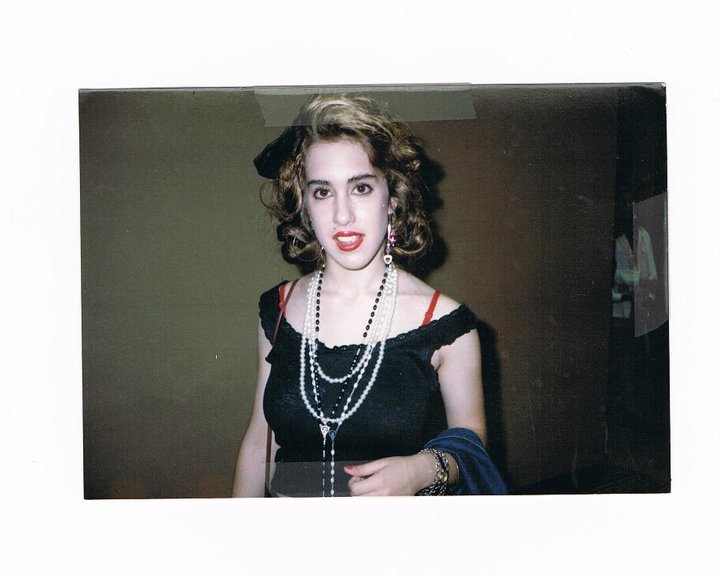
Me as a teen, dressed up as Madonna, when I auditioned for a Pepsi commercial


Recent picture of Madonna I have framed on my desk


"Artists are here to disturb the peace." This James Baldwin quote is the theme behind Madonna's new concert/art film, "Madame X."   Many of the late novelist's quotes are visible behind the musicians and dancers as they perform in "Madame X," and Madonna adds one of her own when she says, "We aren't here to be popular, we're here to be free." 

The first time I heard Madonna's music, I was a teenager growing up in Staten Island, New York, and the song "Physical Attraction" came on my bedroom radio.  I thought "Madonna" was an all-female soul group, but then I saw her on Dick Clark's "American Bandstand" show and was surprised she was one person!  When Clark asked her what she aspired to, she answered, "I want to rule the world." I thought she sounded arrogant, but it turns out she was right.  Shortly after that, I watched her perform "Like a Virgin" live on the MTV Video Music Awards, and her fame just skyrocked.  Suddenly, girls and teenagers wanted to be Madonna and started dressing up like her. I did this too one time when I auditioned for a Pepsi commercial, hence the top photo in this blog.  I didn't get the commercial, but I did make it past the first round, and it was fun to spend the day dressed as Madonna!


I still have my clipping of Madonna in "Time" magazine - May 27, 1985

A couple of years later, I was off to college.  When I met my college bestie, Lauren, we bonded over the surprising discovery that we both chose to go to Berklee College of Music because "'Til Tuesday" singer/songwriter Aimee Mann went there.  By that point, I thought it wasn't cool to like Madonna anymore.  Instead, Aimee Mann was the type of cool punk-pop singer I wanted to be.  Even so, one night, I admitted to Lauren that I "sort of still liked Madonna."  Lauren said there was nothing wrong with that and told me she liked Madonna too!  I felt at that moment, I was never going to grow out of liking Madonna.  In my mind, she was now officially here to stay.

While still at Berklee, I got a job at Tower Records.  One day, I was stocking one of my sections in the back of the Rock/Pop floor when Madonna's "Vogue" video came on a TV that was above my head. It was the first time I had ever seen it, and I was mesmerized at what a celebration of music and art it was! Sometimes, I still get teary-eyed when I hear "Vogue" because it reminds me of that moment I first saw the video, crouching in the middle of the Tower Records floor.  It takes me back to that time period in my life, living on my own for the first time and working to support myself in my own apartment.  Madonna's music has been with me at many stages of my life, and when an artist has been around for so long, each song jogs a different memory.  


I also saved my article of Madonna in NYC's "Daily News Magazine" - June 2, 1985

Earlier this month, in anticipation of "Madame X," I rewatched Madonna's first concert movie, "Truth or Dare," from 1991. When I later watched "Madame X," I noticed a vast difference between today's Madonna and the Madonna of thirty years ago.  The Madonna of "Madame X" is a wiser Madonna.  It is reflected in her music.  "Truth or Dare" is a concert film filled with pop music, and the lyrics are focused on herself. On the "Madame X" album, her lyrics are socially conscious, and the songs incorporate several different styles of music from different parts of the world. Her song "Batuka" was written in the style of Batuque music which is from Cape Verde and is considered one of its oldest music forms.  Batuque music was created by women and was always played by women.  My favorite part of the "Madame X" film is when she performs her song "Batuka" with an all-female band of drummers ranging in ages from teenagers to older women.  Batuque music was banned by the church because drumming was considered "rebel" music, yet somehow it survived and is still played by women today.  As Madonna says in "Madame X," "Women are powerful." 

There is a joke in the "Truth or Dare" movie that backup singer/dancer Niki Haris makes, saying there will be a Madonna "Like a Virgin" tour in 2025.  Now, we are only four years away from 2025, and Madonna is still touring in her early sixties!  Performers like Madonna and The Rolling Stones are sometimes criticized for still rocking out in their later years.  Even more troubling to some is the fact that Madonna is dating a man thirty-six years younger than she is.  This is another thing she has in common with The Rolling Stones, as singer Mick Jagger has been dating much younger women for many years. Maybe Madonna and Mick Jagger date such young people because they need a partner who matches their amazing energy? 

Madonna proves to us every day that older women are meant to be celebrated instead of being put out to pasture.  I love how the "Madame X" movie begins with a montage of Madonna's sexual moments of controversy throughout her entire career, and at the end of the montage, Madonna says that what is actually the most controversial thing about her is that she stuck around.  


Madonna and her boyfriend, Ahlamalik Williams, celebrating her 62nd birthday in Jamaica (usmagazine.com)


Friday, July 16, 2021

Swimming Pools and Me

Me as a teen in my childhood home swimming pool

When I was eight years old, my dad and I sat together in our backyard and watched the workmen dig our grass and dirt to put in a new above-the-ground swimming pool. My mom referred to our pool as a "15 Round" which meant that it measured fifteen feet in diameter.  The outside was blue, and it had straight white panels going down each side with the words "Esther Williams" printed on them. My grandmother told me that Esther Williams was a very famous swimmer who starred in Hollywood movies many years ago.   

Every summer, my best friend, Ania, and I spent most of our time in my pool.  Even though she had an oval, above-the-ground swimming pool in her own backyard, we were always in mine.  A few times, we stayed in so long that our lips turned blue!  We loved being in my swimming pool so much that we never realized we were cold - probably because we were always moving and jumping up and down.  One summer, I spent so much time doing handstands and cartwheels underwater that I came down with an ear infection.  I had to take ear drops and wear earplugs every summer after that.  Sometimes, I pretended I was a mermaid and that my swimming pool was a big tank I lived in while on land. Nothing felt better than being in my swimming pool.

But then I grew up and left home for college in Boston.  While I was away, my mom sold the house.  For many years after that, I had a recurring dream that I returned to my childhood home, and the water in my swimming pool turned green.  I was distraught that the pool was unusable. I figured I dreamed this because shortly before I had left home, our pool water really did turn green.  I hadn't been very good at keeping up with putting in the scoops of chlorine and running the filter.  My dad was the one in charge of our pool, but he passed away when I was fifteen.  In my dreams, as soon as I saw that the water was green, I went on a desperate quest for chlorine. Sometimes, I'd look in my shed and other times I'd try to find a store somewhere, hoping it was still open in the middle of the night.  Eventually, I'd find one, and I'd spend the rest of the dream measuring out the chlorine.  

Illustration from Instagram

I've never had my own pool as an adult, but I always enjoy them whenever I get to swim.  One of my favorites is this wave pool in Pennsylvania.  I didn't know one existed until I went in.  It was the best of both worlds, as my other favorite place in the world is the ocean.  One time, I was staying at a hotel in Nevada, near Las Vegas, and the hotel pool was an inground pool that had the pool water streaming right up onto the concrete floor at your feet as you approached it. I was only in Nevada for a couple of days and had a jam-packed schedule with family who live there so I didn't make time to go into the pool.  Ever since that day,  I STILL regret that I didn't go in, and I swear I will one day go back to that same hotel so I can get into that particular swimming pool! 

Over the years, the swimming pool water in my recurring dreams began to appear clearer and less green. I haven't had one of those dreams in a while.  Sometimes, I miss having a swimming pool to call my own.  I can't have one in my backyard now because my small yard is on a slanted hill which is nearly all rock.  But I guess it would be possible to put in a pool if I hired an expert to check the yard out. I mean, if I can find a store to buy chlorine  in the middle of the night, then I suppose anything is possible!

Esther Williams in 1953 (cinemasips.com)


Monday, March 29, 2021

My Unintentional Evolution To Unique Artist


Me at the Walt Whitman Exhibit at New York Public Library, NYC 


When I was in elementary school at P.S. 53, either third or fourth grade, my teacher asked us to analyze the Harry Chapin song, "Flowers are Red."  These were the days before the Internet, and I didn't even ask my parents to help.  Actually, I thought I would have no problem figuring out the meaning of this simple song, so I just read it and analyzed it the way I was sure Chapin meant it.  I forget exactly what I wrote, but I said that the color red symbolizes something, and the color green symbolizes something else, etc.  After the assignments were graded, our teacher presented two essays to the class.  One essay was the correct interpretation of the song, and the other was the one that she said she wanted to show us because it was so creative and unique.  Mine was the creative essay, and I was embarrassed when the teacher read it to the class because I felt like a failure.  I wish I still had that essay today, but I threw it away after class because I didn't want to remember that feeling of not being able to comprehend the assignment the way everyone else was able to.  

At 18, I was a songwriting student at Berklee College of Music, and I resisted following the advice of my teachers who taught us formulas to use while writing. I had already studied piano since I was 6, so I just took to the keys and composed my own way.   At the time, I thought my songs were great.  In total, I have written nearly 100 songs and recorded at least half of these, all between the ages of 16 and 21.  However, years later, when I listened to a CD of several of them, I noticed how similar many of them sound to each other.  Although I utilized different key signatures, I often used the same chord progressions. Still, I think they are catchy. They are sometimes melodic, sometimes dissonant, and they don't sound like anybody else's. I like my art to be unique.  My songs sound like me: upbeat with singing that is slightly off-key. During that same period, I worked at Tower Records in Boston.  One day, a coworker of mine told me about the rock band he just joined, and as he explained their typical "rock band of the moment" style to me, I had a revelation.  Why even bother putting in the work with the band when they weren't creating anything new?  It made no sense to me to make the effort when his band was just going to sound like everybody else's.

In my early twenties, I shifted from writing songs to writing stories because I felt confined by the songwriting format.  I believed the music was more important than the lyrics in songwriting so I focused more on the music, and that made the words of my songs take a backseat.  In turn,  I felt a need to express more and more of my thoughts, but I didn't want wordy songs. My other dilemma was that I couldn't stop rhyming!  The same problem happened in my Women's Writer's Workshop when I wrote rhyming poetry.  My teacher told me people aren't rhyming that much anymore.  Walt Whitman had the opposite problem in his day as the first non-rhyming poet.  He got rejected by publishers and had to publish "Leaves of Grass," his masterpiece, on his own.  That's also what writers who wanted to do something different did in the past: writers like Virginia Woolf and Anais Nin.  Writers still do it today which brings me to mention the independent publishing company, New Pop Lit, run by the very unique and talented writer and publisher, Karl Wenclas.  

New Pop Lit is doing what I've always strived to do which is to create and publish a new type of writing.  Why not invent something new? They keep it clear and relatable.  They don't just mimic what everyone else is doing.  Just like how the MFA creative writing programs grind out identical writers, Berklee can grind out identical songwriters which wasn't the songwriter I wanted to be.  I am proud to have my writing featured in two of New Pop Lit's zeens: "Zeenith" and "Literary Fan Magazine." New Pop Lit's zeens redefine the Literary Journal.  They are "technicolor literary journals" and feature really cool artwork as prominently as their stories, articles, novel excerpts, and poetry. They make literary journals fun to read. They bring uniqueness back to the writing business.  Because what is the point of spending all this time writing if you're just going to sound like everybody else?


You can find unique, original and talented writers and artists featured at NewPopLit.Com and purchase their zeens at NewPopLit.Com/Shop/.


Sunday, November 29, 2020

I'm Recovering From Covid


My last two blog posts were about quarantine, so I guess it makes sense that #3 would wind up being about me actually coming down with COVID-19.  The whole ordeal started the day after Election Night.  My daughter felt sick with a headache, runny nose and fatigue which I originally assumed was due to her staying up late to watch the election.  But the next day, she felt the same. I didn't think that she had COVID because the infection rate was only at 1% in Staten Island - or so I thought.  That day, Thursday, 11/5, I noticed that I felt unusually fatigued.  I remember saying to my daughter, "Usually when I stay up all night, I'm only tired the next day, not two days later.  Well, I guess I'm just getting older."  I also noticed that every time I stood up or bent down, all the blood rushed to my head.  But again, I thought there was no way we had COVID because I mistakenly believed the infection rate was SO low at the time. Sure enough, by Friday, 11/6, my daughter still felt the same.  Her nose was running, but she also complained that her headache felt different than any other headache she'd ever had.  So I took her to her pediatrician, and her COVID test came back positive.  By this point, I had a post-nasal drip, and since I'd been wearing masks everywhere, I couldn't imagine that I'd caught a cold or sinus infection from anyone while I was out and about which was hardly ever these days anyway.  So when she tested positive, I assumed I was positive for COVID too.  

I spent a very sleepless Friday night even after taking a Librax to calm down my IBS which had acted up from the anxiety.  I woke up every single hour.  The knowledge that there was now COVID in the house was terrifying. My daughter's pediatrician assured me that 99% of teenagers like my daughter are better in a few days and completely better in a week, but what about a woman my age?  I got my COVID test first thing Saturday morning, 11/7, and it was negative, but I still asked the doctor to give me an exam, check my throat, lungs and oxygen levels.  He said that everything was fine except that my throat was red.  

That whole weekend, my daughter was quarantined to her bedroom, and I wore a mask to bring her all her meals.  Physically, I felt exactly the same as I had for the past few days, just fatigued and still had the post-nasal drip, but I didn't feel sick, so I thought that MAYBE I really DID escape getting COVID myself.  Maybe I had allergies and was just overly tired from the sleepless nights and stress of my daughter having COVID? But by Monday, 11/9, my post-nasal drip was so bad that I had to keep swallowing, and I felt very congested and uncomfortable.  I took a spoonful of honey and gargled with salt water.  A few hours later,  I got these terrible gastro feelings where I felt like my stomach and my lower abdominal muscles had tightened in a way that I had never felt before, even with my IBS. The pain and stiffness was traveling up and down, and there was no relief.  I assumed it was either the honey or that I had reclined too soon after eating tomato sauce.  I didn't even remember that gastro symptoms can also be a sign of COVID.  When I got into bed, I had to keep a heating pad on my lower stomach and prop myself up with two pillows until I fell asleep.  Then, throughout the night, the gastro pains were replaced by a headache where very time I turned my head, I felt pain that wouldn't stop. I kept falling asleep and waking up, turning my head, and feeling the headache again. When I finally got out of bed Tuesday morning, 11/10, I took my temperature, and it was 100 degrees.  It was then that I knew I definitely had COVID.  

That's when I panicked.  I called the Teledoc phone number to get a telephone conference with a doctor.  A very nice female doctor called me back, and I told her I first had symptoms on Thursday, 11/5, which would now put me at the beginning of Day 6 of my COVID illness.  I had remembered from reading countless news articles and seeing many news stories on TV that in adults, COVID often worsens several days after the initial onset of symptoms so I asked the doctor which days in the COVID cycle are considered the scary days where one has to worry about his or her symptoms escalating into something serious? She said the scary symptoms happen between Days 5-9, but not to worry, as since my daughter's exposure was contact traced to either 11/2 or 11/3, and since I was already experiencing symptoms on 11/5, most people would have shown the serious symptoms by now. She said I could probably expect to feel more of the same symptoms that I felt right now at my peak.  I tried to hope for the best and remembered that 99% of adults with COVID only experience what is considered minor illness: headache, body aches, congestion, fever, etc., but not serious illness consisting of shortness of breath, chest pains and pneumonia.  But I knew the next few days would be some of the most anxiety-filled of my life.

After I got off the phone with the Teledoc doctor, I took two Tylenols and continued to take them every six hours that day, but my headache didn't go away until nighttime. This meant I had a twenty-four hour headache WITH medication. That night, during my sleep, I broke out in sweats and changed my T-shirt three times, the way you do when you have the flu when the fever finally breaks.  But unlike nearly all the times I've had the flu which started with high temperatures of 101 and above, with COVID, my temperature never went above 100, it was mostly 99, so that surprised me, but I guess I still had to sweat it out.         

The next two days, Wednesday, 11/11, and Thursday, 11/12, which were Days 7 and 8, I was so tired that even going up the stairs made me feel completely exhausted.  That put me in a panic because I couldn't tell if I was now experiencing the "shortness of breath" symptom, or if just the act of climbing the stairs was making me completely exhausted. I still had a feeling of heavy congestion, and I constantly worried I would get a bad cough and chest pains.  I checked my oxygen levels regularly with the pulse oximeter that I immediately ordered from Amazon the night my daughter tested positive, and it really did come in handy to calm my nerves.  My oxygen was usually 98 or 99 (normal readings are from around mid to upper 90's), but my pulse was always in the 100's which I thought was a little high when up to 90 is considered normal.  I read online that sometimes when your body is fighting a virus, your heart has to work harder to pump out the blood which makes your resting heart rate increase, so I tried not to worry about my unusually high pulse rate over the three days that I felt the sickest.

There was one positive note regarding the sickness I felt.  During the afternoons, on the days I felt the sickest, I slept more relaxed and calmly than I ever had in my entire life.  It felt like I was floating on clouds as long as I kept perfectly still.  It was like my body was rewarding me for not using any energy because it needed all the energy it had to fight this virus.  

Meanwhile, the NY Covid Hotline called every single day since my daughter tested positive on 11/6.  They had a file on me too since I was the parent and was exposed to COVID myself.  So by Tuesday, 11/10, after four days of my answering the hotline's questions where I had to respond "Yes" or "No" to a list of COVID symptoms, I was now answering "Yes" to many of them.  The hotline told me, "You are now experiencing symptoms consistent with COVID-19."  After that call, I really looked forward to their daily calls where they would go over the symptoms checklist with me, and I felt reassurance that I was still saying "No" to the serious symptoms of COVID.  I also felt relief at being able to agree that the symptoms I said "Yes" to were improving.  

By Friday, 11/13, I finally reached Day 9, and I continued to improve.  By Day 10, my pulse was back to the 70's, but on Sunday, Day 11, I woke up with no sense of smell.  I noticed it when I went to do my daily cleaning of the bathroom sink when after spraying the Lysol spray cleaner and anticipating its strong smell, suddenly there was nothing.  I couldn't smell the hand soap I washed my hands with either.  I went all around the house and finally found one thing I could still smell which was this huge cinnamon caramel swirl candle.  I was further thrilled when I opened up the jar of peanut butter, and I could smell that too.  But I couldn't smell anything else. I went downstairs to bring up some more scented candles and found one red vanilla chai one in which I could faintly smell the vanilla. When I sat down to eat,  I could taste salty, sour and sweet but only on my tongue.  I couldn't taste the actual food, I could just identify salty, sour and sweet.  I assumed this was because I am a supertaster with many taste buds.  When I ate my meals, I tried to focus on textures more than taste because I couldn't smell my food.  When I made pasta, I couldn't taste the tomato sauce at all, and it was depressing, so I put some raw, shredded mozzarella on it, and the texture and the fact that I could taste a bit of creaminess cheered me up.

Finally, three days later, my smell returned while I was eating an egg sandwich, suddenly noticing that it tasted exactly the way it was supposed to.  I went into the bathroom to spray the Lysol cleaner in the sink to test it, and I was able to smell it.  The vanilla chai candle now smelled like a spicy vanilla, not a very faint vanilla. I went to my bedroom and sprayed perfume on my arm so I could keep smelling it on my wrist all day because I was SO thrilled that I could finally smell again!

It has been a slow recovery though.  Once I had gotten much better and no longer had to quarantine, any time I went out of the house, I got a terrible headache just from the exertion. Even as I worked from home, my hand would sometimes shake while I was typing,  I would get a headache again, and my temperature sometimes went to 99.  This never happened to me with the flu.  I'd have a high fever on the first day, bad body aches and chills, but after about a week, once it was done, it was done.  I might have felt a bit tired over the next week after I'd recovered but not crushingly exhausted as I did now.  It seems to take a much longer time to kick COVID completely.  I think you just have to listen to what your body tells you and rest if it needs you to.  Each day that is a good day, I can tell I'm getting better, but now, even after three and a half weeks of my initial symptoms, I'm still very tired and not back to 100% yet.  

So that's my experience with COVID.  It ran through my entire household, as it is VERY contagious.  My advice is to wear a mask when you're anywhere outside of your house and to take this illness seriously.  Our COVID experience was contact traced back to someone who habitually wore the mask as a chin guard, exposing the nose and mouth.  Avoid indoor areas with anyone who is doing this.  It's not a joke, and it's not a hoax.  Listen to the scientists and stay safe!