Sunday, June 1, 2014

"I'm Terrified."


Recently, the author/reader site Goodreads e-mailed me requesting I provide a question for author Michael Cunningham's upcoming interview in their next newsletter. I've read two of his books, "The Hours" and "Specimen Days," and they are among my favorites. "The Hours" was made into a movie with David Hare as screenwriter and Stephen O'Hare as director.

The question request from Goodreads got me thinking about "The Hours" movie which takes place in three different time periods involving three different, yet connected, women. The first plot involves real-life writer Virginia Woolfe and takes place in 1923 while she writes her novel "Mrs. Dalloway." The second plot takes place in 1951 and has Laura Brown reading the novel "Mrs. Dalloway." The third plot's lead character is Clarissa who is living a life similar to Clarissa in the "Mrs. Dalloway" book because she too is getting ready to host a party and she continuously finds herself focusing on mundane matters, like the details of her party, rather than facing her real-life problems. I've always felt that the Laura Brown character, played by Julianne Moore, got the least attention in the public's reception of the movie, yet her character is the one who moved me the most.

Laura Brown is a housewife whose son is always following her around. She finds this difficult to deal with because she is an introvert with a comprehensive interior life. She is an avid reader which makes her comparable to creative artists who usually have a constant running monologue in their minds where they build their own story plots or obsessively mull over an idea they're trying to figure out. Having a child or anyone interrupt this inner monologue can be unbearable at times. People like Laura Brown are often not interacting with the world around them which is hard for those who don't have this steady dialogue in their heads to understand. When they need to be, they are fully focused on the tasks at hand, but as soon as they are able to, they once again become completely disconnected to the world around them. They are focusing on their monologues, and it's painful for them to be pulled out when they're not yet ready to go. So between her son always watching her, and her husband always lavishing attention on her, she often feels the need to escape. Her husband seems to think she is perfect, and the problem with someone thinking everything you do is perfect is that it's unbelievable. No one is perfect.  This impossible perceived standard Laura lives under causes her to feel anxious and often like a failure.

An example of this is when she tries to bake a cake for her husband's birthday.  It comes out completely lopsided, and she is so devastated, she throws it into the garbage. Yet she knows that her husband would have loved it anyway no matter how awful it looked.  She and her son bake him another cake, but by now, she's had it.  She leaves the cake in the kitchen for him and takes her son to a neighbor's, claiming she has a hair appointment. Instead, Laura drives to a hotel planning to read more of Mrs. Dalloway and then to take pills and kill herself.  She feels she is smothering, and she needs to escape so she can just be alone, but she can't go through with it.

Later that night, Laura is in the bathroom talking through the door to her husband who is in the bed.  She mentions her friend's upcoming operation. He talks to her about it from the bed, but he has no idea she is breaking down and crying in there after he hears her say, "I'm terrified." That's the downside to having a rich interior life. You may be able to entertain yourself and be able to escape through reading books, but nobody ever has any idea of the catastrophic storm that goes on inside of you. Laura does wind up leaving her family and living on her own in Canada. I doubt Laura wanted to be this way, and she probably hated herself for it, but she couldn't fight nature.

I did come up with a couple of questions for Michael Cunningham's Goodreads interview, but neither of them had to do with Laura Brown.  If I did have a question about Laura Brown for him, it would be: "Do you think that if Laura Brown had written books instead of reading them, it would have enabled her to find that escape she so desperately yearned for?"


Tuesday, March 25, 2014

Loving Dorothy Parker And Learning Not To Give A Damn


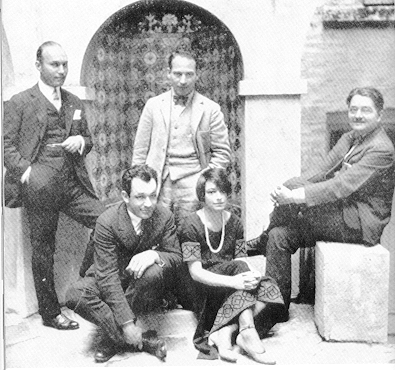
This black and white picture of Dorothy Parker with the pencil in her mouth was pasted to my computer at work for many years. Its caption read: "Dorothy Parker, Master of the Bon Mot." It's true that Dorothy Parker is best known for her witty remarks, both in her personal life and in her book and theater reviews, but she was also a poet and literary writer. Her short story, "Big Blonde," is one of the best short stories I've ever read, and I feel she has been undervalued as a fiction writer. She hung out with mostly men which included fellow writer/critic, Robert Benchley, one of Dorothy's closest friends.  They called themselves members of the "Algonquin Roundtable," a group of writers, critics and actors who got together for lunch every day at the Algonquin Hotel in New York City during the 1920's. Dorothy always held her own while she and these men tried to outdo each other by coming up with the most clever and witty wordplay.  One of Dorothy's most famous on-the-spot witticisms occurred when someone challenged her to use "horticulture" in a sentence. She immediately replied: "You can lead a horticulture but you can't make her think." It was a play on the expression: "You can lead a horse to water but you can't make it drink." In this case, it was leading a whore to culture. Very clever! She was always up for a challenge and never let the men at the Roundtable intimidate her.

But there was one area of Dorothy's life where she didn't always show confidence and that was when dealing with the men she was in love with. A recurring theme of her poetry was her tortured feelings towards these men. Whether it is a new love or a love of many years, men always lead the women who love them into hours of agonizing reflection. Many of these heart-wrenching poems were recited by Jennifer Jason Leigh who brilliantly portrayed Dorothy Parker in the 1990's film "Mrs. Parker and the Vicious Circle." One of the best poems recited in the movie, entitled "Two Volume Novel," was connected to an affair she had with Charles MacArthur played by Matthew Broderick. It broke my heart when he broke her heart: "The sun's gone dim/and The moon's turned black/For I loved him/and He didn't love back." Her relationships often led her into depression and desperation, but she always found a way to turn things around and laugh about them. One of my favorite poems of hers is a famous one called "Resume": "Razors pain you/Rivers are damp/Acids stain you/And drugs cause cramps/Guns aren't lawful/Nooses give/Gas smells awful/You might as well live."


Another thing I love about Dorothy Parker is that she always had dogs in her life. I have a soft spot for dogs and had my own dog, Taffy, for 17 years.  Towards the end of her life, Taffy had Alzheimer's. Yes, dogs can get that too. They run around in circles and cry out at night because they can't remember where they are. I used to sleep with earplugs to escape the howls. I kept her alive for two more years than I really should have because I couldn't bear to lose her. I don't deal with loss very well. Especially when I feel connected to something or someone. Of course you don't want to lose that. How many times in our lives do we really feel a strong connection? Still, I'm waiting to get a dog again. I know I will someday, but not now. Dorothy always had several dogs in her lives. Seems that when she lost one, she immediately replaced it with another, always moving on and looking ahead.

The first night I saw "Mrs. Parker and the Vicious Circle" on TV, I fell asleep because I was watching it in bed with my then-healthy dog. I woke up and saw Dorothy crying by herself. I didn't know what she was crying about, but I imagined she was crying about life and how sad it is. I grabbed my dog and thought about the dog I had growing up, my Cairn Terrier, and how it would be great to go back to being a child again. I always say that the best year of my life was when I was 9 years old. My dad was still alive, and he doted on me.  I got good grades in school, had a lot of friends, and was "going out" with the most popular boy in our class. Nothing compares to the innocence of that time. That was all I really knew and that was all that mattered. But Dorothy wasn't crying about life. She was crying over her best friend, Mr. Benchley's, death. Of course she wasn't crying over something abstract. She had a real reason.

Dorothy wasn't the type to just cry about life. She was tough, and she taught us to lift up our heads and get over it. Kind of like that Elizabeth Taylor quote: "Pour yourself a drink, put on some lipstick, and pull yourself together." That could have been said by Dorothy herself, although Dorothy would have stuck something ironic at the end of it. Trying not to become paralyzed by hypersensitivity is something I struggle with, but when I read Dorothy's poems and think about her courage, I make a conscious effort to just not give a damn:

If I don't drive around the park, I'm pretty sure to make my mark.
If I'm in bed each night by ten, I may get back my looks again.
If I abstain from fun and such,
I'll probably amount to much.
But I shall stay the way I am,
Because I do not give a damn.


Thanks, Dorothy.

Sunday, March 2, 2014

Iggy's New York (and my dream about a Middle-Eastern taxi driver)


The idea for this blog post came to me in a dream I had this morning:  I am in a taxi with a good-looking Middle-Eastern man who won't tell me which country he's from. He's been my driver for the past few days, and I sit in the front seat with him. I realize I'm wearing two different earrings today. One is a silver treble clef and the other is a triangular-shaped earring with an original drawing of Alice in Wonderland pasted onto it. They're both real earrings I have, but I never wear them mismatched. I tell him that the Alice earring is handmade and that I bought it years ago in Greenwich Village at an outdoor flea market back when New York City was cool. I tell him that the New York City he lives in is not the same one that existed when I used to shop at the outdoor flea markets. I say that my best friend, Ania, and I used to take the subway to the Village every Saturday and that New York City was gritty and dangerous back then. There were needles in the streets. That there were many places Ania and I would not go to even during the day.  I say that there are pockets of New York City that are dangerous these days, but back then, the pockets were everywhere. But I say that even with the danger, I still prefer the New York City of years ago. Everything was alive in those days. There was passion on the streets:  people break-dancing, playing music through their boom boxes, and no one was afraid to shout and speak their own minds.  I say that is the character that came out from the boroughs. I tell him that nowadays, New Yorkers are from Texas, Alabama, Europe, and the Middle East. I don't want to insult him, but I also want to be honest. He just listens and watches me without saying a word.

When I wake up, I realize I miss that New York. It's the same Greenwich Village I've written about in my upcoming "Iggy Gorgess" novel.  Iggy's New York takes place in the late 1980's. He hangs out with the homeless in Washington Square Park. He works at a punk clothing store where postcards of Bauhaus and all the great 1980's punk bands are displayed. He eats hot dogs on the street and doesn't care how dirty the carts are that he gets them from. That's how Manhattan was back then. People just let loose and didn't care. There was more crime back then, sure. But most of the time, people bonded together in the struggle. You didn't get reprimanded by a bystander if your voice was too loud while walking down the street. You didn't complain when you had to walk 20 blocks before you could find a public restroom. And if you were lucky enough to find one, you didn't care that it was so filthy you couldn't graze your hand against the walls or the seat.  You were just happy enough you finally found one and didn't have to hold it in on the graffiti-filled subway on the way home. You didn't expect New York to comply with your demands and to bend for you. It was New York, and you adapted to the City's ways.

Maybe that's what my dream is trying to tell me: To go with the flow of my life and grab what I can from it rather than waiting around for life to fall into place according to my particular demands and expectations.  Or maybe it's telling me that my "Iggy" novel would best be marketed to Middle Eastern taxi drivers.


Sunday, January 5, 2014

Iggy Was Lonely And He Needed Some Friends (even if they were strange and unusual)


Iggy moved to Greenwich Village, NYC, completely by himself without knowing anyone who lived there.  He had no family and no friends in his neighborhood, so he did what anybody in his situation would do:  he headed for the welcoming arch of Washington Square Park and then to the large, circular fountain. When he sat down at the edge, a voice startled him:


“Great day for a swim, wouldn’t you say?”  A middle-aged man wearing filthy, tattered clothes and ripped shoes with his toes hanging out stood before Iggy, pointing at the fountain.
Iggy looked at him, confused.  “Yeah, I guess.”

The man sat beside him.  He had a short, closely-shaved haircut and smelled just like Iggy’s jacket did when he sat on the bus too much without washing it.  Iggy slid a few inches over, keeping a tolerable distance.

“Why don’t you jump in?” The man said, still looking at the fountain.
Iggy laughed under his breath.  “I don’t think so,” he said.
“My name’s Tom, what’s yours?”
“Iggy."

Iggy didn't know it yet, but he had officially made his first friend. 

Iggy always felt like an outsider. He was always away from the action where everything happened, always looking in. When he met Tom, he didn't care that Tom had no money or even a place to live.  He cared that Tom seemed genuine when he spoke to him.  He cared that Tom spoke to him at all. 

“Are you usually here?” Iggy asked.
“I’m always here.” 
Iggy didn’t know what to say to the strange man.  He felt uncomfortable and wanted to leave.  “Look, I’ve got to go,” he said.
The man lifted his head weakly and held out his soiled hand.  “My name’s Tom, what’s yours?”

The next morning, Iggy passed through Washington Square Park and looked for Tom again.  Tom spotted Iggy sitting on the edge of the fountain and asked Iggy to meet his 'roommate.'  Joe was more a resident of this planet than Tom was, and he told Iggy that he "used to have a joint over on 14th Street," but then one day got kicked out because he couldn't pay his rent "no more," adding that "life's a bitch."

Later in the story, Tom wound up in the "looney bin," but Joe and Iggy remained friends.  Iggy had just started his new job working at a punk clothing store called 'Caterpillar,' but he hated his job and called in sick one day just because he was tired, depressed, and didn't feel like going in.  Joe admonished Iggy as a concerned dad would and then told him the story of how he once quit his job on Wall Street and sold everything he had in order to buy a space to set up his own store where all the "rich ladies" shopped. His first year was good, but by the next year, he'd lost everything because he didn't have anyone to help him with "the books." Iggy asked him why he didn't just ask for his old job on Wall Street back:
 

Joe leaned back again and plucked a piece of grass from out of the ground.  He examined it. 
“I didn’t want to.  I figured, what for?  If that’s the way life wants to treat me, then why should I?  Better to be a bum on the street.  At least I’d know what’s in store for me.”  Joe looked into Iggy’s eyes.  “No expectations, no disappointments.”  
 
Joe's story served as a cautionary tale to Iggy.  The next day, he followed Joe's advice and went back to work with a better attitude.  Seemed as though Joe was an odd person for Iggy to take advice from since he was not a functioning member of society, much less a member of the workforce.  But Joe was something that was more important to Iggy.  Something rare and unusual.  Joe was a friend.


 "Iggy Gorgess" novel will be released in early 2014.


Tuesday, November 12, 2013

Iggy Was Poor So He Needed A Job (because even people with great hair need jobs!)


Everyone knows it's hard to land a job these days. But in the 1980's, it was easy.  In "Iggy Gorgess," Iggy walks into Caterpillar clothing store and interviews for manager, Rosalie:  "Have you ever worked retail before?"  she asks him.  "No,"  Iggy says. "That's alright.  Everyone has to start somewhere."  That's how it was back then during the decade Iggy lives in.  Even so, for those of us lucky enough to have a job in this decidedly non-80's economy, we, and Iggy, still have a huge hurdle to jump over every day:  Dealing with our co-workers.

We spend more time with our co-workers than we do with our family.  So naturally, a hierarchy gets formed whether we like it or not.  Think about it:  your boss takes on the parent role; your closest co-worker friend takes on the sibling role; and everyone else takes on the cousin role.  Sometimes there are much older co-workers at our jobs, and they take on the grandparents role.  But just like a real family, you don't always get along.  Iggy is naturally antisocial, and he believes the worst part of having a job (other than it taking him away from his real passion, novel writing) is to have to deal with his co-workers.  First, he meets Janna, his spiky-blonde-haired supervisor, who he believes is lazy and shouldn't even be in that position.  Later, he meets Robbie and Marta. He likes them but feels they aren't as mature and worldly as he is (after all, he's lived on his own in Germany for two years).  He thinks his boss, Rosalie, is pretty, and he feels safe when he's around her (the parent role).

It's human nature to try and categorize the people we come in contact with in order to make sense of where we stand in the world.  Especially when it comes to co-workers who are essentially strangers yet you're thrown together and forced to interact with each other eight hours a day, seven days a week.  Iggy immediately analyzes his co-workers and makes judgments of them in order to understand how he measures up in a social situation he's never comfortable in:

Marta chatted with the two teenage boys who were looking at the rock pins.  Iggy watched her.  He thought she was too outgoing.  Too happy and so young.  Janna disappeared into the office.  Iggy was confused about her.  In some ways, she seemed friendly, but in other ways, she was cold.  He wasn’t sure what to make of her.  Rosalie was the nicest, he liked her.  She was warm, he felt protected around her.  But she was the owner and probably didn’t leave the back office very often.  He wouldn’t see much of her. It was too bad though.  She was the only one he felt comfortable around. 

But by far, the worst co-worker he has to deal with is Craig.  He's a tall, blonde-haired giant who Iggy meets on his second day of work.  He comes off as a bully, and he used to date Janna who still fawns over him, which makes dealing with the two of them double trouble for Iggy.  Here's another excerpt where Craig is leering at Iggy who tries not to notice:

“Did anyone tell him the 70’s are over?” the blonde giant said loudly.  “Sid Vicious is dead.”
“Craig!” Janna said, laughing.

Iggy didn’t look up. He just steadily counted his nickels.  He didn’t even lose count.  But he’d heard what the idiot said, and he knew it was directed towards him.  But what did he mean – Sid Vicious is dead?”  He thought about it for a second. Oh yeah, the hair.  Iggy jotted down the total of nickels onto his paper.
 
There is nothing Iggy would like more than to be able to quit his job. But he doesn't want to end up like the homeless men he's befriended who he often chats with in Washington Square Park, so he sticks it out. He's just like the rest of us who have no choice but to try and get along with people who we normally wouldn't socialize with outside of the workplace. There are countless books on the market on how to deal with difficult co-workers.  There have been times I've wanted to invest in one of these myself, but I've found that the easiest way to deal with difficult co-workers is to always be one step ahead. Know your co-worker's weakness (in Iggy's case, it's Craig's lack of intelligence) and use your sense of humor (even if only to amuse yourself) whenever possible:


“You live alone?” Craig asked Iggy.
“Yeah.”  Iggy came back behind the counter and picked up the price gun.
“I live with my buddies.  I would get so bored if I had to live alone.”
“I’d get bored too,” Iggy said.
“But you do live alone,” Craig said, looking confused.
Iggy peeled off a price sticker that got stuck inside the gun.  “I mean, if I were you and I had to live with myself, I’d be – bored.”
Craig thought for a moment.  “Is that some kind of crack or something?” he asked Iggy angrily.
Iggy stared down at the clothes on the counter and smiled closed-mouthed.  “Can’t you take a joke?” he asked.
Craig relaxed.  “Oh, yeah, yeah, of course." 


"Iggy Gorgess" novel will be released in Winter 2014.  Cover illustration by Dan Schurtman

Saturday, October 5, 2013

"Iggy" Novel Coming This Winter!


Iggy was bored so he moved to New York.  Before there was Felicity -- the lead character of my "Bliss, Bliss, Bliss" novel -- there was Iggy.  In fact, if there hadn't been an Iggy, there would have never been a Felicity.

When my best childhood friend, Ania, and I were teenagers, we loved taking the subway on Saturday afternoons to Greenwich Village in Manhattan. We saw people with dyed black or blue hair, mohawks, and black leather clothes with silver studs and safety pins on them when we went to the Village.  We shopped at the stores "Flip" and "Butterfly," which sold black leggings and punk clothing.  Butterfly also had jewelry and postcards.  It was a Bauhaus postcard that gave me the idea for Iggy's look.  That dyed black, punk hairstyle spiked up high, and black eyeliner always stayed in my mind.  That was a real punk.

Years later, while living in Canada, I enrolled in a Women's Writer's Workshop at the local college and wrote several short stories with female lead characters, but I never liked them.  They didn't speak for me, and I couldn't find a female voice I could relate to.  One night, while flipping the TV channels, I stumbled upon a 1970's movie starring Jon Voight called "The Odessa File."  Something about the mood of the scene captivated me.  It is about an American man living in Germany with his German go-go dancer girlfriend.  He spends many hours one evening reading a manuscript when his girlfriend suddenly enters the living room and says she's trying to get a taxi for work.  He says, "Don't I always take you?"  They both seem aloof and moody, and the scene just drew me in.  Suddenly, Iggy was born.

I immediately wrote a short story called "Iggy's Dailies."  It was about a moody male character who I put into a scene similar to that evening in Germany in "The Odessa File" movie, but I made him live in Greenwich Village, NYC. I remembered that Bauhaus postcard I'd seen in the punk shop those years ago. I made him look like that.  There was still the problem of what to name him.  I had such a hard time coming up with one, so I told myself that I was just going to look down at the magazines on my coffee table, and I'd choose the first name I looked at.  The first thing my eyes caught focus of was a tiny picture of Iggy Pop.  Iggy.  I couldn't come up with any other names, so I decided to just call him Iggy.

I brought "Iggy's Dailies" into my Women's Writer's Workshop.  They didn't like the title and told me it was not a "slice of life" story, as I'd called it. At the time, I took their word for it, but looking back, I think Iggy is a slice of life story.  It is a sample of Iggy's life.  It's him hanging around in his living room, reading his manuscript.  It's Iggy. Simply Iggy.  It's a depiction of Iggy's everyday reality.  The only difference between my novel and a typical "slice of life" story is that I developed Iggy's character.  He's not just a bit part in a story that's front and center. 

I took Iggy with me to my Novel Writing course and began writing Iggy in chapter form. Next semester, I took a Screenwriting class and adapted the first 10 pages of my Iggy novel-in-progress as a screenplay.  Our final assignment was to choose a few people from our class to act out the dialog in the screenplay.  I chose someone named Joel to play Iggy. He was an actual actor who I'd seen in a Canadian beer commercial where he said "Hi, I'm Joel, and this is my beer commercial."  He played Iggy and told me afterward that he really enjoyed it.  I got encouraged.

When I moved back to New York City, I submitted a few chapters to "Antimatters Magazine," a magazine that published articles about the musicians who performed at a very popular East Village Antifolk Music Club called "Sidewalk CafĂ©."  Iggy seemed to be a good fit for the magazine because he lived in Greenwich Village, and he had a musician's look and hairstyle. "Antimatters" published excerpts of Iggy in four of their issues. 

Now, I'm preparing to publish Iggy in complete form as an E-Book and limited paperback.  I will be pinning to his "My E-Book Iggy Gorgess" Board on Pinterest, tweeting about him and running contests on my Facebook Author Page, and I've got a first line for his introduction into the social media world too:  Iggy wanted to meet you all, so he decided to join Facebook.


Monday, August 5, 2013

I Wish I Were A Weeki Wachee Mermaid


Weeki Watchee, Florida is "The Only City of Live Mermaids."  When I was little, my parents took me there to the underwater theater to see the live mermaid show.  I watched the mermaids in awe as they stayed underwater, breathing through hoses while they swam and acted out an action story.  Outside the theater, there was a machine to put coins into to create your own mermaid figurine.  When it popped out, it felt like wax.  Mine was a blue mermaid riding on a seahorse.  I kept it all the way into adulthood, but one day, I threw it away along with my dreams of becoming a mermaid myself.

My fascination with mermaids began even before my Weeki Wachee visit when I came across a record in my parents' collection called "The Lonely Mermaid."  It had a light blue and white label, and when I played it on my portable orange record player that had a white cover that closed and a handle for carrying, it sounded so sad.  I pictured one mermaid sitting on a huge rock in the middle of the ocean as she listened to that sad song.

A few summers later, we got a 4-foot, round swimming pool installed in our backyard.  I remember sitting with my dad in our screen porch, both of us fascinated while we watched the men dig and dig to put up our Esther Williams swimming pool.  I learned to swim in that pool and discovered I enjoyed being under the water even more than above.  I often pretended I was a mermaid in captivity, living in my own 4-foot deep, contained water tank.  But I spent too much time underwater, and one of my ears began to hurt.  The doctor said I had "Swimmer's Ear," and I needed to take drops and wear earplugs from that point on.  Turns out I wasn't really an actual mermaid.

But to keep my dream alive, I began collecting mermaids. When I went away to college, I brought my few mermaid dolls and two really cool ceramic mermaids along with me.  But on one of my return visits, I discovered that my best friend, Ania, had started her own mermaid collection, and hers was way better than mine!  Her new friends were world travelers, and they always remembered to pick up some rare, handcrafted piece for her that they had bought from some place exotic.  Soon after, I abandoned my own collection because my Disney Ariels just couldn't compete with Ania's new beauties!

So, I couldn't become a mermaid, and I couldn't surround myself with mermaids, but I still had the ocean.  The ocean brings me home.  When I stand at the edge of the ocean and breathe in the salty air, I feel like I'm where I'm supposed to be.  When I swim in the ocean, I like to float on top of the water.  My favorite time to float is right after a big wave comes to shore and it's followed by a small, yet wide wave that is calm.  When I jump with it, it pushes me up gently, and I'm floating and soaring.  These days, I'm content with the jump, although I used to swim a lot more.  Instead of staying put when that big wave came, and waiting for the smaller one, I used to turn around and swim back to shore along with the big wave.  Sometimes, the wave was so huge, it whipped me roughly back to shore, knocking me down, in a rocky landing. During those times, I wished I were a real mermaid because as a mermaid, I'd have no problem staying afloat with my fishtail! 

Even though I can never be a mermaid, it doesn't mean that mermaids don't exist.  After all, the oceans' depths have not been completely explored by humans, so I'll never know for sure if there really IS a lonely mermaid sitting on a huge rock in a hidden section of the ocean somewhere, just like the one I pictured in that sad song.