Showing posts with label women writers. Show all posts

Monday, March 16, 2026

My Novel Taming Jaguars Is Finished!!!


Jasmine, Patsy, and Vera accompany me everywhere. They join me when I take a walk, help me do the dishes, cook baked ziti with me, and listen when I play the piano. After a handful of years, this is how I got to know them, and now that my fifth novel, "Taming Jaguars," is finished, it's time to send them off into the world. 

Jasmine is the "I" character in Taming Jaguars. It is summertime, and the story begins when at age forty-nine, she moves into the beach house owned by her new boyfriend, Rex, in the fictitious town of Cape Castle. Rex is Jasmine's first serious boyfriend since her marriage ended with a shocking confession over a decade ago. She is perpetually filled with anxiety that her relationship with Rex will not work out, so she spends the summer self-medicating with Chardonnay and through the healing scents of the ocean's sea salt. At first, Taming Jaguars was supposed to focus on Jasmine and Rex's burgeoning relationship, but after a year of outlines and sketches of my first few chapters, I realized I'd rather explore her friendship with two of my female characters, Patsy and Vera. I wanted to learn more about their personalities and histories because I found these unique and gutsy older women fascinating. 

Patsy is a blue-eyed blonde spending another summer living in her faded musician boyfriend's beach house. She is forty-four years old, and she ignores the ticking of her biological clock, preferring to focus on enjoying the hedonistic temptations in life. She brings her closest Cape Castle friend, Vera, into the mix who is a youthful seventy-nine-year-old with no qualms about wearing her bikini top every time she relaxes in the beach town. Throughout my novel, Vera sets out to help Patsy and Jasmine with their youthful dramas despite harboring a spicy secret of her own.

Now that the drafts are finished, my next step is spreading the word on social media. When I self-published my novels, Bliss, Bliss, Bliss  (2011) and Iggy Gorgess (2014), I connected with writers, editors, and indie publishers through Twitter, but now that Twitter is gone, I'm mostly on my Facebook Author Page, Instagram, and my Goodreads Author Page. Recently, I've discovered Substack, yet another website where writers can post notes and quotes from their novels.

Since Taming Jaguars is not yet a printed book, I am working on a one-page synopsis and author's bio to submit to independent publishers hoping to find someone who will help me get Jasmine, Patsy, and Vera into the hands and minds of readers.

Although Taming Jaguars mostly focuses on older women, my character Mel is an Instagram model in her early twenties, and the disdain Jasmine and Patsy have for her is often humorous. Here is a short excerpt that features Mel, Jasmine, and Patsy meeting Vera at the spa's indoor swimming pool:


            Mel changed from her white terrycloth robe into a skimpy, pink and tan bikini. I couldn't figure out where she had gotten a bikini?

            “Umm,” she said. “I should have told you both to bring bikinis today. I always carry one in my purse.”

            “That's resourceful,” Vera said.

            “But why would it be 'resourceful' to carry a bikini in your purse?” Patsy asked.

            “Because we are the inhabitants of a beach town.” 

            “It's silly,” Patsy said. “I always know when I'm going for a swim. I don't have many pop-up bikini moments to surprise me!”

            I laughed loudly, but Mel just shrugged.

           “Oh, don't be callous,” Vera said. “If you girls had carried bikinis in your purses today, you and Jasmine would be in the water with us right now instead of kicking your legs about at the edge of the pool! 


Thank you for reading a bit about my journey writing my fifth novel, Taming Jaguars. Stay tuned for more excerpts at the following links: 

https://www.facebook.com/chrissibliss/ 

https://www.instagram.com/christabelgorgess/?hl=en

https://www.goodreads.com/author/show/5232496.Chrissi_Sepe

https://substack.com/@chrissisepe?


Photo by Ralph Crane


Friday, May 9, 2025

Brooke Shields Saves The Day!

My Brooke Shields doll and two of my Brooke books

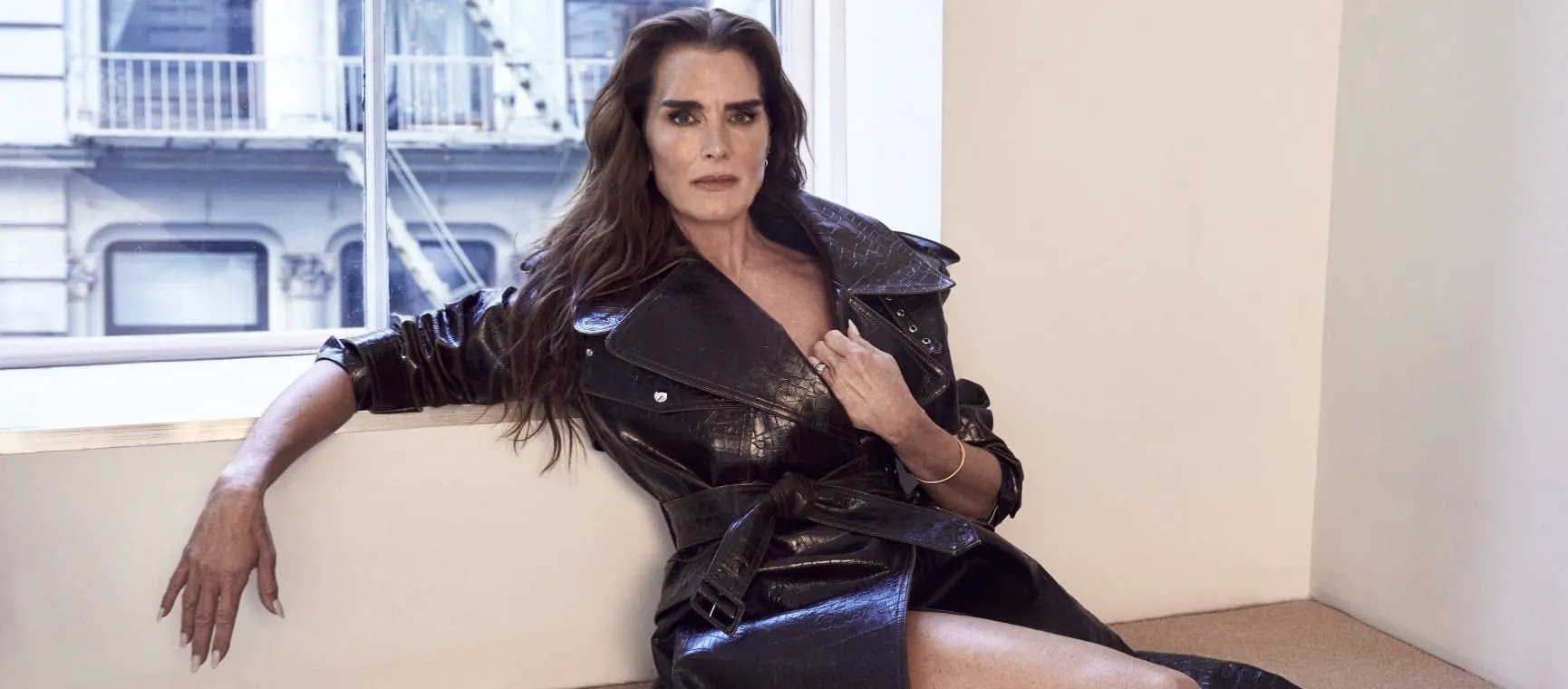
Do you believe in synchronicity? I do! Actress/Model/Wonderful Person, Brooke Shields, keeps popping up into my life. No, I've never met her in person. It's just that her pictures, books, and social media posts somehow repeatedly make their way into my life at the times I need her most.

Years ago, I dreamed I got a personal, handwritten letter in the mail from Brooke. I have no memory of what it said. Even when I first woke up, I couldn't remember. All I remember is that I woke up extremely upset and disappointed that it was only a dream. The feeling of longing was unmistakable, and it took a while to shake off the depression that she didn't actually write me. I felt sad thinking she never would. But something was going on in the universe that made me feel as though I should pay attention to Brooke.  


Photo from Reddit


The first time I saw Brooke Shields was on the cover of Time Magazine’s “Face of the 1980’s” issue. I was in my dad’s hospital room, a few days after he was diagnosed with cancer on my twelfth birthday. Brooke was almost sixteen, and she looked beautiful and glamorous in a pink dress that had a huge ruffle extending over the top of one shoulder. Looking at Brooke’s picture and reading the article about her model life allowed me to put my attention somewhere else for a moment. Fantasizing about her exciting life made me feel better because I desperately needed an escape, and she brought me comfort. Little did I know then that decades later, Brooke would provide me comfort as I faced other new chapters in my life.

Inspired by Brooke, I asked my mom if I could sign with 'Lil Stars Agency" when I was fourteen years old. This is one of my contact sheets used to choose a pic for my acting portfolio. I landed two extra jobs in two movies. One was as a camper in "Old Enough," and the other was as a student in "No Big Deal" starring Kevin Dillon.

During Brooke's heyday, I had posters of her on my bedroom wall. One was from her "Blue Lagoon" movie which I watched countless times on the only premium movie channel my family had called WHT. The channel streamed from a box which sat on the top of our TV, and the reason why it was our only movie channel is because my town didn't have cable lines yet! I don't have my posters anymore, but I still have a trade paperback book from that time period called "The Brooke Book," and of course, I still have my Brooke Shields doll. I treasure her even though her leg has now fallen out of its socket, held up only by her tights. She also doesn't have shoes anymore which my daughter probably lost when she was a kid.  

As the years rolled by, Brooke never left my mind. I remember her playing Rizzo in "Grease" on Broadway, and I watched every episode of her 1990's TV comedy show, "Suddenly Susan." Then, in the mid 2000's, the connection I felt with her in my dad's hospital room reappeared when she released a book called "Down Came the Rain" about her experience with postpartum depression. The book was released only months before I became a mom myself. I bought it shortly after I gave birth because I too suffered a bad case of postpartum depression. Again, she was there exactly when I needed her.


Photo from Woman's Day

Now, Brooke has a brand new book out called, “Brooke Shields is Not Allowed to Get Old.” It's about her experience of moving from adulthood into older adulthood, and I am amazed at how much I identify with it. Brooke has a largely positive view of getting older and isn't shy about revealing her own personal experiences. She is surprised about the benefits being an older woman brings which nobody tells us about, as I am too. It's as if society WANTS us to be miserable!  Here's a quote from her book's introduction: 

 “What I’ve come to realize – not only from my own lived experience but also from conversations with other women my age – is that these “later” years are all about coming into your own and pivoting in the directions you’ve always wanted to go. You can finally live the life you intended to, because you no longer have to act in accordance with external timelines, something that is part and parcel of being a woman.  I don’t have to get married by this date or have kids by this age or get a certain job before that milestone. My time is my own.”


                                                                 Photo credit - Alex Caley

I agree! We’ve all heard that midlife is supposed to be the end, especially for a woman. We are expected to be depressed about our changing looks and to be filled with regret of having our best years behind us. I would never want to return to my twenties and thirties. It's so freeing to know that I have reached all those milestones. Brooke has a theory of why she, and I, and countless others are finding ourselves to be way happier in this time of our lives than we ever expected to be:

“You start happy, you end happy, and somewhere in the middle things take a big dip. But that dip, for women, comes at age forty. From there, things start looking up! This era of forty-plus really is when things get easier, or maybe it’s just that we feel better equipped, but either way, happiness is on the upswing. For men, research shows, the bottom of the U comes at age fifty. Could it be that the narrative we’ve been fed of the irrelevant fifty-year-old woman is really just a product of men feeling their worst at this time? Might it be that they just assumed we’re bummed out, too, but never took the time to ask?”


I found this pic on Google which is of the exact same poster from "The Blue Lagoon" that I had on my bedroom wall!


Brooke has helped create her own hair products designed specifically for the particular needs of older women. These are a couple of her "Commence" products from inside my shower. They smell and work amazing! The pic below is the front and back of the postcard I get along with my Commence hair products packages


Brooke has saved the day for me many times throughout my life, and she's made me realize that women in midlife need each other now more than ever. Brooke even created an online community, originally called "Beginning is Now" and now renamed "Commence," which is a place where we women can share our stories and discuss our thoughts about subjects that only women in their forties, fifties, and sixties can truly understand because we are living this shared experience at the same time. I'm so grateful to Brooke for being so honest about her own personal experiences, opening the door for more of us to share things we may not have the courage to share about ourselves otherwise. I'm going to continue being a part of Brooke's community, and sometimes I wonder if the things we discuss in our women-in-midlife community are some of the things that were in that letter I dreamed about so many years ago?


Photo from Pinterest


Monday, November 11, 2024

Gimme Some Of That DIY, Feel-Good Writing!


The first time I saw a zine was in the late 1980's at Tower Records Bookstore in New York City. It was made of simple, white printer paper by a fan of Kate Bush. It had black and white pictures of Kate that were photocopied and stapled into the magazine. Although not as popular as they once were, DIY zines are still around, and this summer, I stumbled upon a bunch of them at the East Village Zine Fair on St. Mark's Place in NYC. As I checked out the many tables, my eyes caught sight of a particular table run by Quimby's Bookstore in Brooklyn. It had DIY zines that were reminiscent of the zines I used to love to buy so many years ago. Among the teeny-tiny mini zines, I saw a bunch of regular-sized zines by an artist named Jolie Ruin who I recognized because she sells artwork on Etsy. I even had one of her art collages in my Etsy favorites which was a small, art canvas decorated with colorful beads and a quote from a Juliana Hatfield song. I didn't even know she was a zinester and that she published Riot Grrrl-inspired zines!

The simplicity of zines reminds me of my Berklee College of Music days when we all made homemade cassette tapes of our original songs and played them for each other. Sometimes, someone would comment that the recordings of the vocals and instruments should be more slickly produced. I often disagreed. I'd say I rather listen to a guy strumming a guitar and singing lyrics that moved me than a demo of overproduced songs that say nothing and provide nothing original. The passion of three-chord grunge songs of the early 1990's touched so many people, and even today, as soon as you hear the first chords of a Nirvana song, you immediately know it's them.  


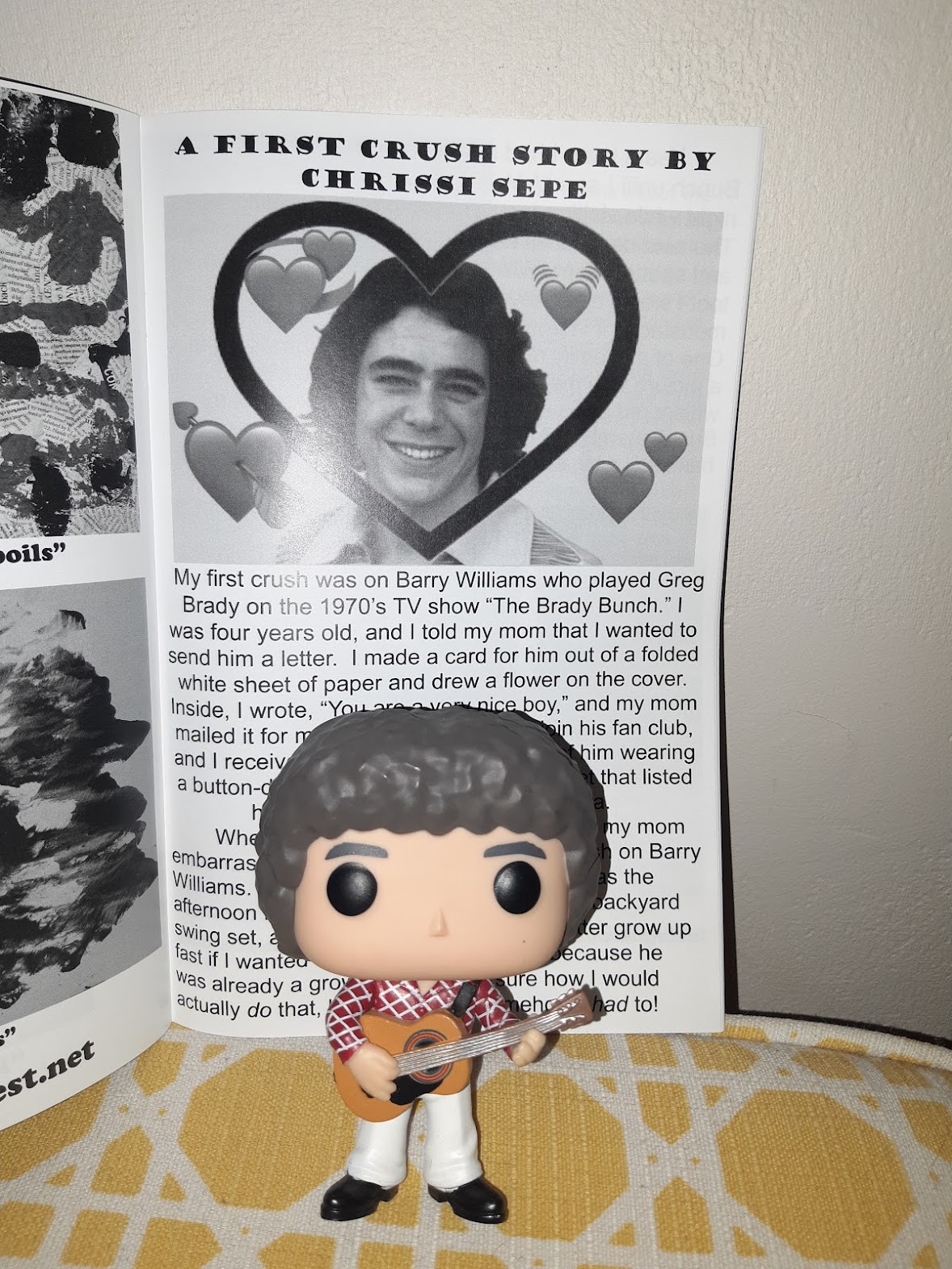
The SlutCake zines include not only Jolie Ruin's writing and art but also from a variety of contributors.  My story about my childhood crush on Barry Williams (Greg Brady of the TV show "The Brady Bunch"), and how I met him years later as an adult, is featured in SlutCake #18 - the Love and Crushes Issue

I've grown tired of reading traditional literary journals because so often the stories have shock value themes and an unusual number of tragic endings. I remember one short story - a contest winner -  entitled, "Ice Cream for Breakfast." The title made it sound like it was a pleasant, let's throw caution to the wind, story but instead it was about the mom regretting she hadn't permitted her little boy to have ice cream for breakfast because she was too busy searching for a cure while he was dying of a disease. What this story did for me was made me never want to read a story like that ever again. I believe that we readers can be inspired by stories with everyday, relatable, topics and don't need to have our worlds annihilated in order to be moved by a piece of writing! 

The "Jolie Ruin" zine section at Quimby's Bookstore in Brooklyn, NYC

Discovering Jolie Ruin's zines and art collages have added new excitement to my writing life. When my first order of zines from Etsy came in, I spent one Saturday afternoon on my bed drinking tea and reading Jolie's "The Escapist Artist" zines from cover to cover. I was intrigued by her journal entries from the early 2000's printed in the zines. She told honest, entertaining, and personal stories from when she was in her early twenties, and they took me back to my own early twenties and to those moments when I too saw indie bands perform at rock clubs and had those same feelings of excitement while watching live music and drinking beer with people my own age. 

This "mini" zine by Jolie Ruin contains raw and honest stories straight from her journal entries of 2005


I bought this issue of The Escapist Artist from Jolie Ruin's Etsy Shop, and she mailed it to me along with a bonus sticker and mini business card


Jolie's Riot Grrrl Press company that she runs with her husband Jamie makes T-shirts with quotes and designs that are clever and funny. After ordering the "Make Zines Not War" T-shirt, I answered the call for models to appear in the upcoming Delia*s-inspired Riot Grrrl Press T-Shirt Catalog!


Zinesters contribute more to pop culture than just printed stories. Jolie Ruin creates DIY art, patches, stickers, and even spoken word cassettes and music. I'd suggest giving zines a try even if you primarily read traditional literature. There's enough in the writing market for every taste and style, so like my t-shirt says: "Make Zines, Not War!" 


My very own Art Collage handmade by Jolie Ruin that I bought from her Ebay store. Some of Jolie Ruin's art collages are featured in the Netflix movie "Moxie!" 

https://www.ebay.com/usr/jolieruin

https://www.etsy.com/shop/JolieRuin


Wednesday, April 20, 2022

Written, Created, Directed, Produced, and Acted by Women


Marie Reuther as Julie in "Kamikaze"

These days, when I need to relax and take time out from writing my novel, I like to stream TV series.  I'm enjoying this but am hoping my novel won't take ten years to finish like "Catcher in the Rye" did for J.D. Salinger.  Then again, if my novel could turn out even one tenth as good as "Catcher in the Rye,"  I'll take it!  As much as I love Holden Caulfield, lately I find myself drawn more towards stories that have female lead characters and scripts written by women.  I find that when women create female characters and write situations and dialogue for them, they portray women a lot closer to how we really are.  I've noticed that female writers are more comfortable with writing their female leads as antiheroes.  This is refreshing, as opposed to being inundated with idealized versions of women or women depicted as martyrs or victims.  It is more like real life.  The below three series are a few of my most recent favorites.  They may not sit well with everyone, but I believe they are truthful to the female experience and portray women as imperfect human beings with life lessons to learn.  

Kamikaze on HBO Max  Favorite Line: "Do what you want."  

At first, I was hesitant to watch "Kamikaze" because of the depressing premise:  An eighteen-year-old girl named Julie gets a text from her dad telling her that his plane is crashing and advising her to "do what you want."  Also on that airplane is her mother and twenty-two-year-old brother, her only sibling.  After the crash, she is so distraught she doesn't get out of bed for three days.  When she does get out of bed, she has one goal which is to die too so she can be with them.  She decides to fly on a different commercial flight every day until one of the flights crashes.  But after a close call, the relieved man sitting next to her tells her that based on statistics, a person would have to fly every single day for twenty-nine years to die in a plane crash.  So she abandons that plan and decides to focus on having fun instead. She continues to live her life recklessly and still has a death wish because she hasn't changed her mind about wanting to die and rejoin her family.  She travels to different countries, setting her eyes on particular guys she wants to have sex with.  She breaks some hearts but who can judge her when she has just endured the unfathomable grief of losing her entire family?  I lost my father as a teenager so I imagine I felt one third of the type of pain she feels, and I also remember some months of not fearing death and of living recklessly.  Spoiler Alert:  At the end of the series, Julie discovers she is pregnant.  She doesn't know which guy out of a possible four is the father, but she ends her death wish, and I believe this is because when her baby is born, she will regain a part of her precious family back.  Julie is portrayed as a daring young woman who decides to take charge of her life.  Even though her choices are destructive, she still has the courage to follow her own path.  The women who created and wrote for this series were not afraid to portray Julie as a female antihero.  

Gypsy on Netflix  Favorite Line: "Nothing's certain, except for whatever's happening right here.  In this moment."

Jean Holloway is a psychotherapist who lives a cushy life with her husband and nine-year-old daughter in the suburbs.  Like Julie in "Kamikaze," she is also living recklessly, but it is not due to having suffered a life-changing loss. Instead, it is because she is depressed at the fact that her lifestyle is not true to her authentic self.  As a young woman, Jean shunned committment but reluctantly settled down because she feared living life alone.  Her mother put this fear into her head.  As a therapist, Jean sets out to help her patients but continually veers off the track as she becomes fascinated by and envious of the people who her patients describe as being toxic in their lives.  Her patients seek therapy to break obsessions with these people, but in turn, Jean becomes obsessed by her patients' descriptions of them because she believes these toxic people are living the types of exciting lives that she wants to live.  She is bored and needs an escape.  She goes on a quest to befriend these people by finding them and introducing herself as Diane Hart, a journalist. Jean is leading a secret, dual life, using an identity she feels is closer to the free spirited woman she used to be.  

Naomi Watts as Jean in "Gypsy"


Blythe Danner as Nancy (Jean's mom) in "Gypsy"

Jean forms new relationships and friendships as Diane Hart, and learns her new friends' secrets by asking her patients questions about them during their therapy sessions with her.  One patient get frustrated, telling Jean he doesn't want to delve deeper into understanding his toxic ex-girlfriend.  Instead, he is trying to get over her.  Jean manipulates her patients and guides them to make changes in their lives that suit her new connections with the people she has met as Diane Hart.  But not everything Jean does is malicious.  She also sets out to do good.  For one of her patients who is a mom struggling in her relationship with her grown daughter, she rewrites a letter that was given to her from the patient's daughter. Jean thinks the letter is too cold so she changes it, mimicking the daughter's handwriting, writing a warmer letter.  When the mom reads the new letter rewritten by Jean, she is comforted and leaves the therapy session happy. Jean also consistently shows love and respect for her own daughter who is misunderstood at school.   My favorite part of this series is Jean's relationship with her own mother, played brilliantly by Gwyneth Paltrow's mom, Blythe Danner.  Jean and her mom have a very strained relationship.  Her mom knows that Jean is manipulative and is destroying other people's lives.  But she is also the only person who knows her secrets and the only one who understands her.  Although we have trouble liking Jean by the end of the series, seeing her mother's unconditional love for her is heartwarming.  "Gypsy" portrays a real and flawed woman who doesn't murder anyone but has a long way to go in working on herself.  I think this is true to life.  Women are usually portrayed on TV and in movies as having had to endure some type of trauma to make them act maliciously, yet Jean has a loving family behind her and has had no trauma. She is just a human who hurts. She's not a victim, and she's not a martyr.  She's a realistic and damaged woman.

Fleabag on Amazon Prime   Favorite Line: "You already know what you're going to do." 

"Fleabag" is not only created and written by a woman, Phoebe Waller-Bridge, but Waller-Bridge also stars in it. "Fleabag" is a comedy, but also sad, as the female lead (only referred to as "Fleabag") is a young woman who feels responsible for the death of her best friend, Boo, who walked into moving traffic to try to get injured so she could get the attention of her philadering boyfriend, but she dies accidentally instead.  Fleabag feels responsible because she turns out to be the one who the boyfriend was unfaithful with, yet Boo didn't know it was Fleabag who slept with him. Fleabag misses Boo terribly, as she was the only person she felt close to because Fleabag is unable to form any other lasting relationships, as she just compulsively sleeps with men as an addiction.  Even though she's sad and lonely and often clashes with her self-absorbed sister, callous stepmother, and emotionally-absent father, Fleabag finds something funny in every situation.  Her sense of humor is her saving grace.  Fleabag also has an eye-opening scene with actress, Kristin Scott Thomas, who co-stars in one episode as a career woman who wants to impart some wisdom about the female experience, and she does so to Fleabag when they go out for a drink together.  She says that women are born in pain.  They have menstrual periods, endure childbirth and sore boobs, and because of this, women have the pain within themselves.  But men, on the other hand, have to create their own pain, and they seek it by finding wars to fight and crises to worry about.  Men have to create their own guilt whereas women are excellent at carrying their guilt all by themselves without ever having to create it or to go out and seek it.  

When Fleabag finally finds love, the man she falls for is a priest.  This is something we can all relate to, as my great-grandfather was a priest who left the priesthood to marry my great-grandmother.  Of course, I'm just kidding when I say that this is relatable to all people (although it is true what I said about my great-grandparents, so it IS relatable to me), but I do believe every woman can find something to relate to when watching TV series where women do the writing because when we women create female characters and stories about women, we are writing for us.


Andrew Scott as The Priest and Phoebe Waller-Bridge as Fleabag in "Fleabag"


Monday, March 29, 2021

My Unintentional Evolution To Unique Artist


Me at the Walt Whitman Exhibit at New York Public Library, NYC 


When I was in elementary school at P.S. 53, either third or fourth grade, my teacher asked us to analyze the Harry Chapin song, "Flowers are Red."  These were the days before the Internet, and I didn't even ask my parents to help.  Actually, I thought I would have no problem figuring out the meaning of this simple song, so I just read it and analyzed it the way I was sure Chapin meant it.  I forget exactly what I wrote, but I said that the color red symbolizes something, and the color green symbolizes something else, etc.  After the assignments were graded, our teacher presented two essays to the class.  One essay was the correct interpretation of the song, and the other was the one that she said she wanted to show us because it was so creative and unique.  Mine was the creative essay, and I was embarrassed when the teacher read it to the class because I felt like a failure.  I wish I still had that essay today, but I threw it away after class because I didn't want to remember that feeling of not being able to comprehend the assignment the way everyone else was able to.  

At 18, I was a songwriting student at Berklee College of Music, and I resisted following the advice of my teachers who taught us formulas to use while writing. I had already studied piano since I was 6, so I just took to the keys and composed my own way.   At the time, I thought my songs were great.  In total, I have written nearly 100 songs and recorded at least half of these, all between the ages of 16 and 21.  However, years later, when I listened to a CD of several of them, I noticed how similar many of them sound to each other.  Although I utilized different key signatures, I often used the same chord progressions. Still, I think they are catchy. They are sometimes melodic, sometimes dissonant, and they don't sound like anybody else's. I like my art to be unique.  My songs sound like me: upbeat with singing that is slightly off-key. During that same period, I worked at Tower Records in Boston.  One day, a coworker of mine told me about the rock band he just joined, and as he explained their typical "rock band of the moment" style to me, I had a revelation.  Why even bother putting in the work with the band when they weren't creating anything new?  It made no sense to me to make the effort when his band was just going to sound like everybody else's.

In my early twenties, I shifted from writing songs to writing stories because I felt confined by the songwriting format.  I believed the music was more important than the lyrics in songwriting so I focused more on the music, and that made the words of my songs take a backseat.  In turn,  I felt a need to express more and more of my thoughts, but I didn't want wordy songs. My other dilemma was that I couldn't stop rhyming!  The same problem happened in my Women's Writer's Workshop when I wrote rhyming poetry.  My teacher told me people aren't rhyming that much anymore.  Walt Whitman had the opposite problem in his day as the first non-rhyming poet.  He got rejected by publishers and had to publish "Leaves of Grass," his masterpiece, on his own.  That's also what writers who wanted to do something different did in the past: writers like Virginia Woolf and Anais Nin.  Writers still do it today which brings me to mention the independent publishing company, New Pop Lit, run by the very unique and talented writer and publisher, Karl Wenclas.  

New Pop Lit is doing what I've always strived to do which is to create and publish a new type of writing.  Why not invent something new? They keep it clear and relatable.  They don't just mimic what everyone else is doing.  Just like how the MFA creative writing programs grind out identical writers, Berklee can grind out identical songwriters which wasn't the songwriter I wanted to be.  I am proud to have my writing featured in two of New Pop Lit's zeens: "Zeenith" and "Literary Fan Magazine." New Pop Lit's zeens redefine the Literary Journal.  They are "technicolor literary journals" and feature really cool artwork as prominently as their stories, articles, novel excerpts, and poetry. They make literary journals fun to read. They bring uniqueness back to the writing business.  Because what is the point of spending all this time writing if you're just going to sound like everybody else?


You can find unique, original and talented writers and artists featured at NewPopLit.Com and purchase their zeens at NewPopLit.Com/Shop/.


Sunday, March 31, 2019

Why I Believe It Is Essential To Watch SMILF

Photo from Stalktr.net

This Sunday marks the last episode of Showtime Channel's "SMILF" until (hopefully) the show gets picked up by another network. It would be a shame to see this masterpiece which depicts the lives and thoughts of real women in an honest and unique way cease to exist when it was only just getting started.

SMILF is the brainchild of writer, director and actress Frankie Shaw. She stars as Bridgette Bird who is a single mom with a young son named Larry, and they live together in South Boston. Bridgette loves to play basketball, has a raw sexuality and a vulgar mouth, but her love and devotion to her son is fierce. I discovered SMILF late in the game, after Season 1 ended, but I binge-watched all eight episodes on a day off from work and instantly got hooked. Subsequently, as Season 2 began, my favorite thing to do each week was grab my bottle of birthday Shiraz wine that my best friend got me, pour a glass, cut a sliver of cheddar cheese, and sit down at 10:30 pm, Sunday nights, to watch SMILF.

SMILF is different and daring. Similar to HBO's "Girls" but focusing mainly on Bridgette, her mom, brilliantly played by Rosie O'Donnell, and her son, Larry, rather than an ensemble female cast. The intelligence in the writing is still there and the lead character again is a true-to-life, flawed, human being who is aware that she has a lot to learn but wants to do it in her own way and on her own timetable based on the feelings she has from within rather than imitating what she thinks is expected of her from society. She is just another creative woman who feels differently than everybody else and is simply trying to muddle through life as best as she can.


Gloria Steinem said in her book "Outrageous Acts and Everyday Rebellions" that the way to test if  you think someone is being sexist is to switch the male and female roles in their story and see if you think the same things would happen and the same feelings elicited if the roles were reversed. For example, if  someone tells you a story about how their female boss at work was  "on the rag" today because she was getting on everybody's case for not getting their work done fast enough and was being bitchy with everyone, would the storyteller have used the same language if their story had been about a male boss or would this just have been considered a typical day at the office and not even worthy of mentioning? Last Sunday's SMILF (Season 2, Episode 9: "Single Mom Is Losing Faith") demonstrated this type of test commendably.  The entire episode has a cowboy setting, and initially, the viewer naturally assumes that the male cowboys are in charge of the town, but odd things are seen in the background. There are good-looking men walking around in the background of the town saloon, and they are wearing pants with holes cut out in the backs of their blue jeans revealing naked backsides. Shortly after this scene, as more dialogue occurs between the male and female characters, it becomes obvious that the reason these male inhabitants of this Western town are dressed this way is because the town is run by women. So instead of seeing females' butt cheeks predominantly featured in yoga pants or hanging out the backs of short-shorts, this is what this town features. Men wear make up and speak in gentle, self-effacing, remorseful tones. In this episode, Bridgette is having a bad day as she is riding her horse around town and lamenting over having to pay Cowboy Taxes so she says she needs to blow off some steam. The way she makes herself feel better is to go upstairs and gain the services of her male prostitute who proceeds to ride her from the top in exactly the same style as a woman rides a man.

SMILF is not preachy in its feminist viewpoint. It shows instead of tells. The cowboy episode is a great example of this. Its script never spells out what it's trying to say. Rather, it's all symbolism, and you have to figure it out for yourself. These days, we need a show like SMILF to show a real portrayal of women who dictate their own sexuality rather than giving into the needs of older, powerful men as has been traditionally done in entertainment for decades. SMILF is honest and original. Just like so many of us women are. Maybe SMILF is still ahead of its time. Similar to how female bosses were several decades ago.


Photo from Fanpop.com


Monday, October 23, 2017

The One Thing Every Fiction Writer Needs


Keri Russell as Jenna in "Waitress" movie written by Adrienne Shelly


"The role of a writer is not to say what we all can say, but what we are unable to say." - Anais Nin


It amazes me how some writers are able to muster up the courage to write about troubling and controversial feelings that most people won't even admit to, much less write about. Sometimes I'll read a writer's story and wonder: What did her mom think (and say to her) after she read this? I have definitely written my novels and stories from my heart, but I know that I haven't written entirely from my mind. I don't write everything I'm thinking, and I hold back for fear of what others will think about me after they've read me.

When I saw the movie "Waitress," I was blown away by how deep and honest the dialogue was. The screenplay was written by Adrienne Shelly who also directed and acted in the film. Tragically, she was murdered at the age of forty shortly before the film was released. The film is about a young woman's feelings about her unborn baby while pregnant. Shelly was also a mom whose young daughter was only two and a half years old at the time of her death.

Jenna is the lead character in "Waitress," and she is a compulsive baker of delicious pies. I use the term "compulsive" because she can't stop herself from baking them whenever she needs to release her emotions. She names the pies according to what she's feeling while she bakes. One pie is named "Baby Screaming Its Head Off in the Middle of the Night and Ruining My Life Pie" which is a good example of the unsettling feelings she's having during her pregnancy.


Jenna isn't happy about being pregnant at all, and she definitively says so to anyone who asks. But she feels a sense of obligation to have her baby. When her doctor tries to assure her not to be nervous during her first sonogram because it is normal to be nervous, she surprises him by telling him that she isn't nervous about her baby at all. Noticing how unenthusiastic Jenna is about her pregnancy, one of her friends gives her a notebook to write letters to her unborn baby, hoping this will summon up some feelings of warmth in Jenna. These letters are read throughout the movie, but instead of helping Jenna feel more bonded to her unborn child, she writes letters telling her baby how much she resents her. Later, when she has to pay for the crib, she writes the baby a letter telling her that the money she spent on her crib was supposed to be her money to get out of town and start a new life. She writes that now every time she puts her baby down in her crib, she's going to blame her for the fact that she had to pay for this crib and, in turn, couldn't start a new life. Once her baby is born though, Jenna immediately falls in love with her.  Shelly poured her entire heart out in the screenplay, and if any of these feelings and thoughts were actually Shelly's during her own pregnancy, it took an amazing amount of courage and self-examination to write these down for the script.


Amy Koppelman - writer of novel "I Smile Back"-  and Sarah Silverman who starred as "Laney" in the movie


Another writer who is incredibly brave is Amy Koppelman. In her novel, "I Smile Back," she writes about a wealthy mother who feels so much pressure to lead the perfect life of a suburban mom that it causes her to break down and secretly live recklessly by using drugs and having sex with strangers. Again, not autobiographical, but it was written as an exaggeration to show how a woman often struggles trying to live life in the role of a happy and well-adjusted suburban mom. Koppelman, who is also a suburban mom, has stated in interviews that all of her novels contain at least something of herself and her life. Koppleman's book takes courage to have out there because no writer would want anyone to believe that the things Laney does and says are in any way autobiographical. Readers often believe that at least SOME of a novelist's protagonist's thoughts and actions come directly from the writer's own psyche and experiences. It took a lot of courage to write so uninhibited and to take the chance that anyone would think Koppelman felt Laney's feelings or worse did the things she does in "I Smile Back." There is one scene where she masturbates with her son's stuffed animal and another where she tells a stranger she just met in a bar to lick her ass during a sexual encounter. Laney acts out due to fear and depression which is explained in much of the dialogue in the movie: "I just don’t understand why anyone bothers to love anything at all. I mean by the time you’re three you’ve pretty much figured out that everything you love is going to be taken away." Laney doesn't see the point of being happy when there is so much misery in this world.


Quote re having a child said by Sarah Silverman starring as Laney in "I Smile Back" movie based on the novel by Amy Koppelman 


I feel that both Shelly and Koppelman have successfully and commendably completed works with a no-holds-barred approach. They have dug deep inside their souls and wrote about the feelings that all of us women have lurking somewhere inside but would never have the courage to admit, much less write about.  Again, not everything a fiction writer's protagonist says should be deemed autobiographical, but we do know that many literary giants have admitted to basing their novels' protagonists on themselves and that events in their plot lines were often true events.


I still have yet to conquer this fear of what others will think about me when they read my writing. This is a hurdle that every fiction writer needs to overcome in order to be truly great. Of course, the best way to write is as if nobody will ever read it, and then, once it's done, just release it and throw caution to the wind! We have to become fearless in writing, same as we need to take chances in all other facets of our lives. For women, this often gets easier with age. Most of us can only become truly radical once we are older. We have to risk being not liked. We have to risk not being dutiful and good. We have to deal with the verbal onslaught and mistrust that will ensue once we have gotten our writing out there. It's not the end of the world. I guess that's the only way to be brave enough to write EXACTLY what we are feeling and thinking and to never hold back in writing ever again. To realize that whatever happens after we've released our writing to the public, it will never be the end of the world.


Adrienne Shelly


Wednesday, May 10, 2017

Reading "Moshi Moshi" And Sharing Tea, Grief, Hotels, And Smiles With Banana Yoshimoto


"I nodded and sipped my cocktail. The taste of fresh fruit spread over my tongue.  This was all that being alive meant, really." - From the novel "Moshi Moshi" by Banana Yoshimoto


The first novel I read by Banana Yoshimoto was "Kitchen." It is a short novel about a woman in her twenties dealing with grief. I was also in my twenties at the time, and it hadn't been that many years since I had lost my dad at the age of fifteen. In "Kitchen," lead character, Mikage, has just suffered the loss of her grandmother to whom she had been very close. To deal with her loss, she takes to sleeping on her kitchen floor because the hum of the refrigerator makes her feel less alone. "Kitchen" is what hooked me to Yoshimoto's novels and solidified her as my favorite modern author. Yoshimoto's newest English-translated novel is called "Moshi Moshi," and it continues to display her genius in describing twenty-something women suffering early loss. What is different about Yoshimoto's novels is that although her characters are hurting, each of her novels shows a glimmer of optimism. I haven't come across any other writer who accurately depicts the devastation of dealing with grief while simultaneously describing the protagonist's ability to maintain a positive attitude. Each of her characters finds happiness in the simplest of things. This trait matches Yoshimoto's "deceptively simple" prose, as her writing has often been described. Her language is simple, yet the meanings underlying her novels' themes are deep.


"Moshi Moshi" takes this grief theme full circle from "Kitchen." "Moshi Moshi" is the story of a young woman in her twenties named Yoshe who has just lost her father by carbon monoxide poisoning. Her dad had recently begun a relationship with a bewitching woman without Yoshe and her mom knowing.  This woman wanted to die but needed someone to take along with her, so she coerced Yoshe's dad into a car parked in the forest and poisoned them both.

Yoshe is an only child, just barely a woman, who is living on her own. She is fresh out of culinary school and now has a job helping out in the kitchen of a bistro. Yoshe tries to deal with her grief, and as she is "finally starting to be able to feel the joy in sitting down to a cup of tea or just getting up in the morning," her mom decides she can no longer bear living in the condo the three of them had shared in the town of Meguro. Instead, she wants to move in with Yoshe to the city of Shimokitazawa which has younger residents and many tourists. She tells Yoshe that Shimokitazawa reminds her of the first city she and Yoshe's dad lived in when Yoshe was a baby:

"Back then both your Dad and I were happy, for no particular reason - maybe because we were young, or it was just that kind of age.  We'd shop every day in Yanaka Ginza - we'd get deli food for dinner, savory preserves, roasted rice crackers, and then a cup of tea. If we had time, we'd stop at the traditional dessert parlor and have a beer, or some isobeyaki."

Yoshe realizes that her mom needs this time to heal. Yoshe absorbs herself in her cooking and waitressing work at the bistro and begins dating a customer she meets there named Shintani-Kun. But her grief overwhelms her.  Still, she shows up to work every day at the bistro no matter how badly she feels:

"Even so, come tomorrow morning, I'd be kneading bread dough, boiling water, shredding salad vegetables, mopping the floor. My body would know what to do, and I'd smile and greet customers when they came in."

Pretty soon, Yoshe and Shintani-Kun start going out for drinks after she finishes her workdays at the bistro, and she feels a sense of hope:

"I felt joy. Working at the bistro, Shintani-kun feeling at home there. Seeing my apartment across the street. I knew it wasn't going to last forever - things changed and moved on, and if you thought they could stay the same, they got ruined, like our family had done. Still, I desperately wanted all of this happiness to stay, just the way it was."


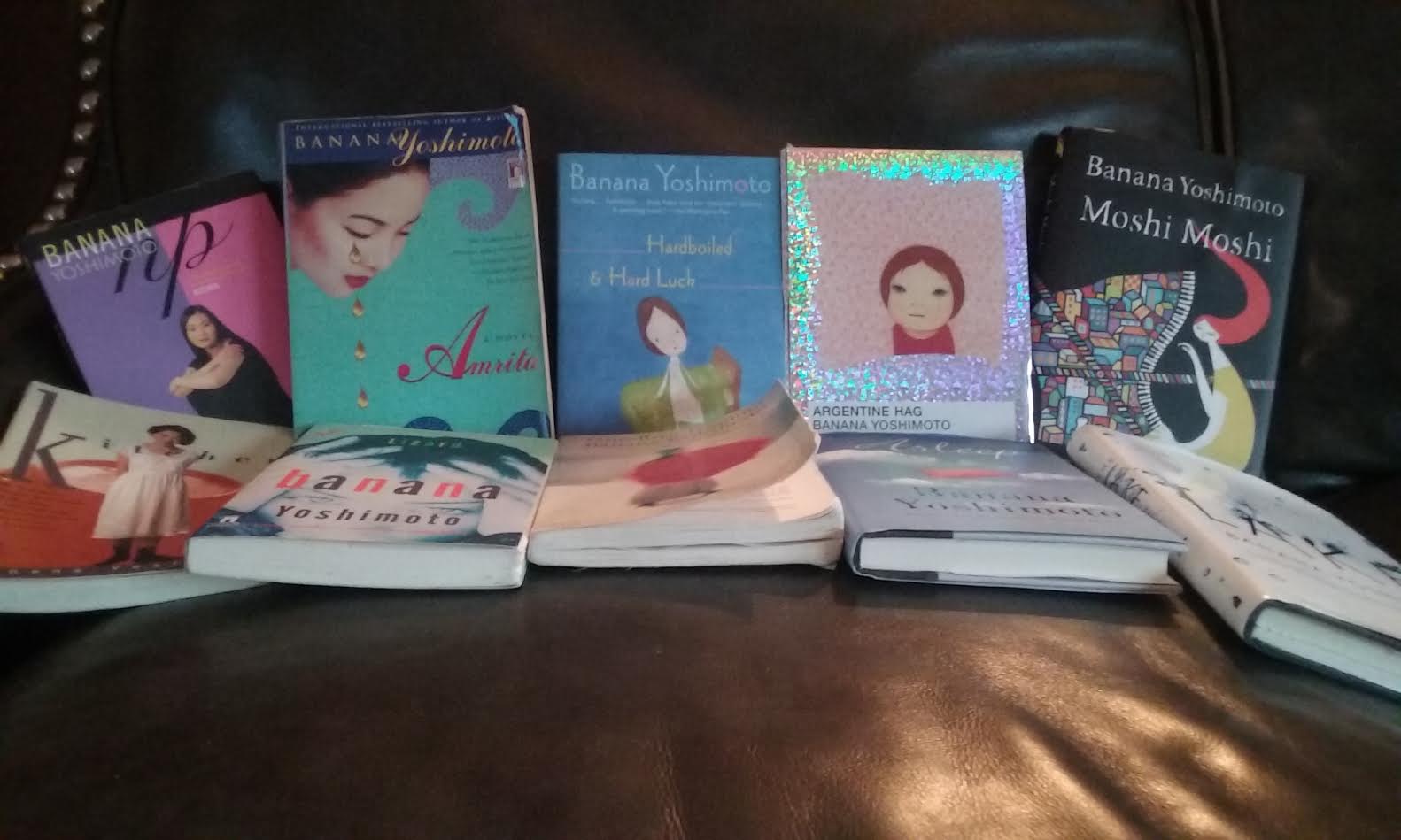
My Banana Yoshimoto collection of books on my couch

When your parent dies while you are still in childhood, a part of you remains arrested in that state because the only place you can be with them throughout adulthood is in your memories. I definitely related to the solace Yoshe seeks in her memories that she relays throughout "Moshi Moshi." Yoshe remembers her childhood vacations this way:

"The light from the TV dappling the dark room made me think of family vacations of old. I felt as though I was back in a room in a traditional inn, already asleep, while Mom and Dad watched TV lounging on the mat floor."

I particularly liked this hotel memory because my happiest memories from childhood are the times my mom, dad and brother took family vacations to Disney World or the Poconos, and we had our parents' undivided attention. We explored the parks and swimming pools by day and then shared the same hotel room by night.


Yoshe believes that memories of her dad are etched not only in her heart and mind but also in the places he walked through: "Of course, there were some things that didn't change - the familiar and nostalgic colors and smells, tastes and places in our memories.  But we could no longer relive them as things that were real to our own bodies."

These lines remind me of Walt Whitman's "Leaves of Grass" poems which were a favorite of my dad's. He even wrote his own rock opera in the late 1960's-early 1970's by composing his own versions of Whitman's poems through several original songs, often titled the same as Whitman's poems.  The main theme in "Leaves of Grass" is how we are all connected as entities who live the human experience. This includes all of us now living in the present, those who have lived in the past, and those who will walk this earth in the future. Whitman talks about how all generations have physically walked over the same grounds as each other, and when blades of grass grow, these blades are nourished and grown out from the bodies of our ancestors. There is a connection between past, present and future generations because we walk the same steps over the same parts of earth together. The following line from "Moshi Moshi" reminds me of Whitman and also of my dad:

"I started walking again, and even though I was wearing grown-up shoes on a grown woman's feet, the lightness of my step felt just the same as they had when I'd walked in my favorite childhood sneakers, which Dad had taken me to buy."


My dad and me

As the seasons pass, Yoshe's mom embraces the fact that there are so many young people living in Shimokitazawa, and she seems to be returning to a previous youthful self that Yoshe didn't even know existed.  My mom did that too after my dad died. Suddenly, she started hanging out with friends who were in their twenties, and she listened to pop music on the radio and went out dancing. It makes sense now because she was so young back then: my dad was only forty-one when he died, and my mom just turned forty the next month. I remember one of my mom's friends gave her a birthday card that said: "Life begins at 40," and my mom hung that card up in our kitchen.  But I didn't like that card. I wasn't ready for anyone to have any kind of new life other than the childhood I had grown familiar with.

Yoshi expresses similar thoughts. It appears to her that her mom suddenly doesn't need any help with her grief while Yoshe is still struggling so much. It feels like a blow to her when she finds out her mom has landed a job in a tea shop. Yoshe wants to be happy for her mom but realizes she is initially unable to:

"I'm the one who didn't want Mom to get better, I realized. I was shocked at my own immaturity. I was the one who wanted her to stay at home in my apartment, who wanted to keep my mother to myself.  Now, standing in this shop, she was back in the wider world, among everyone else."

I can relate to those feelings too.  All children believe that even as life changes, and they leave school and move on to work life, at least their family will still remain intact. It was a rude awakening for Yoshe and for me when our lives suddenly changed before we properly reached adulthood.


Yoshe tries to follow her mom's example to move forward, but she is still very vulnerable and not in the proper mindset to enter into a healthy and mature relationship with Shintani-Kun. When she finally allows herself to take the next step in their relationship, she's not really into it: "We're probably going to sleep together now..., but so what? What's it going to change?"

Yoshe's nihilistic attitude is a common example of the depression that often hits young women after a major loss in the family. Your entire world has been turned upside down and everything you thought you believed in as a child has suddenly changed due to that one event. I remember sitting in a movie theater in 1990 watching the film "Sweetie" and relating to one of the lead characters, a woman named Kay. She analyzed everything but felt nothing. She looked for symbolism to try and make sense out of life and find messages in things while performing obsessive rituals. In her case, she was obsessed with trees and cracks in the sidewalk. But her anxiety only increased. I also suffered from obsession, anxiety and a feeling of meaninglessness. Looking back, I see I was still trying to make sense out of life and to heal from my grief. Life is frightening when you have to recover from loss. You long for the security you knew as a child.

At the end of the novel, Yoshe visits the scene in the forest where her father and the woman were found dead in the car. She tells her dad it is alright to let go, and he can be at peace. She realizes that she must now focus on the present. Once you suffer a loss, you always fear it will happen again. It's probably more on your mind than someone who has never experienced a significant loss in their life. But we have to be thankful and mindful of what we have in the present. We don't have to worry every single minute. The people we have in our lives are still here:

"My father was gone now, but my mother was here. I could be with her today, for certain, at least, and hopefully much longer than that. I'm coming home now, Mother - Mother, I'm glad you're here - I'll be coming through the door in a moment."


My mom put this yellow happy face in her car to cheer herself up on cloudy days

While getting ready for the paperback version of "Moshi Moshi" to come out, Banana Yoshimoto lost her own father unexpectedly. For years, people had criticized her for not writing about grief in a realistic way. After all, many of her novels are about losing primary family members, but she had never lost one. I remember after I'd read "Kitchen," I was shocked to learn that she herself had not lost a parent. Yoshimoto says that after she lost her father, she realized that she indeed had been on the right track all those years. She said her own writing in "Moshi Moshi" gave her the answers she now looked for as if she somehow knew what she was going to need to help her heal.


Recently, I posted my Goodreads Review of "Moshi Moshi" and was thrilled when Banana Yoshimoto responded to me and thanked me in English for my "beautiful review!" Previously, she had only communicated to me through emoticons and emojis because she doesn't speak or write in English. But just like how Whitman believed previous generations can communicate with present and future generations through shared experiences, language is not a barrier either. I will forever treasure the time that Banana Yoshimoto sent me this smile:


I'm still dreaming that one day I will take a trip to Japan and meet her in person. Why wouldn't I want to meet my favorite novelist?